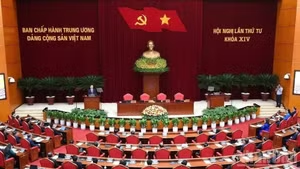
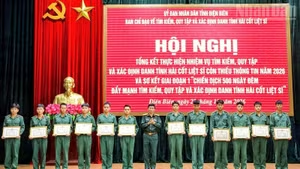
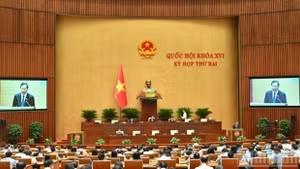
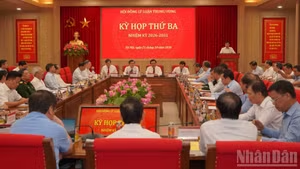
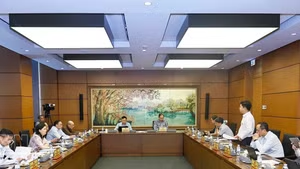
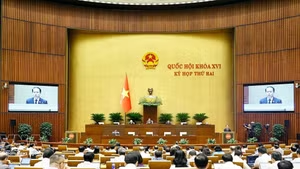
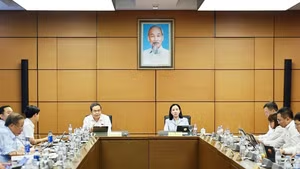
Information and education work does not directly generate growth results or targets, but it contributes to inspiring aspirations, strengthening confidence and creating a stable political and social environment, while mobilising the people and businesses to join hands in implementing policies and guidelines.
From a common understanding to consensus in action
Double-digit growth requires substantial resources and the coordinated involvement of the entire political system, the business community and the people. In this process, information and education work plays a role in clarifying the objectives, significance, requirements, and impacts of development policies, helping officials, Party members, the people and businesses gain a proper understanding and proactively participate in their implementation.
Hai Phong is the only locality in the country to have recorded double-digit growth for 11 consecutive years. In the first six months of 2026, Hai Phong’s GRDP was estimated to have grown by 11.31%, ranking third nationwide. State budget revenue in the city reached 113.55 trillion VND (4.38 billion USD), equivalent to 58.3% of the annual estimate and 21% higher than the six-month revenue target. Total export turnover reached 25.9 billion USD, up 8.3% year on year.
Ten of the 12 key socio-economic targets met or exceeded the set plans. Alongside the comprehensive implementation of economic development solutions, the Hai Phong Party Committee has placed emphasis on building a common understanding and social consensus around the locality’s development goals and tasks.
In this spirit, the Hai Phong Party Committee’s Commission for Information, Education and Mass Mobilisation has proactively renewed the content and methods of its advisory work, with a focus on staying close to reality, putting people and businesses at the centre, and regarding the creation of social consensus as one of the decisive factors in achieving the growth target and laying a foundation for the 2026-2030 period.
Communication efforts are no longer limited to providing information on policies and guidelines, but focus on clarifying objectives, significance, impacts and the responsibilities of each stakeholder, helping officials, Party members, the people and businesses gain a fuller understanding of development opportunities and their respective roles.
Notably, communication efforts have been implemented in line with specific tasks and at specific times, with a focus on investment attraction, business support, administrative reform and key projects. Coordination with the Viet Nam Fatherland Front and socio-political organisations has also been strengthened to monitor public sentiment and opinions and promptly advise on the handling of issues arising at the grassroots level. At the same time, communication methods have been renewed through digital platforms, social media and grassroots information systems, combining traditional and modern forms of communication to improve accessibility and interactivity.
Nguyen Quang Phuc, Head of the Hai Phong Party Committee’s Commission for Information and Mass Mobilisation, said that in 2026, the city is determined to achieve GRDP growth of at least 13%, striving for 14%, while laying a foundation for successfully achieving its development targets for 2026-2030. Development policies can only be implemented effectively with the people’s consensus, the business community’s support and the coordinated involvement of the entire political system.
Therefore, information and mass mobilisation work has shifted strongly from providing information to policy communication, and from helping people “know” about policies to helping them “understand, trust and participate in their implementation”. Information is always provided in a timely, accurate and consistent manner, particularly on new and major issues with wide-ranging impacts, such as special mechanisms, economic zones, free trade zones, infrastructure, industrial and urban development projects.
Through implementation across the city, communication and mobilisation efforts have contributed to building a common understanding and coordinated action, inspiring aspirations for development and creating new momentum for policies and guidelines to be effectively implemented in practice.
Creating a stable political and social environment
As localities face the need to expand their development space, mobilise social resources and implement major policy decisions, strengthening confidence and building consensus help maintain political and social stability and create favourable conditions for investment, production and business activities to proceed smoothly.
Affirming this point, Duong Minh Dung, Head of the Dong Nai Party Committee’s Commission for Information, Education and Mass Mobilisation, said that in the process of building Dong Nai into a centrally run city, the commission has identified maintaining the Party’s ideological foundation, strengthening public confidence and ensuring political and social stability as not only Party-building tasks but also important conditions for attracting investment, enhancing competitiveness and promoting sustainable development.
Accordingly, information, education and mass mobilisation work has been renewed towards proactive forecasting, orientation and information management, with monitoring ideological developments, conducting public opinion surveys and analysing information serving as the basis for advising the Party Committee on leadership and direction.
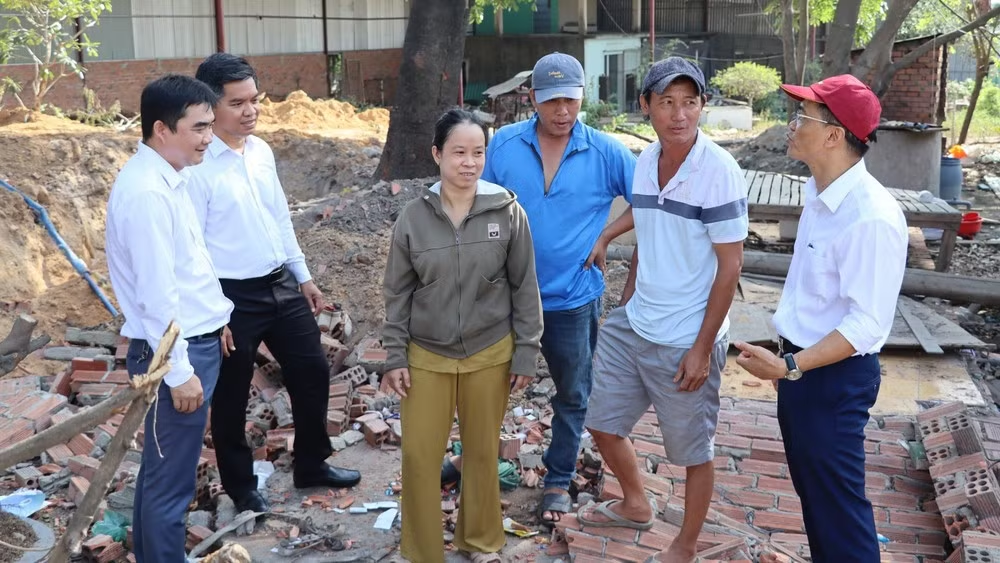
The implementation of key projects and works in Dong Nai clearly demonstrates this role. The Party Committee’s Commission for Information, Education and Mass Mobilisation has closely coordinated with State agencies in information and communication work, monitoring public opinion and conducting mass mobilisation before, during and after project implementation.
Through dialogue, communication and mobilisation, and the timely resolution of issues arising at the grassroots level, many households have voluntarily donated land, expressed their support for compensation and site clearance efforts, and actively participated in building a civilised urban environment.
This approach has not only helped maintain political and social stability, but has also built consensus from an early stage, contributing to ensuring that key programmes and projects are implemented on schedule and effectively. This is an important foundation for Dong Nai to maintain stability, attract investment and realise its double-digit economic growth target, while striving to become a new growth pole in the southeastern region.
The double-digit growth target is not merely a matter of economic indicators, it is also a matter of mobilising and harnessing the combined strength of the entire political system, the business community and the people. High growth requires major policy decisions and profound changes. This also means that the role of information and education work must continue to be promoted more effectively. Only when development policies are properly understood, consensus is built, and issues arising at the grassroots level are promptly identified and addressed can resources be unlocked, contributing to rapid and sustainable socio-economic development.