Alongside positive results in supplying capital for production and business activities, the banking system is also facing the challenge of simultaneously addressing multiple pressures, including imbalances between capital supply and demand, interest-rate pressures and the risk of rising bad debts.
Flexible monetary policy
According to SBV Governor Pham Duc An, amid numerous difficulties and challenges, monetary policy has been managed proactively and flexibly, helping maintain macroeconomic stability, control inflation and stabilise the exchange rate. Regarding interest rates, the SBV has issued a series of directives to commercial banks to maintain reasonable rates, thereby facilitating access to capital for people and businesses, with positive results.
Notably, on April 9, the SBV held a direct working session with commercial banks, requesting them to lower deposit rates on new deposits with terms of six months or longer, while also reducing lending rates to improve access to capital for businesses and individuals. Proactively guiding interest rates amid mounting pressures from international markets underscores the central bank’s determination to strike a balance between supporting economic growth and ensuring the safety of the banking system.
Alongside interest rates, the exchange rate has continued to be managed flexibly in line with market developments and in coordination with other monetary policy instruments. As a result, the foreign exchange market has operated smoothly, the economy’s legitimate foreign currency needs have been fully met, and the USD/VND exchange rate has remained flexible, helping absorb external shocks and stabilise market sentiment.
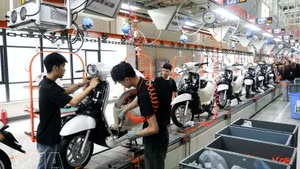
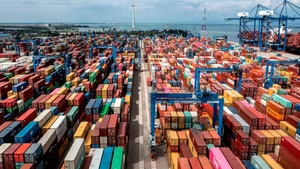
Accordingly , credit has continued to flow into production, business activities and priority sectors. By the end of May 2026, around 77% of total outstanding loans in the economy were directed towards production and business activities. Several priority sectors accounted for significant shares, with agriculture and rural development representing 22.09% and small and medium-sized enterprises 19.84%. Meanwhile, credit to exports grew by 20.53%, while lending to high-tech enterprises rose by 26.36%.
Chairman of the Board at HDBank Kim Byoungho said the SBV’s proactive and timely directives have helped maintain monetary stability and banking system safety while enabling credit institutions to support businesses and individuals. Against this favourable backdrop, HDBank recorded positive results in the first half of the year. Its outstanding loans increased by nearly 18% from the beginning of the year, with credit concentrated on production, business activities and priority sectors. The non-performing loan ratio was kept below 2%, while the capital adequacy ratio remained above 13%. Notably, following the meeting on April 9, HDBank immediately cut its listed deposit rates by 0.5 percentage points per year across all terms of six months or longer.
Unlocking long-term capital
The results achieved since the early year have provided a positive foundation for economic growth, but they also pose greater challenges for policy management during the remainder of 2026.
As credit expands faster than capital mobilisation and the economy’s demand for medium- and long-term funding continues to increase, the banking system is facing mounting pressures that require more flexible policy responses.
According to Dr Dao Minh Tu, Vice Chairman and Secretary General of the Viet Nam Banks Association, credit institutions are confronting an imbalance between capital supply and demand. Investment capital needs across the economy are currently substantial, while meeting those needs through bank credit is becoming increasingly challenging, as deposit growth is lagging behind credit growth.
Interest rates represent another major concern. When liquidity and capital supply-demand conditions become imbalanced, fluctuations in interest rates are inevitable. The Government and the SBV have issued strong directives to lower interest rates to support businesses.
However, reducing interest rates is not simply a matter of providing immediate assistance to enterprises; it must also ensure the financial safety of the banking system. Balancing funding costs, lending rates, profit margins and system safety is a difficult but unavoidable challenge. Therefore, medium- and long-term policies are needed to support businesses rather than leaving commercial banks to shoulder the entire cost.
In addition to funding pressures, difficulties facing businesses are increasing both existing and potential risks of bad debt, particularly amid developments in the real estate market.
Another obstacle lies in the handling of collateral. Since National Assembly Resolution No.42/2017/QH14 on the pilot settlement of bad debts of credit institutions expired, the pace of bad-debt resolution has shown signs of slowing, as legal provisions governing debt recovery remain insufficiently specific, creating numerous difficulties.
Meanwhile, risks associated with digital payments, including customer data exploitation, verification of collateral and high-tech fraud, are also posing significant challenges.
Drawing on the practical operations of commercial banks, Dr Dao Minh Tu proposed stronger development of medium- and long-term capital markets, particularly the stock market, bond market and investment funds, to ease the burden on the banking system as the economy’s principal source of capital.
State preferential credit policies should also be designed in line with practical conditions, with the SBV involved from the outset to ensure their feasibility.
In addition, relevant legislation, including the Land Law, Housing Law and Law on Real Estate Business, needs to be better aligned to remove obstacles to collateral disposal and debt recovery. Clearer and more specific policies are also needed for credit to small and medium-sized enterprises, giving commercial banks a stronger basis for lending rather than relying solely on broad policy guidelines.
From the perspective of commercial banks, a representative from HDBank recommended that the SBV continue supporting market liquidity and provide refinancing when necessary to ease pressures on the interbank market and stabilise interest rates.
“The SBV should continue to support and encourage commercial banks to attract sustainable funding or green credit from international markets in order to diversify their funding sources. In addition, stronger coordination with the Ministry of Finance is needed to optimise the use of idle State Treasury funds, thereby providing short-term liquidity to the interbank market,” HDBank Chairman Kim Byoungho proposed.