According to experts, Politburo Resolution No. 27-NQ/TW dated August 28, 2026, on regional development and the organisation of national development space in the new period marks a turning point, shifting from linkages based on administrative boundaries to the joint creation of a unified development space, forming a large-scale investment ecosystem and enhancing international competitiveness.
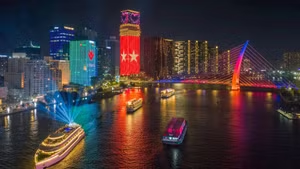
In the new development space structure, the southeastern region is identified as the country’s largest growth-driving region, as well as a centre of high-tech industry, digital technology industry and international logistics. Ho Chi Minh City plays the role of a growth pole, a leading force with spillover effects, with the goal of becoming an international financial centre and a hub for regional and international connectivity.
Meanwhile, the Mekong Delta is positioned as a modern, sustainable, dynamic and highly efficient agricultural economic centre, with strong development of the marine economy, clean energy and renewable energy. Can Tho City is the region’s growth pole. Other localities in the region focus on developing services, logistics, industries serving agriculture, agricultural processing and innovation.

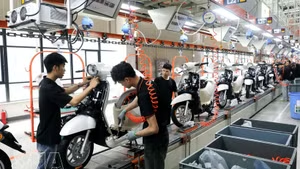
Within this linkage, development spaces have clear complementary advantages. Ho Chi Minh City brings together markets, capital, technology, high-quality services and international connectivity networks. The southeastern region has strengths in industry, production and logistics. The Mekong Delta has a strong foundation in agriculture, fisheries, processing, the marine economy, energy and climate change adaptation.
If effectively connected, these advantages will not only create synergy in scale but also help form inter-regional value chains, from production and processing to logistics, finance, technology and international markets. In this way, each locality can both promote its own strengths and contribute to a unified development space, creating additional room and growth momentum for the entire region and the country.
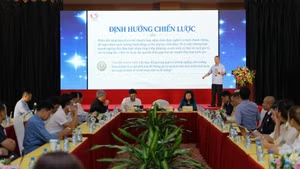
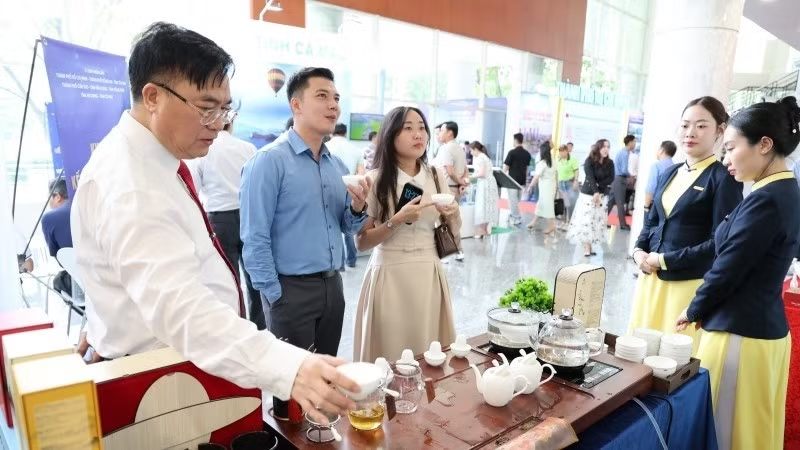
Recently, at the conference on investment connectivity and development cooperation between Ho Chi Minh City and provinces and cities in the southeastern region and the Mekong Delta, Pham Quang Nhat, Director of the Ho Chi Minh City Investment and Trade Promotion Centre, said that when making investment decisions, enterprises often look at the entire chain, from research and development, logistics and markets to the time required for administrative procedures and the responsible focal point. Therefore, investment plans need to go beyond the limits of a single locality.
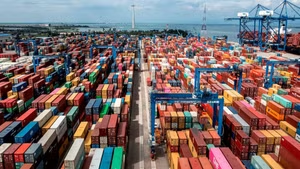
In the immediate term, priority could be given to three groups of value chains: high-tech industry connected with seaports, aviation and logistics; agriculture and fisheries associated with deep processing, cold chains, branding and exports; and clean energy, the circular economy and climate change adaptation.
Each plan must clearly identify which locality is responsible for which link, which infrastructure and resources are ready, which agency will handle procedures, and what the expected timeline will be. Only then can the advantages of Ho Chi Minh City and the two regions of the Southeast and the Mekong Delta become a unified investment proposition.
From this perspective, Pham Quang Nhat proposed specific tasks. First, localities should jointly standardise the list of investment opportunities according to value chains and readiness levels. Each project needs to include core information on planning, location, scale, investment method, infrastructure, procedures that still need to be completed and the focal point in charge.
Second, each connection should have a unified monitoring file covering the investor, areas of interest, proposed project or location, lead and coordinating agencies, response deadline, processing steps and results. Data should be continuously updated on a digital investment promotion platform to create a unified and seamless monitoring flow.
Third, for proposals with implementation potential, the Ho Chi Minh City Investment and Trade Promotion Centre should directly discuss and work with investors, transfer proposals to the appropriate agencies and monitor responses. Issues beyond its authority should be compiled and reported, while matters falling under the responsibility of a particular locality should be proactively handled by that locality, with results shared.
Finally, there should be regular reviews of projects under study, projects that require additional conditions, obstacles that need to be removed, and connections that have been translated into concrete cooperation.
Experts said that in the new linkage structure, Ho Chi Minh City needs to promote three core capacities: connecting markets and international networks; providing high value-added services in finance, technology, innovation, logistics and training; and coordinating investment demand so that it reaches the right locality, the right agency and the right time.

Ho Chi Minh City’s leading role must create more opportunities for the entire region, with other southeastern provinces and cities also taking part in production, industrial and logistics links in line with the advantages of each locality.
Regional linkage in the new period is not about simply adding up potential, but about reorganising functions to create new value. Ho Chi Minh City, the southeastern region and the Mekong Delta can only become a single investment space when markets, technology, production, raw materials, energy and logistics come together in specific projects.
According to Bui Minh Thanh, Vice Chairman of the Ho Chi Minh City People’s Committee, the southeastern region and the Mekong Delta have different advantages but great potential to complement one another.
Ho Chi Minh City has markets, finance, science, technology, innovation, services and international connectivity capacity. Localities have strengths in industry, agriculture, energy, logistics, tourism, resources and development space.
If planning can be connected with infrastructure, infrastructure with urban areas, urban areas with logistics, capital with projects, technology with production and products with markets, a development space with much greater competitiveness than that of individual localities developing separately will be created.
Therefore, Ho Chi Minh City wishes to work with localities to make a strong shift from the mindset of “investment promotion by individual locality” to “creating an investment ecosystem for the entire region”. The city does not only seek to attract investment for itself, but must also promote its role as a centre for convergence, connectivity and resource allocation for a broader development space.