An important milestone on path of economic development
The World Bank has officially upgraded Viet Nam from the lower-middle-income group to the upper-middle-income group in its annual country classification published in 2026, based on 2025 Gross National Income (GNI) data. Specifically, this year’s GNI per capita threshold for the lower-middle-income group is 1,176-4,635 USD, while that for the upper-middle-income group is 4,636-14,375 USD.
Accordingly, Viet Nam’s GNI per capita in 2025 reached 4,970 USD, growing steadily from 4,490 USD in 2024. With this result, Viet Nam has successfully surpassed the new threshold set by the World Bank, 4,636 USD for the upper-middle-income group, to enter a new economic position.

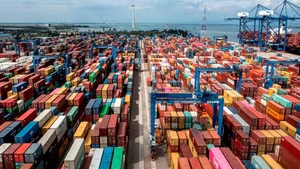
The World Bank’s assessment also shows that Viet Nam is one of the notable growth cases in this year’s classification update. According to the organisation, Viet Nam’s growth was driven by an export-led development model, with export turnover increasing by more than 15% in both 2024 and 2025, while GDP grew by 7% and 8%, respectively.
Speaking to Nhan Dan Newspaper about the development of Viet Nam’s GNI per capita, Assoc. Prof. Dr Nguyen Duy Dat, Director of the Institute of International Business and Logistics at Viet Nam University of Commerce (Thuongmai), said that 40 years ago, Viet Nam launched its comprehensive Doi Moi (Renewal) reform, shifting from a centrally planned mechanism to a socialist-oriented market economy. At that time, GNI per capita was very low; in the 1990s, it was just over 100 USD. In 2000-2010, GNI gradually increased and Viet Nam moved from a low-income country to the lower-middle-income group. In the 2010-2020 period, the economy grew rapidly, with GNI rising sharply and approaching 3,500 USD by 2020.
In 2021-2025, the World Bank assessed that Viet Nam’s GNI grew by an average of about 10% per year, among the strongest sustainable growth rates in the region.

Nguyen Thi Mai Hanh, Head of the National Accounts System Department under the Statistics Office of the Ministry of Finance, said Viet Nam’s inclusion in the upper-middle-income group is a very important milestone. It reflects the results of the country’s economic growth process and shows that the scale and quality of the economy have continued to improve, while people’s income and living standards have gradually been raised.
“This result demonstrates the great determination and efforts of the Party, the State and the Government, together with the consensus and active participation of the entire people,” Assoc. Prof. Dr Nguyen Duy Dat affirmed.
Viet Nam’s recognition as an upper-middle-income country is not only statistically significant, but also opens up many new opportunities for the economy.
According to Nguyen Thi Mai Hanh, first of all, this contributes to enhancing Viet Nam’s prestige and position in the international arena and increasing its attractiveness to investors, especially high-quality investment flows. At the same time, it also creates favourable conditions for Viet Nam to participate more deeply in global value chains.
Viet Nam’s recognition as an upper-middle-income country helps enhance its prestige and position in the international arena and increases its attractiveness to investors, especially high-quality investment flows.
Nguyen Thi Mai Hanh
Nguyen Quang Huy, Executive Director of the Faculty of Finance and Banking at Nguyen Trai University, said becoming an upper-middle-income country will increase national competitiveness. This will help attract a new wave of FDI into industries with advantages in technology and knowledge content, such as semiconductors, AI, renewable energy and R&D centres.
From a domestic perspective, income growth not only expands the scale and improves the quality of the consumer market, but also profoundly reshapes spending structures. Improved incomes also create momentum for expanding the domestic market, promoting the development of modern services, the digital economy and high-quality consumption, thereby contributing to the formation of a more balanced growth structure between the domestic market and exports.
At the same time, this will encourage domestic enterprises to become more self-reliant and invest in digital transformation, science and technology to improve labour productivity and product quality, and become an indispensable link in global supply chains.
With the new position of the economy, it is expected to generate greater confidence among international investors, contributing to promoting cooperation, trade and investment activities in the coming period.

Challenges in overcoming “middle-income trap” and moving towards high growth
According to the Resolution of the 14th National Party Congress, the Party and State have set the goal that by 2045, Viet Nam will become a developed, high-income country.
A review of Viet Nam’s development process shows that in 2009, the country crossed the low-income threshold and was recognised as a lower-middle-income country, with GNI per capita of about 1,120 USD. It took the country 17 years of effort to increase GNI per capita by about 4.4 times compared with 2009 and rise to the upper-middle-income level.
According to the World Bank’s latest annual country classification, Viet Nam needs to reach a GNI per capita threshold of 14,375 USD to be recognised as a high-income country, nearly three times its current level.
Commenting on Viet Nam’s path ahead, Assoc. Prof. Dr Nguyen Duy Dat said it is not difficult for the country to maintain the upper-middle-income level, but making a breakthrough into the high-income group is an extremely major challenge, often referred to as the “middle-income trap”.
Neighbouring countries such as Thailand and Malaysia have remained stuck in the “middle-income trap” for many years. By contrast, Singapore and the Republic of Korea have successfully broken through into the high-income group because, after reaching the upper-middle-income level, they maintained continuous and stable double-digit growth for many years.
The associate professor pointed out that experience from other countries shows Viet Nam must fundamentally change its growth model, master science and technology, develop domestic enterprises and improve labour productivity.
On this occasion, Nguyen Thi Mai Hanh, Head of the National Accounts System Department under the Statistics Office, noted that moving to a new income group is mainly a change in economic classification according to World Bank criteria. It does not mean Viet Nam has become a developed country, while the income gap with developed countries remains considerable.
When entering the upper-middle-income group, access to concessional loans and international development assistance may gradually decline. At the same time, requirements for growth quality, technological level, human resource quality and sustainable development will become higher than before. Therefore, labour productivity, innovation capacity and the competitiveness of the economy still need to be further improved in the coming period.
To create endogenous momentum, Nguyen Quang Huy, Executive Director of the Faculty of Finance and Banking at Nguyen Trai University, discussed several key solutions with Nhan Dan Newspaper.
First, the private economic sector needs to become a pioneering force in innovation. The formation of large-scale private enterprises capable of mastering technology, building global brands and leading value chains will determine the quality of growth in the long term. Close linkages between domestic enterprises and the FDI sector will also help increase the localisation rate and promote technology transfer.
For exports, the focus needs to shift from growth in quantity to growth in quality. Instead of relying heavily on preliminary processing and outsourcing, priority should be given to deep processing, technology application, the development of supporting industries, investment in design, intellectual property and national brand building. The goal is not only to increase export turnover, but more importantly to increase Vietnamese value in each product, gradually moving from “Made in Viet Nam” to “Created in Viet Nam” and “Branded by Viet Nam”.
In addition, high-quality human resources must move one step ahead. Huy emphasised: “Competition among economies in the new stage is competition for talent.” Therefore, it is necessary to fundamentally renew education and training towards developing digital skills, creative thinking and research capacity; and prioritise the training of experts in strategic fields such as semiconductors, artificial intelligence (AI), big data, biotechnology, robotics and new energy.
Competition among economies in the new stage is competition for talent.
Nguyen Quang Huy
A breakthrough driver is attracting new-generation FDI. Unlike in the previous period, the goal is no longer to attract more projects or more capital, but to attract source technologies, knowledge, data and global innovation networks. Viet Nam needs to prioritise high-tech projects, while building an ecosystem attractive enough for multinational corporations to place research and development (R&D) centres in the country. At that point, Viet Nam will gradually shift from the role of a “manufacturing workshop” to an “innovation hub”, where ideas are formed, products are designed and technologies are developed for the region and the world.
Entering the upper-middle-income group is evidence of Viet Nam’s successful development journey, but the path ahead will be determined by the quality of reforms and innovation capacity. With growth momentum based on science, technology, innovation and digital transformation, Viet Nam will have a solid foundation to overcome the middle-income trap, maintain high and sustainable growth, and realise the goal of becoming a developed, high-income country by 2045.