The WB has released its 2026 country classification based on 2025 gross national income (GNI) per capita. With a GNI of 4,970 USD per capita, exceeding the minimum threshold of 4,636 USD, Viet Nam has officially been classified as an upper-middle-income country.
This achievement is more than just a statistical milestone. Nearly four decades after launching Doi Moi, Viet Nam has, for the first time, advanced to a new level in the classification system of one of the world's leading international financial institutions.
A milestone marking sustained development journey
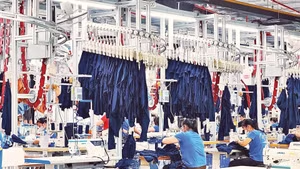
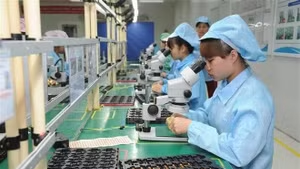
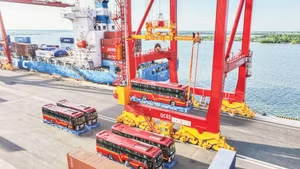
The WB has spoken positively of the quality of Viet Nam's economic growth in recent years, describing the country as one of the region's standout growth stories. Driven by its export-oriented development model, Viet Nam recorded export growth of more than 15% in both 2024 and 2025, while GDP expanded by around 7% and 8%, respectively. Between 2021 and 2025, GNI increased by an average of around 10% per year, placing Viet Nam among the region's fastest-growing and most resilient economies.
Only four other economies were upgraded in this year's classification, highlighting the difficulty of reaching upper-middle-income status, particularly amid heightened global economic uncertainty.
According to Nguyen Thi Mai Hanh, Director General of the National Accounts Department under the Statistics Office of the Ministry of Finance, the WB's decision to classify Viet Nam as an upper-middle-income country represents "a highly significant milestone", reflecting years of sustained economic growth. The country's economic scale and quality have continued to improve, while people's incomes and living standards have been steadily rising.
"Joining the upper-middle-income group brings many tangible benefits. First and foremost, it enhances Viet Nam's international standing and credibility. At a time when competition to attract investment is becoming increasingly intense, recognition by a reputable international institution such as the World Bank will help strengthen investor confidence, expand access to high-quality investment flows, and support Viet Nam's deeper integration into global value chains," Hanh said.
The milestone also provides an important foundation for Viet Nam to achieve the development goals set by the 14th National Party Congress. The country aims to become a developing nation with modern industry and upper-middle-income status by 2030, before attaining developed, high-income country status by 2045.
The challenge of escaping middle-income trap
Global experience shows that reaching upper-middle-income status does not automatically lead to high-income status. The WB's World Development Report 2024 notes that since 1990, only 34 economies have successfully escaped the "middle-income trap" to become high-income countries. About one-third achieved this through accession to the European Union or by benefiting from abundant oil resources. Notably, in this year's classification, no economy moved from the upper-middle-income group to the high-income category.
These figures underscore the scale of the challenge ahead, requiring deeper, more determined, and more sustained reforms. According to Tehmina Khan, the WB's Lead Economist for Viet Nam, Cambodia, and Laos, Viet Nam is among the few emerging economies undertaking multiple major reforms simultaneously, ranging from administrative reform to cutting procedures and reducing regulatory burdens on businesses. These efforts are generating optimism and strengthening confidence among international investors.
However, institutional reform alone is only a necessary condition. To achieve its goal of becoming a high-income country by 2045, Viet Nam must also strengthen public sector capacity, ensure effective policy implementation, and deliver tangible improvements in the economy's competitiveness.
The WB has identified four major bottlenecks that Viet Nam needs to address. The first is the widening gap between foreign-invested enterprises (FIEs) and domestic businesses. Although the FDI sector accounts for only around 5% of all enterprises, it remains the main driver of exports.
Meanwhile, many domestic private firms, particularly small and medium-sized enterprises (SMEs), continue to face difficulties in accessing capital, technology and markets. Unless the domestic business sector becomes more competitive, much of the economy's value added will continue to depend on FDI.
The second challenge is the economy's limited resilience to external shocks. Although fiscal space remains available, Viet Nam continues to rely heavily on international trade and external demand. Any disruption to global supply chains or escalation in trade tensions could have a significant impact on economic growth.
The third challenge is the economy's heavy reliance on credit. According to the WB, Viet Nam's credit-to-GDP ratio reached around 145% in 2025, ranking among the highest in ASEAN. While this has supported investment, it also poses considerable risks should the economy face external or domestic shocks.
The fourth challenge is infrastructure. Logistics costs remain high, while many strategic infrastructure projects must be completed on schedule to reduce business costs and strengthen national competitiveness. According to the WB, the priority is not only to increase public investment but also to select the right projects and ensure effective implementation so that every investment dollar generates new productive capacity.
Viet Nam's GNI per capita rose from 3,540 USD in 2021 to 4,970 USD in 2025, reflecting sustained macroeconomic stability, export growth, expanded investment, stronger business development, and deeper integration into the global economy.
From the perspective of the national statistical authority, Hanh also stressed that Viet Nam's entry into the upper-middle-income group represents a shift in its level of development rather than evidence that it has already become a developed economy.
"There remains a considerable gap between Viet Nam and high-income economies. Labour productivity, innovation capacity, and the overall competitiveness of the economy all need to improve significantly," Hanh said.
Moving into the upper-middle-income group also brings new challenges. Concessional loans and international development assistance are expected to decline, while expectations regarding growth quality, science and technology, innovation, workforce quality, and sustainable development will become increasingly demanding.
This requires Viet Nam to shift decisively from a growth model driven by capital and labour to one based on productivity, science and technology, innovation, and the efficient use of resources.
The development experience of many countries shows that while some milestones are simply remembered, others reshape a nation's development trajectory. For Viet Nam, international recognition as an upper-middle-income country will have lasting significance only if it serves as a springboard for a new stage of development built on knowledge, innovation, and productivity, enabling the country to become a prosperous developed nation by 2045 in line with the goals set by the Party and the Vietnamese people.