Vu Dai Thang, Chairman of the Ha Noi People's Committee, said that during the first six months of 2026, the city had simultaneously implemented a broad range of measures to maintain administrative discipline, remove difficulties for businesses, promote investment, ensure social welfare, and stabilise people's livelihoods.
Ha Noi has also continued to refine its development model under the framework of "three pillars, five drivers, and four development spaces", establishing a growth model driven by science and technology, innovation, digital transformation, high-quality human resources, and the promotion of cultural values.
These orientations have been translated into action programmes and medium- and long-term development plans, helping to expand development space and create new growth momentum for the capital.
As a result, the capital's economy has maintained positive growth. Gross Regional Domestic Product (GRDP) expanded by 8.22% in the first half of this year, marking the highest first-half growth rate in the past decade. State budget revenue collected in the city reached approximately 410 trillion VND, fulfilling more than 62% of the annual estimate.
Public investment has continued to be identified as the key driver of growth. During the first six months of the year, the city disbursed nearly 64 trillion VND in development investment, more than doubling the figure recorded in the same period last year. Progress on numerous key infrastructure projects has also accelerated.
At the same time, Ha Noi has actively mobilised social resources, attracting around 33 trillion VND in non-budget investment, generating spillover effects across construction, services, real estate, and logistics.
However, the results achieved have yet to match the capital's potential and advantages and remain insufficient to meet the double-digit growth target assigned by the Party Central Committee and the Gvernment. Growth pressure during the second half of the year therefore remains considerable.
A number of bottlenecks relating to investment, site clearance, and project preparation still need to be addressed. Meanwhile, market demand, enterprises' capacity to absorb capital, and the competitiveness of some businesses remain limited.
With full awareness of the capital's responsibility in contributing to the country's overall growth target, Ha Noi has identified the second half of 2026 as a period for accelerating progress and achieving breakthroughs. The city remains firmly committed to a GRDP growth target of 11% or above, with no downward adjustment, while focusing on mobilising and effectively utilising all available resources to fulfil the targets that have been set.
According to leaders of the Ha Noi People's Committee, the city will concentrate on mobilising and making efficient use of all resources while fully leveraging the new mechanisms and policies provided under the 2026 Law on the Capital to create breakthroughs in development. The immediate priority will be to accelerate public investment disbursement and strive to achieve the highest possible implementation rate under the 2026 plan, regarding it as the key driver of growth, social investment, and job creation.
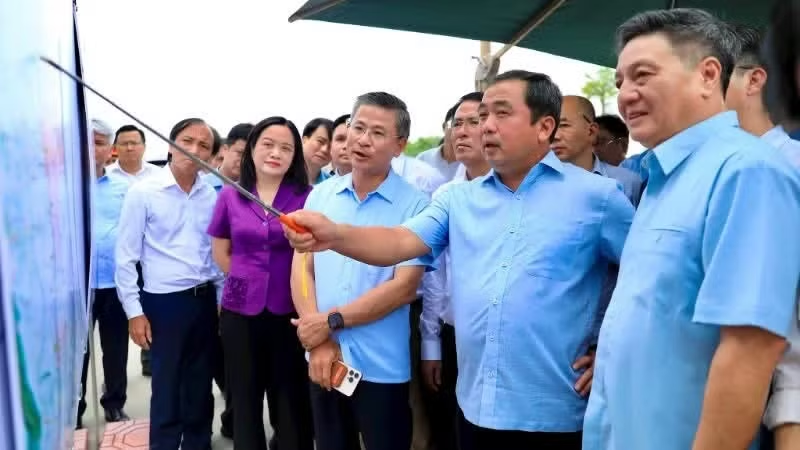
At the same time, the city will focus on comprehensively resolving bottlenecks relating to site clearance, planning, and investment procedures; completing investment preparation and land clearance to enable the simultaneous implementation of strategic infrastructure projects, including national highways, ring roads, bridges spanning the Red River, railway projects, multi-purpose facilities, new urban development areas, and social housing projects.
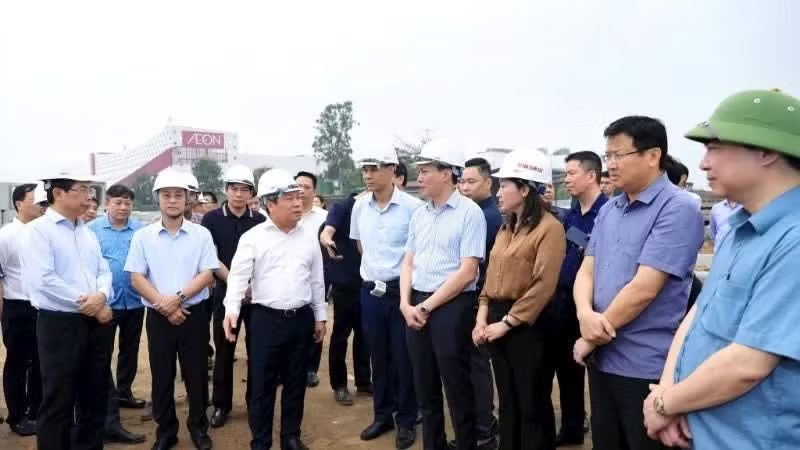
One of the key requirements set by the Ha Noi People's Committee is to reform its approach to governance by shifting from a "plan management" mindset to a "growth management" mindset. Under this approach, each department, sector, commune, and ward must develop specific growth scenarios for its respective sector or locality, quantify its contribution to the city's GRDP, and assess the efficiency of investment resources through the added value generated for the economy.
Vice Chairman of the Ha Noi People's Committee Nguyen Xuan Luu said that every delayed project and every task that is prolonged is not merely an administrative issue but directly affects the city's growth rate. Therefore, from now until the end of the year, the People's Committee will continue to operate on the principles of assigning specific targets, specific deadlines, and specific responsibilities; conducting concrete performance reviews; and using growth outcomes as the benchmark for evaluating the leadership capacity of agency heads.
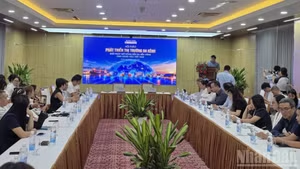
At a recent conference on implementing the city's key tasks for the second half of the year, Secretary of the Ha Noi Party Committee Tran Duc Thang instructed the Ha Noi People's Committee and relevant departments to review growth scenarios and accelerate all ongoing work so that the city can achieve its 11% growth target in 2026. He also requested the development of scenarios identifying key driving projects to lay the foundation for double-digit growth in 2027 and the years ahead.
Specifically, the city will focus on both immediate and long-term priorities, especially promoting industrial development, the digital economy, the green economy, innovation, and science and technology, while ensuring the substantive implementation of commitments made at the investment promotion conference and the announcement of the Capital Master Plan with a 100-year vision on June 29.
Tran Duc Thang stressed the need to continue vigorously reforming administrative procedures and improving the investment and business environment, ensuring that investors are not discouraged by cumbersome procedures and that harassment is eliminated so as not to undermine the city's investment climate.
Authorities at all levels and across all sectors have been instructed to accelerate public investment disbursement, provide strong support for non-budget investment projects, and assign specific responsibilities to each leader, department, and locality for controlling the critical path of strategic infrastructure projects, covering both public and private investment.
"Our capital is standing before tremendous opportunities and prospects, but these come with equally great responsibilities. We must translate our determination into concrete results, including economic targets achieved, higher incomes, more jobs created, completed infrastructure projects, bottlenecks removed, social welfare policies delivered to the people, and a stronger sense of responsibility and better public service among every official, civil servant, and public employee across the political system," Secretary of the Ha Noi Party Committee Tran Duc Thang said confidently.