The view was shared at a seminar on Canada-Viet Nam agricultural trade and investment partnership organised by the Canada-Viet Nam Trade Council, which brought together representatives from government agencies, research institutions and businesses from both countries.
Greg Folinazzo, representing Agriculture and Agri-Food Canada (AAFC), said Viet Nam is a priority market and a strategic gateway for Canada’s agricultural sector in Southeast Asia.
Canadian exports of agricultural, food and aquatic products to Viet Nam grew by an average of 22.7% annually during 2021-2025, reaching about 702 million CAD (503.5 million USD) last year. Major products included wheat, soybeans, frozen beef, frozen crab, and canola meal. Meanwhile, Canada imported about 964 million CAD worth of agricultural and food products from Viet Nam in 2025, mainly shrimp, fish fillets and value-added processed products. The complementary trade structure creates room for greater two-way trade and supply-chain connectivity.
Calvin Xiao, Relationship Manager at Export Development Canada, said Viet Nam is a key market not only because of its population and growing domestic demand, but also its potential to connect Canadian businesses with other Southeast Asian markets.
As Canada steps up trade diversification and seeks to reduce its dependence on the North American market, Viet Nam could serve both as a market for Canadian goods and a base for Canadian businesses to build production capacity and expand operations in the region, he said.
Natujwa Maliondo, Senior Trade Development Officer at the Ministry of Agriculture and Irrigation of Alberta province, said Canadian businesses should look beyond Viet Nam’s market size and view the country as part of a broader strategy to access the whole ASEAN market.
The Comprehensive and Progressive Agreement for Trans-Pacific Partnership (CPTPP) provides businesses from both countries with tariff preferences and improved market access. However, further administrative simplification and a better policy environment are needed to attract more Canadian investment in Viet Nam’s agriculture, food and processing sectors, and encourage Vietnamese investment in Canada.
Delegates noted that Canada may find it difficult to compete with suppliers closer to Viet Nam on price and transport costs, but its agricultural products have advantages in reliability, food safety, traceability, nutritional quality and environmental standards.
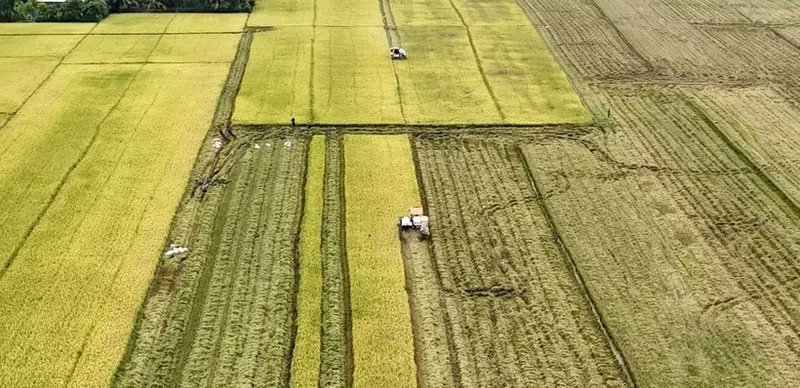
Beyond goods trade, bilateral agricultural cooperation is expanding into research, innovation and technology transfer, with potential areas including precision agriculture, hydroponics, fertiliser technology, deep processing, post-harvest preservation, emissions reduction and carbon-credit measurement.
Prof. Huy Dang of Trent University said climate change is reshaping food production in both countries. Canada faces harsh winters and the need to strengthen food self-sufficiency, when the Mekong Delta is affected by saltwater intrusion, land subsidence and rising sea levels.
Hydroponics could be a promising area of cooperation as the technology can save up to 90% of water, supporting production in areas where surface water is saline or groundwater extraction needs to be restricted, he said.
Businesses also highlighted the importance of finding suitable local partners, understanding business culture and building long-term relationships. They said Canadian firms could focus on specialised segments and leverage their strengths in quality, technology and branding rather than compete directly with established suppliers.
With CPTPP as a foundation and Canada-ASEAN economic ties expected to grow, agricultural cooperation is expected to become a practical avenue for Viet Nam-Canada relations, creating opportunities for mutually beneficial trade, investment and innovation.

![[Infographic] Viet Nam's 16 Comprehensive Strategic Partners](https://en-cdn.nhandan.vn/images/nyM650OGFWrOVWc-xajqN-rTZ68Rlmc1fiGJOhBRYHHdkBILL2hAdMw_FHcqH-128bTaQBSOAMd0_NcTypwz7H-j_NBZzuSdgF8ETMmVl1xLtdcCjym8rCUyKZqQgOZtC4ouMEzxlJoQ-MllehtjehDxIkn58uqaoaCRy4fSY54/1792513260540-1528117236743671738-1528117236743671738-9e797c256fe32c7c7b9c1cc03b0ca64e.jpg.avif)