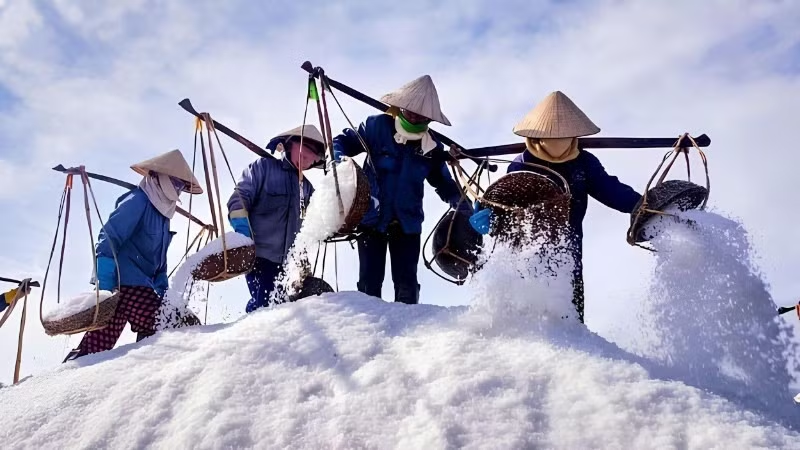
As one of the largest salt-producing areas in central Viet Nam, Hon Khoi not only provides livelihoods for generations of local residents but also preserves traditional salt-making as part of the coastal region’s cultural heritage. Despite many ups and downs, Hon Khoi’s salt farmers have remained steadfastly attached to their fields, preserving the taste of the sea in every crystal formed by sunshine, wind and human labour.
Crystallising into “pearls of the sea”
As the sun begins to rise above the horizon, its first rays illuminate the Hon Khoi salt fields in brilliant white. The scraping of rakes across the salt beds and the sound of wheelbarrows carrying freshly harvested salt blend into a symphony of patient, disciplined labour. Every stroke of the rake, every sun-weathered face and every bead of sweat contributes to the formation of pure white salt crystals, standing in stark contrast to hands darkened by the sun and sea breeze.
Amid the dazzling white salt fields under the scorching summer sun, 70-year-old Nguyen Cha, who has spent more than 40 years making salt, bears the marks of his lifelong occupation on his slender face, sun-darkened skin and deep wrinkles.
He said there is virtually no such thing as a day off during the salt-making season. Once the season begins, salt farmers settle into a routine that starts long before sunrise. At around 4am, they are already in the fields, taking advantage of the cooler hours to rake the salt. By 9 or 10am, the sun is high overhead, heat radiates intensely from the salt beds, while salt-laden air fills the breeze.
“Producing a single grain of salt involves many stages. Seawater is first channelled into storage ponds and left for about a week to increase its salinity. It is then pumped into intermediate ponds where the salinity continues to rise. Only when the brine reaches a salinity level of around 20-25 degrees is it transferred to crystallisation ponds. If the weather is favourable, with continuous sunshine for about four days, salt crystals begin to form across the surface and farmers can start harvesting. Although the process is not overly complicated, the success or failure of an entire salt crop depends almost entirely on the weather,” Nguyen Cha said.
Recalling earlier years, the veteran salt farmer fell silent for a moment, his eyes welling up as he remembered a time when farmers had little mechanical support.
“Life was much harder in the past. After the salt was raked up, we had to put it into sacks, load them onto carts and take them all the way to the port to be loaded onto ships. Every grain of salt we sold carried the sweat of the salt farmers. People in Hon Khoi have lived off salt for generations. The work was hard, but salt put food on the table and sent our children to school. Generations have grown up from these salt fields, so everyone loves the trade and remains deeply attached to it,” he said.
Nguyen Thi Nien, another salt farmer who has spent 32 years in the trade, said the occupation depends almost entirely on natural conditions. Whether there is salt to harvest largely comes down to the weather. During summer, when seawater is saltier and sunshine abundant, crystallisation is faster and yields are higher. But rain or prolonged cloudy weather dilutes the brine and prevents salt from crystallising, potentially wiping out the work of an entire crop.
“To have one hectare of crystallisation ponds, around three hectares are needed for concentrating seawater. For lined ponds used to produce clean salt, five to seven sunny days are enough before harvesting can begin. Traditional earthen salt fields require between 10 days and half a month for crystallisation, although under favourable conditions their yields are often higher,” Nien explained.
Despite working in temperatures that can exceed 40 degrees Celsius, enduring back pain, hands cracked by saltwater and the constant anxiety of approaching rain, Nien has never considered leaving the trade.
“It is extremely hard work, but I am used to it. Whenever it rains and I have to stay at home, I miss the salt fields. I just hope for steady sunshine so we can harvest salt and earn some extra income for our family,” she said.
For generations of salt farmers, the occupation is not merely a means of earning a living; it is also part of the distinctive beauty of this coastal region. Under the brilliant golden sunshine, the salt beds sparkle as crystals bloom across their surfaces like white flowers of glass. For the farmers, the sight seems to wash away the exhaustion with every sea breeze.
Preserving the occupation amid change
Le Minh Chau, Vice Chairman of the Dong Ninh Hoa Ward People’s Committee, said the ward currently has more than 430 hectares devoted to salt production, with around 240 households still engaged in the trade. Of these, nearly 200 households are members of the Ninh Diem May 1 Salt Production Cooperative.
According to Chau, salt-making is important not only economically but also as part of Dong Ninh Hoa’s cultural identity.
“Average annual salt output exceeds 28,000 tonnes, providing a stable source of income for Hon Khoi salt farmers. Salt-making is one of the locality’s traditional occupations, creating jobs and income while helping preserve the cultural identity of the coastal region. The Hon Khoi salt fields are a distinctive feature of the locality and also offer potential for developing signature products associated with experiential tourism in the future,” he said.
However, salt-making currently faces numerous challenges. Climate change has made weather patterns increasingly unpredictable, with unseasonal rains disrupting the crystallisation process. Meanwhile, salt prices remain unstable, and most products are still sold as raw salt, resulting in low added value that does not adequately reflect the labour invested by farmers.
“The economic returns from salt-making are still not commensurate with the effort of salt farmers. The application of science and technology remains limited, infrastructure for production, processing and storage is not yet comprehensive, and relatively few businesses are involved in consumption linkages. These are issues the locality is gradually working to address so that residents can feel secure in continuing the trade,” Chau said.
To increase the value of Hon Khoi salt, local authorities have strengthened connections between producers, businesses, cooperatives and purchasing establishments to establish more stable supply and consumption chains. The locality is also encouraging investment in deep processing, brand development and product promotion while supporting farmers in applying science and technology to production.
On that basis, local authorities will continue studying the development of the Hon Khoi Salt brand, gradually improving product quality, value and competitiveness. At the same time, greater application of science and technology and stronger links among producers, businesses and cooperatives are expected to help establish a sustainable value chain.
The locality is also looking to develop the traditional salt-making village in conjunction with experiential tourism, connecting it with Doc Let Tourist Area and other coastal destinations in Dong Ninh Hoa.
In the future, visitors could not only admire the salt fields and learn how sea salt is produced but also try their hand at raking and carrying salt. Such experiences could help increase the value of salt products, create additional livelihoods for local residents and contribute to preserving the traditional craft.
Perhaps the greatest value of the Hon Khoi salt fields lies not merely in the tens of thousands of tonnes of salt produced each year, but in the perseverance and resilience of generations of salt farmers who continue to preserve the traditional occupation handed down by their ancestors.
In every pure white crystal formed from sunshine, sea breeze and seawater glisten the sweat and enduring devotion of generations of Hon Khoi salt farmers.






![[Video] Eight-month public investment disbursement reaches 50% of yearly plan](https://en-cdn.nhandan.vn/images/nyM650OGFWrOVWc-xajqNz57td8idIAL_VG9puyG2UZSh9a-ip79SRwvbzBwNEcQ_SZtLGThwR4Kp7S4xd9nklBm2seVye4c367gN-6eKf4/giai-ngan-von-dau-tu-cong.jpg.avif)