Innovation for development
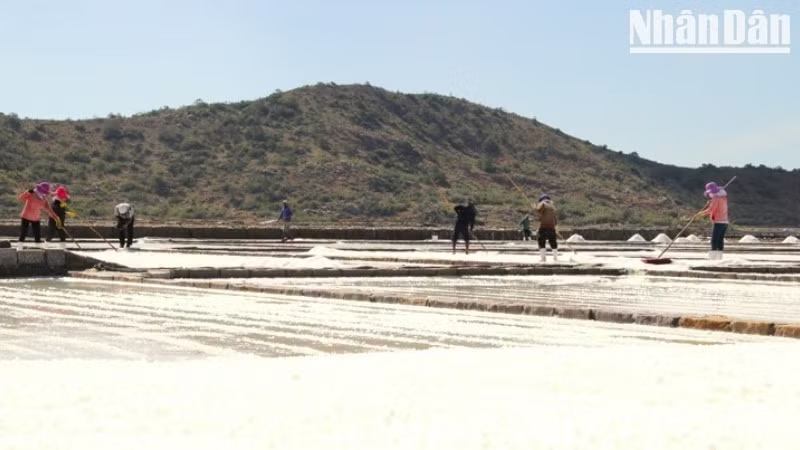
Every day, as the sun rises over the sea, the sparkling salt fields in villages of Khanh Hoi, Tri Thuy 2, and Phuong Cuu 1 begin to bustle with activity as salt farmers diligently rake layers of white salt and pile them into large mounds at the edge of the fields. This traditional craft has been preserved for generations.
With its year-round hot and dry climate and abundant sunshine, Ninh Hai boasts prolonged sunlight hours, which is an advantage for developing large-scale concentrated salt production.
Le Thanh Tam, Deputy Head of the Economic Department of Ninh Hai Commune, noted that the locality has 1,145 hectares of manual salt production (also known as earthen-based salt production) and industrial salt production, creating jobs for nearly 900 workers. In the first six months of 2026, salt production yielded over 100,000 tonnes, of which manual salt accounted for 45%, with an average selling price of about 1.2 million VND/ton. However, most of the product is still consumed as raw material, with low added value. Meanwhile, the area for salt production using plastic tarpaulin on the ground, resulting in higher quality refined salt, only accounts for about 19% of the area for manual salt production. Therefore, salt farmers need to invest more to develop this production model.
Faced with the need to improve competitiveness, many salt farmers have boldly revamped their production methods. Bui Hoa, in Khanh Hoi Village, is one of the efficient salt-producing households in the locality. Each year, his family harvests more than 1,200 tonnes of salt, generating nearly 1 billion VND in revenue and providing regular employment for 10 workers. According to him, to stay in the profession long-term, salt producers cannot rely solely on production volume but must improve product quality to meet the increasingly stringent demands of the market.
At the Tan Tien Clean Salt Facility in Tri Thuy 2 Village, Tran Thi Tan, one of the pioneers in switching to the model of salt production on plastic tarpaulin, stated that all eight hectares of her family's salt fields have been renovated, using the new method. Although the initial investment cost is higher, the salt crystallisation time is shortened to about five days per harvest; the salt grains are white, clean, contain fewer impurities, and labour costs are significantly reduced thanks to the mechanisation of some stages. More importantly, the clean salt meets market demands, resulting in stable output and higher selling prices.
This transition is also being championed by many production facilities in the locality, creating a foundation for the salt industry to evolve steadily along a modern and sustainable trajectory.
Catalysing the formation of value chains
According to Nguyen Khac Hoa, Deputy Secretary of the Party Committee and Chairman of the People's Committee of Ninh Hai Commune, the area of salt production using plastic tarpaulins is still modest compared to the total area of traditional salt production, indicating that the locality still has much room to expand the clean production model, improve quality, increase competitiveness, and effectively exploit the potential of the traditional salt-producing region.
“In the coming time, the locality will focus on expanding the area of salt production using plastic tarpaulins; promoting the application of science and technology; building brands; strengthening links with businesses; and developing OCOP products from salt. Through this, we will gradually increase added value, develop the salt industry in a modern and sustainable direction, and gradually reduce the consumption of products mainly in the form of raw materials with low economic value,” Hoa emphasised.
Not only does Ninh Hai possess a vast raw material area, but it is also gradually optimising the production-processing-consumption chain. Besides 494 households producing salt manually, the locality currently has three industrial salt production enterprises and nine facilities processing refined salt and iodised salt. In the first six months of 2026 alone, these facilities processed approximately 1,180 tonnes of refined and iodised salt, creating a foundation for developing value-added product lines to meet domestic market demand and aim for export.
Based on this experience, Ninh Hai has resolved that salt production development should not only focus on increasing output but also on building a complete value chain. The locality will continue to review production area planning, support the expansion of clean salt production models, promote the application of technology, and strengthen linkages with businesses to form a close connection from production and processing to consumption.
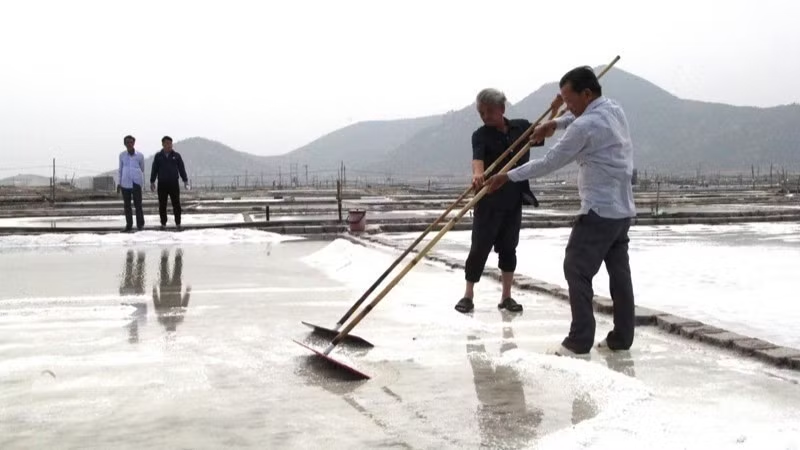
Alongside production development, the coastal salt fields are simultaneously being positioned as unique experiential tourism destinations. The shimmering white salt fields under the sun, the image of salt farmers diligently “nurturing” each grain of salt, and the processed salt products will be synergised to forge tourism products that reflect the local identity, thereby bolstering the Ninh Hai salt brand and generating supplementary livelihoods for the people.
Today, Ninh Hai salt stands poised to transcend the boundaries of a traditional agricultural product. With the strong application of science and technology, the completion of the value chain, and the strategic integration of tourism, salt will yield high economic returns and become a symbol of a land that preserves its ancestral craft, proactively innovates for integration, and achieves sustainable development.
From the shimmering white fields under the sea sun, a new horizon is unfolding, which will propel Ninh Hai salt production to achieve greater prominence through the cultural values, labour, and identity that have been nurtured over many generations.