From business accounts, QR code payments, and sales management to electronic tax declarations, tax payments, and credit, a digital financial ecosystem is gradually taking shape, helping this segment of the economy adapt to an increasingly modern business environment.
Transparent cash flows open the way to access to capital
Millions of household business are entering an important stage of transformation as requirements for cash-flow transparency, tax management, and cashless payments become increasingly standardised. While most trading activities were previously managed through notebooks, cash, and a personal bank account, this approach is showing many limitations in the digital business environment.
Le Minh Trang, the owner of a small accommodation establishment in Ha Noi, said that in the past, guests paid for rooms through various channels, including cash, bank transfers, and online booking platforms. Electricity, water, labour, and service costs were managed separately, making it very time-consuming to compile monthly business results. When there were only a few rooms, it was possible to keep track of things by memory, but as the number of guests and transactions increased, the lack of a clear tracking system made it easy to confuse actual revenue with the amount of money in the account.
This is also the reality for many household businesses. Cashless payments are becoming increasingly common, with cash flows coming from various sources such as bank transfers, e-wallets, and e-commerce platforms, while many traders still mainly rely on manual records to manage revenue. As transaction volumes increase, it becomes more complicated to reconcile accounts and determine revenue, costs, and the performance of each sales outlet.
Making cash flows transparent is not only a requirement for tax management but, first and foremost, a demand for household business themselves. Separating income and expenditure, fully recording transactions, and building clear financial data enable business owners to gain a more accurate view of business effectiveness while creating a basis for accessing formal financial services. Recognising this demand, many commercial banks are shifting from providing individual products to developing digital financial solutions covering the entire business process.
At VPBank, direct consultation programmes have been carried out at many markets and business areas across the country. In addition to helping customers open accounts, the bank guides them in becoming familiar with tools for cash-flow management, electronic payments, and online tax payments. Direct engagement helps household businesses that have long been accustomed to traditional management methods gradually change their habits.
Meanwhile, Vietcombank has developed a set of solutions tailored to different stages of a household business’ development, from opening a shop and digitalising cash flows to expanding sales outlets and preparing capital for growth. In sales, VCB OneQR allows a single QR code to receive payments from both domestic and international customers. The merchant management application supports the creation of dynamic QR codes, acceptance of card payments through contactless transactions on mobile phones, and revenue tracking by individual cashiers. When revenue and cash flows are fully recorded through the bank, household businesses have a stronger basis for accessing appropriate credit limits.
VietinBank has also developed an ecosystem comprising payment accounts, QR codes for receiving money, payment acceptance devices, cash-flow management, credit and various digital utilities for household businesses and enterprises, all integrated into a single application.
Building a digital financial ecosystem
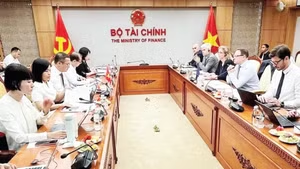
However, to help millions of household businesses transition from manual management to transparent digital operations, the efforts of individual banks alone are not enough. The greater requirement is to establish connectivity among tax agencies, the banking system, sales management platforms, and payment infrastructure. In this direction, many commercial banks and the Tax Department under the Ministry of Finance have cooperated to support household businesses in their digital transformation, promote electronic tax payments, and encourage cashless payments.
For example, Vietcombank and the Tax Department have worked together to disseminate information and provide guidance on using accounts for business activities, connecting them with tools for electronic tax declaration and payment, and gradually establishing transparent financial management habits. Le Quang Vinh, Member of the Board of Directors and Chief Executive Officer of Vietcombank, said that digital transformation in finance and taxation can only become substantive when there is coordinated cooperation among state management agencies, banks, sales platforms, and the household business community. Meanwhile, Mai Son, Deputy Head of the Tax Department, said that connecting tax agencies, banks, and sales platforms would help improve voluntary compliance, reduce errors in fulfilling tax obligations, and promote the digitalisation of household businesses nationwide.
VietinBank and the Tax Department have also signed a cooperation agreement to strengthen information dissemination, implement tax policies, and promote cashless payments among household businesses, individual business operators, and enterprises. The focus is on researching digital tax solutions and strengthening connections between banking services and the platforms and applications of tax agencies, thereby helping taxpayers fulfil their obligations electronically in a more convenient, secure, and transparent manner.
At the same time, the connection between banks and tax agencies helps standardise cash flows and financial obligations, while payment infrastructure serves as a link that brings digitalisation deeper into each sales transaction. Recently, NAPAS and KiotViet signed a cooperation agreement to introduce VietQR code payments on the platform, while also expanding the network for accepting cross-border QR code payments to serve international customers.
According to the business, the platform currently has more than 300,000 merchants across more than 20 industries. “This combination will help promote cashless payments and improve operational efficiency for enterprises and household businesses, while also expanding opportunities to reach international customers and contributing to the development of Viet Nam’s digital economy,” said Tran Nguyen Hao, Chief Executive Officer of KiotViet.