Positive signals
Over the past five years, Viet Nam has built and gradually implemented a green finance system for low-emission and environmentally friendly production activities, including agriculture. On the basis of Directive No. 03/CT-NHNN dated March 24, 2015, of the State Bank of Viet Nam, several banks such as BIDV, VCB, HDBank and Agribank have launched credit packages for green production, including waste treatment, high-tech agriculture, digital transformation, regional linkages and emission reduction in production chains.
By 2025, outstanding loans for green credit packages in agriculture from domestic banks had reached around 150 trillion VND. In addition, the country has also attracted significant capital from international organisations such as the Green Climate Fund (GCF), the World Bank (WB), the Asian Development Bank (ADB), and bilateral support programmes from developed countries such as Japan, Germany, the Republic of Korea and the Netherlands.
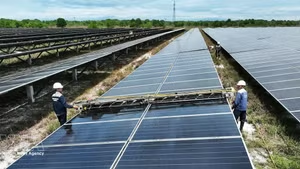
Statistics from the State Bank of Viet Nam show that around 50 financial institutions in Viet Nam are implementing green credit packages. These include the “Green credit for sustainable agriculture” package financed by BIDV in coordination with GIZ of Germany for 78 low-carbon rice cultivation and bioenergy projects in the Mekong Delta, with total capital of around 1.2 trillion VND; a project package for farms applying IoT and solar energy implemented by HDBank with total capital of 2 trillion VND; a pilot preferential loan project for cooperatives by Agribank; and financial support from ICF and ADB to develop a green finance criteria framework, assess risks and identify a list of green projects.
According to experts, the share of green finance in agriculture remains low compared with its potential. Small agricultural enterprises, cooperatives and farming households find it difficult to access green credit for production transformation because they cannot meet investment criteria such as collateral, credit records and mechanisms for pricing carbon credits.
According to the WB, by 2050, Viet Nam will need around 368 billion USD to achieve its net-zero target, of which the agricultural sector will account for around 20% of total capital. This shows that, to reach the target, the country needs to soon complete green finance mechanisms for agriculture, including an institutional framework, investment funds, tax incentives, interest rates, collateral valuation and climate risk insurance tools.
Mechanisms to remove bottlenecks
In reality, the implementation of green finance sources for the agricultural sector in Viet Nam still faces many barriers, from institutional to technical ones, as there is no unified set of criteria for identifying green projects, leading to difficulties in appraisal and risk management, while financial mechanisms are not yet sufficiently preferential to motivate enterprises to transform production.
In addition, most credit institutions and agricultural enterprises still have limited capacity to assess environmental, social and governance (ESG) impacts. Credit institutions also face numerous difficulties related to the legal framework, the national data system for the green economy and green project portfolios, while lacking qualified human resources for ESG-related financial activities.
It is necessary to develop a set of criteria for identifying high-tech, low-emission agricultural projects; build a preferential credit system, especially for high-tech projects requiring large amounts of capital, such as farming models combined with solar power use, large-scale IoT and AI applications, and supply chain digitalisation, in order to create favourable conditions and attract private enterprises to invest.
Expert Nguyen Dinh Dap, Viet Nam Academy of Social Sciences
According to expert Nguyen Dinh Dap from the Viet Nam Academy of Social Sciences, it is necessary to develop a set of criteria for identifying high-tech, low-emission agricultural projects; build a preferential credit system, especially for high-tech projects requiring large amounts of capital, such as farming models combined with solar power use, large-scale IoT and AI applications, and supply chain digitalisation, in order to create favourable conditions and attract private enterprises to invest.
In addition, competent agencies need to complete the system for measurement, reporting and verification of emissions (MRV) as a basis for issuing green bonds and pricing carbon credits. This is an important condition that allows small enterprises, cooperatives and farmers to be considered for green credit loans.
The Institute of Policy and Strategy for Agriculture under the Ministry of Agriculture and Environment has proposed a number of solutions, such as developing and issuing a national set of criteria for green agricultural projects covering emissions, efficient use of energy, water and resources, circularity and ESG; developing and issuing specific guidelines on green credit and specialised green bonds in agriculture; and the State Bank of Viet Nam considering the development of a green agricultural finance action framework to provide a legal basis for commercial banks to design appropriate financial products.
Difficulties facing entities seeking access to green capital should be removed, while support programmes should be strengthened to improve their capacity to prepare environmental dossiers and ESG reports. Enterprises should also be encouraged and facilitated to participate in value chains, thereby enhancing governance capacity, reducing risks and improving production sustainability.
Difficulties facing entities seeking access to green capital should be removed, while support programmes should be strengthened to improve their capacity to prepare environmental dossiers and ESG reports. Enterprises should also be encouraged and facilitated to participate in value chains, thereby enhancing governance capacity, reducing risks and improving production sustainability.
In addition, it is necessary to strengthen the State’s role in mobilising resources, providing guidance and shaping the market; use appropriate financial tools as “seed investment” to encourage enterprises to adopt high-tech and green applications; integrate climate finance into national target programmes; and develop a diverse range of green financial products and green capital markets.
Notably, access to green capital and international cooperation should be strengthened through expert-level training in the credit system and green enterprises; the development and replication of international PPP models, especially in credit, climate insurance and clean technology transfer; and the enhancement of governance, appraisal and supervision capacity for high-tech projects.