Amid the restructuring of global supply chains, agricultural products from the Mekong Delta must undergo comprehensive standardisation to maintain their position and affirm sustainable value.
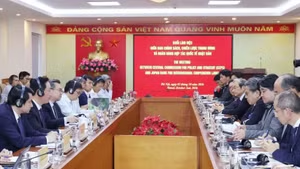
Hua Truong Son, Deputy Director of the Can Tho Municipal Department of Industry and Trade, stressed that expanding markets, diversifying partners, and improving value chains are vital for businesses exporting to China.
As the hub of the Mekong Delta, Can Tho has strong potential in agriculture, processing industry, trade, and logistics to expand cooperation with Chinese partners.
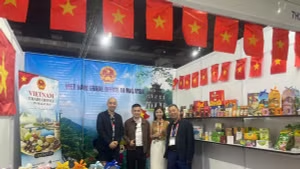
The city aims to directly connect Chinese businesses, distributors, and importers with domestic enterprises, with a focus on key products such as fruit, rice and rice-based products, seafood, and processed food.
Can Tho is also seeking to attract Chinese investment in logistics systems, distribution centres, deep processing, e-commerce, and green technology.
Dang Phuc Nguyen, Secretary General of the Viet Nam Fruit and Vegetable Association (Vinafruit), said China has maintained its position as the largest market for Vietnamese fruit and vegetables for many years, accounting for 65-70% of the sector's total export revenue. However, Chinese consumer preferences and regulations have changed significantly.
China now imposes stringent requirements on agricultural products from the Mekong Delta. Exporters must accurately register production and packing facility codes as well as growing-area codes. Violations involving quarantine pests or harmful organisms could result in imports being suspended altogether. Food safety and chemical residue requirements have also been tightened to levels approaching those of the EU, the US, and Japan.
Major Chinese importers are increasingly favouring partners that use low-carbon transport and environmentally friendly packaging, while also requiring transparent traceability. Supply chains from farms to consumers are expected to be digitised so that products can be easily traced.
Dang Phuc Nguyen said that the only way for agricultural products from Can Tho and the Mekong Delta to increase market share is to urgently establish a 'green production' roadmap, standardise raw material zones, and enhance deep-processing capabilities.
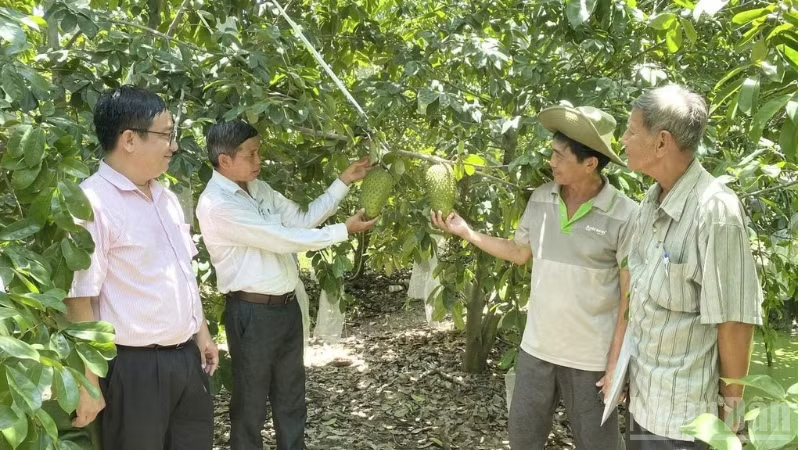
From the perspective of exporters, Nguyen Dinh Muoi, Deputy General Director of Vina T&T, said cultivation and crop care must strictly comply with protocols signed between the competent authorities of the two countries.
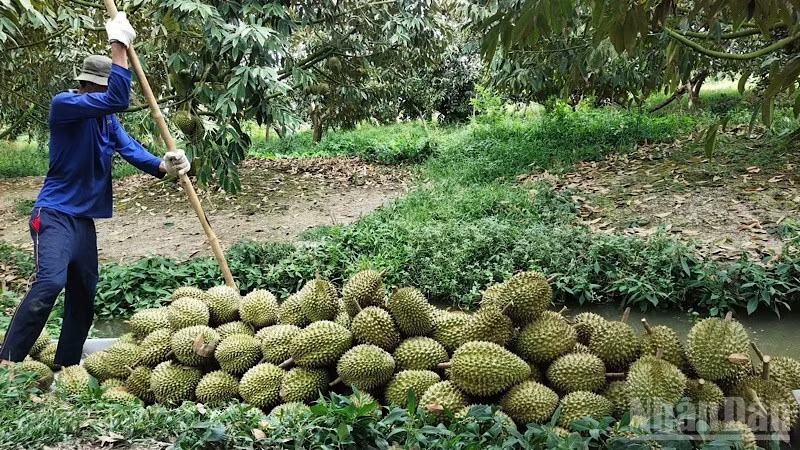
Businesses and local authorities must strictly protect growing-area codes and crack down on fraud and impersonation to safeguard the reputation of Vietnamese fruit brands. Packing facilities should also establish strict internal quarantine systems to ensure that exported products are completely free of insects and microorganisms subject to Chinese quarantine controls.
"Digitising growing areas and standardising packing facilities are not barriers, but powerful passports that enable Vietnamese fruit to strengthen its position and compete on an equal footing in China and other demanding markets such as the US, the EU, Japan, the Republic of Korea, Australia, and the Middle East," Nguyen Dinh Muoi stated.
Local authorities should also halt the uncontrolled expansion of crops outside planned areas, which can lead to oversupply and falling prices; strictly manage the use of growing-area codes to prevent code sharing that could damage the national brand; and accelerate the transition to organic farming, circular agriculture, and low-emission production.
Upgrading Mekong Delta agricultural products for export to China is no longer simply about selling what producers have, it is about supplying what the market demands. Turning agreements into concrete economic contracts, particularly through improving the quality of goods and services, will be an important lever to drive breakthrough, sustainable, and green growth in the region's agricultural trade in the near future.