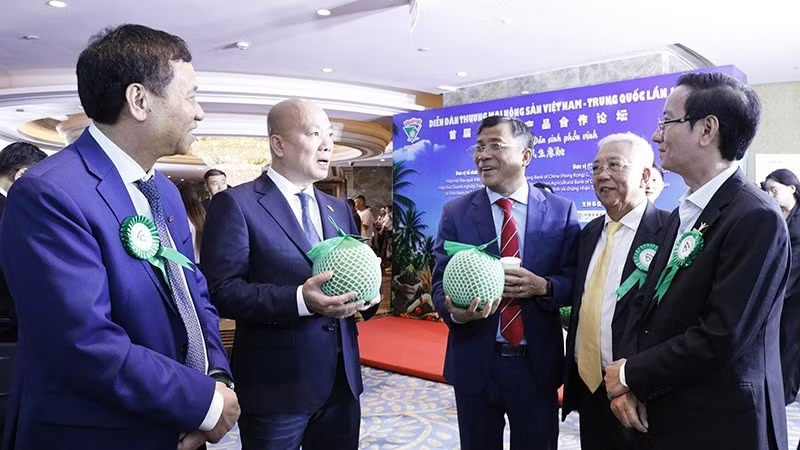
On June 24, the Vietnam Fruit and Vegetables Association, the Ho Chi Minh City Chapter of the China Business Association in Viet Nam, in coordination with the Chinese Consulate General in Ho Chi Minh City, jointly organised the first Viet Nam–China Agricultural Trade Forum.

The forum aimed to provide updates on market trends, policies, and the latest regulations governing imported agricultural products, while discussing measures to promote sustainable official exports to the Chinese market. It also sought to improve the quality and safety of agricultural products entering the market and to strengthen direct business connections between enterprises of the two countries.
In his opening remarks, Nguyen Thanh Binh, Chairman of the Viet Nam Fruit and Vegetables Association, said this is a crucial time for Vietnamese enterprises to make a fundamental shift from export volume to quality and safety; from fragmented production to integrated value chains; and from unofficial border trade to transparent and sustainable official exports. For Chinese partners, he added, the forum offered an opportunity to meet suppliers directly, identify capable and reputable business partners, and gain a better understanding of Viet Nam's business environment and regulatory system.

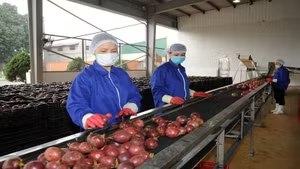
Speaking at the forum, Pham Quoc Liem, Chairman of the Board and General Director of U&I Agriculture Corporation (Unifarm), noted that China has more than 1.4 billion consumers and imports around 1 billion USD worth of bananas annually, making it one of the world's largest banana markets. Meanwhile, Viet Nam's banana industry is aiming to achieve 1 billion USD in export revenue in the coming years.
Viet Nam currently ranks among the world's top 10 banana exporters, with annual export turnover of approximately 418.7 million USD. The country has around 161,000 hectares under banana cultivation and substantial room for further expansion.

According to Dinh Cao Khue, Chairman of the Board and General Director of DOVECO, the greatest opportunity in the coming years lies not in fresh produce but in deep processing. With its enormous population, expanding middle class, and rapidly growing demand for convenient, safe, and naturally sourced food products, China presents tremendous opportunities for processed fruit products.
Pham Quoc Liem emphasised that achieving the 1 billion USD export target will require more than expanding cultivated areas or increasing production. More importantly, Viet Nam must enhance value at every stage — from each banana and each hectare of cultivation to the entire supply chain. This means restructuring the industry's value chain, from seed varieties and production areas to cultivation, harvesting, storage, processing, and marketing, with leading enterprises playing a pivotal role.

From another perspective, Nguyen Dinh Tung, Chairman of the Board and General Director of Vina T&T Group, noted that the current pace of appraisal, approval, and issuance of growing-area codes and packing facility codes has yet to keep pace with business demand. Such delays not only disrupt trade but also increase opportunity costs for both Vietnamese farmers and Chinese importers.
He therefore called on the Chinese side, particularly the General Administration of Customs of China (GACC) and relevant authorities, to accelerate the appraisal and approval process for growing-area and packing facility codes, promptly resolve pending applications, establish a "green lane" for priority customs clearance, and reduce the rate of physical inspections at border gates to ensure agricultural products retain maximum freshness when reaching Chinese consumers.
Luong Duc Vinh, a representative of the China Certification & Inspection Group (CCIC) Southwest Region, said that harmonising inspection standards, strengthening traceability, and applying digital technologies would be key to enhancing agricultural trade between Viet Nam and China.
Building on its successful pilot projects, CCIC plans to expand the application of its AI-enabled traceability model— currently used for Vietnamese durian exports to China— to other agricultural and aquatic products, while connecting traceability data with China's single-window mechanism and smart customs system.
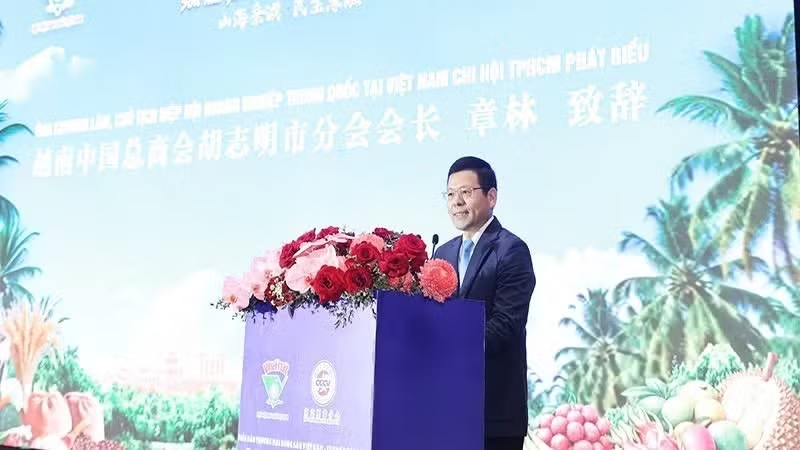
Zhang Lin, Chairman of the Ho Chi Minh City Chapter of the China Business Association in Viet Nam, said the association remains committed to strengthening connectivity across agricultural value chains, supply chains,and financial chains between the two countries.
To improve the effectiveness of fruit and vegetable trade promotion in the Chinese market, Vu Ba Phu, Director General of the Trade Promotion Agency under the Ministry of Industry and Trade, said local authorities should plan and develop export-standard production areas, improve production quality in line with food safety and sustainable development standards, and strengthen quality control at the source to avoid violations of China's import regulations.

He Wei, Chinese Ambassador to Viet Nam, said that to seize the vast opportunities in agricultural trade, both countries should strengthen the application of digital technologies and build robust new infrastructure for smart agriculture. He stressed the need to tighten source control, provide farmers with scientific cultivation guidance, and implement standardised management practices.
He also called for stronger cooperation among capable, technologically advanced, and reputable agricultural enterprises from both countries, enabling them to serve as important bridges between farmers and consumers. He also suggested promoting the development of deep-processing industrial zones to increase the added value of agricultural products.