This also served as a catalyst for the Northwest coffee-growing region to shift its focus—moving away from expanding cultivation areas toward production methods that align with local natural conditions, enhance quality, and ensure sustainable development.
Transitioning from extensive farming to sustainable production
Speaking at the recently held webinar on promoting coffee production in Viet Nam in compliance with the EUDR: transitioning from traditional farming to sustainable production in the Northwest, Nguyen Manh Son from the Institute of Policy and Strategy for Agriculture and Rural Development (IPSARD) noted that the Northwest region possesses characteristics that differ significantly from the Central Highlands—the country’s largest coffee-producing region.
Currently, the Central Highlands accounts for over 90% of Viet Nam’s total coffee-growing area. Many cultivation zones there have reached a level of relative stability, gradually adopting intensive farming techniques, scientific and technological applications, intercropping with shade trees, and adhering to sustainable production standards.
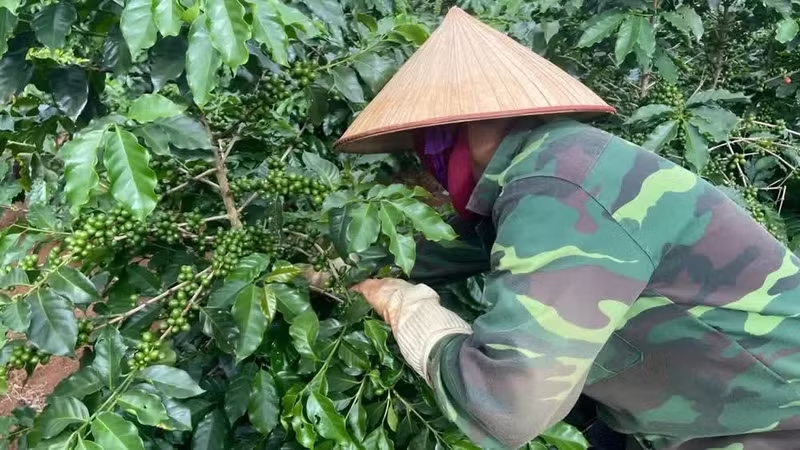
In contrast, most of the coffee-growing area in the Northwest has been established only recently—particularly since 2023, following a sharp rise in export coffee prices. Much of this land is still managed through traditional, extensive farming methods that rely heavily on rainfall.
Given the steep terrain, these farming practices not only limit yields but also pose risks of soil erosion and land degradation. Consequently, alongside any expansion of cultivation areas, the Northwest coffee region must gradually transform its production methods to better suit local natural conditions, conserve resources, and improve product quality.
In Son La, various transformation models are emerging, including intercropping fruit trees, planting shade trees, utilising modern irrigation systems, and adopting sustainable farming practices.
Notable examples include the model implemented by the Bich Thao Coffee Cooperative and the sprinkler irrigation systems adopted by several coffee-growing households in Muong Chanh Commune, with support from the organisation CARE.
According to Dr. Nguyen The Manh, an expert at CARE, the project on “Green and Sustainable Adaptation for Ethnic Minority Communities in Son La Province”—a collaboration between Mekong Elevate and CARE—is supporting several “smart” agricultural models aimed at the sustainable development of the coffee sector.
Irrigation systems offer a highly effective solution as coffee plants face the increasingly evident impacts of climate change. For Arabica coffee in Son La, water-efficient irrigation can help regulate flowering times, reduce labor requirements, and improve yields.
When combined with ground cover (such as grass) and organic fertilizers, these systems also help maintain soil moisture, enhance biodiversity, and improve soil health. However, high investment costs and limited water availability remain significant bottlenecks—particularly in areas with water scarcity or at high altitudes, where installing and operating irrigation infrastructure presents substantial challenges.
The effectiveness of these shifts in farming practices is demonstrated by the experience of Ha Van Thao’s household in Muong Chanh Commune. In 2024, with support from the CARE project, the family installed a system featuring both drip irrigation at the base of the plants and overhead sprinkler irrigation.
After one year, by comparing the irrigated areas with those that remained unirrigated, the family observed a clear difference in yield—prompting them to expand the irrigation system across their entire production area. From the perspective of a cooperative, Nguyen Xuan Thao, Director of the Bich Thao Coffee Cooperative, argues that farming practices used in the Central Highlands cannot be mechanically applied to Son La.
Arabica coffee in Son La differs from the Robusta coffee grown in the Central Highlands in terms of variety, geographical conditions, climate, soil composition, flowering periods, and pollination processes. Consequently, irrigation techniques and cultivation protocols must be tailored to the specific characteristics of each region.
Since 2017, the Bich Thao Coffee Cooperative has introduced new coffee varieties for replanting, focusing on climate change resilience and disease resistance. The cooperative also provides training to local farmers on the use of microbial agents, irrigation, pruning, canopy management, and the planting of shade trees.
According to Thao, yields in some of the cooperative’s cultivation areas are maintained at approximately 25–30 tons of fresh cherries per hectare; certain new varieties, such as A16 and TN7, can reach 40–45 tons of fresh cherries per hectare under intensive cultivation.
However, yield is not the sole objective. Quality must go hand-in-hand with yield to generate greater value for the product—a particularly important consideration as the coffee-growing area in Son La continues to expand.
Accurately identifying production zones to meet EUDR requirements
According to the Bich Thao Coffee Cooperative, the total annual export volume of green coffee beans from Son La is approximately 50,000 tonnes; however, high-quality and specialty coffee account for a very small fraction—less than 1%.
"These figures indicate that the challenge for the coffee industry in the Northwest is not merely about increasing cultivation area or yield, but rather about enhancing quality and accurately identifying the appropriate production zones," said Thao.
With about 40,000 hectares of coffee in Son La—most of which is managed through extensive farming practices by individual households—scaling up sustainable production models presents significant challenges.
Dr. Nguyen The Manh noted that, based on his research into coffee in Son La, there is currently no comprehensive study of the province’s coffee-growing regions. Such a study would need to incorporate data on temperature, ecological conditions, soil properties, pedology, agrochemistry, and regional characteristics to pinpoint areas truly suitable for Arabica coffee cultivation.
Not all parts of Son La share the same conditions or are equally well-suited for producing high-quality Arabica coffee. Therefore, rather than focusing solely on expanding the cultivation area, it is essential to clearly identify the specific zones that possess the right conditions for coffee production.
In the long term, organisations, businesses, and relevant stakeholders need to develop a comprehensive, standardised dataset for Son La, encompassing meteorological data, soil information, and other pertinent factors. This will serve as a scientific and practical foundation for evaluating and identifying areas suitable for coffee cultivation.
Given the context of the EUDR (European Union Deforestation Regulation) and the increasingly stringent requirements of the international market, the coffee sector in the Northwest must not only verify the origin of its products but also address how they are produced—ensuring that production aligns with natural conditions and generates tangible value.
This also provided a basis for the Northwest coffee industry to shift its focus from expanding cultivation areas toward enhancing quality, efficiency, and sustainability, thereby better meeting the demands of the international market.