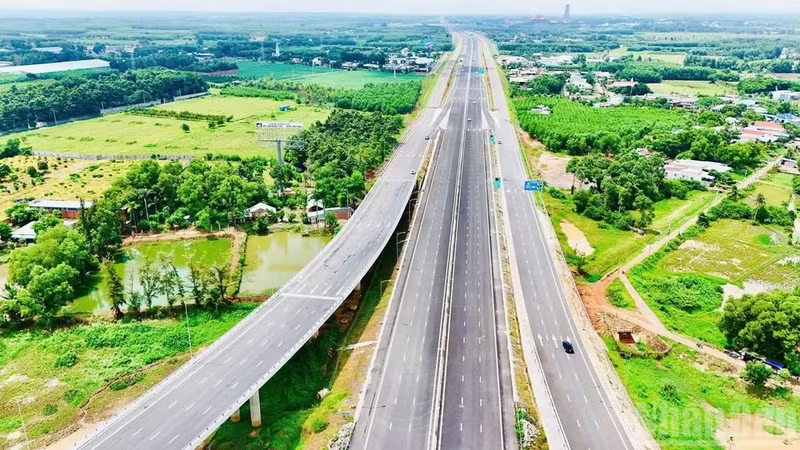
Ahead of the planned opening of the first phase of Long Thanh International Airport, Airports Corporation of Viet Nam (ACV) is working with ministries, sectors, and local authorities to develop plans for organising traffic within the airport, while also promoting the development of public passenger transport networks linking the airport with other regions.
Scientific and coordinated traffic organisation has been identified as one of the key requirements for ensuring safety, maintaining smooth traffic flow, and improving the quality of passenger services.
Scientific traffic management and greater use of technology
Under the plan currently being implemented by ACV, passenger pick-up and drop-off areas at Long Thanh International Airport will be organised according to different types of vehicles, ensuring efficient use of available road space while minimising conflicts between traffic flows.
Public buses and vehicles serving aviation operations will be given priority in areas adjacent to the terminal for passenger pick-up and drop-off. This arrangement is intended to make it easier for passengers to continue their journeys after completing airport procedures. Meanwhile, dedicated parking areas will be provided in open-air spaces and specialised parking facilities for contract vehicles, tourist coaches, and vehicles transporting groups of passengers. Pick-up and drop-off activities will be organised according to designated time slots and locations, helping to prevent arbitrary stopping and parking and reduce the risk of localised congestion.
For taxis and ride-hailing vehicles, a centralised dispatch system is being considered. Vehicles would wait in designated holding areas before being directed into dedicated passenger pick-up lanes in front of the terminal according to actual demand. This arrangement is intended to improve the efficiency of passenger pick-up areas while maintaining traffic order and safety around the terminal.
The road system providing access to the terminal is planned to operate on a one-way traffic basis, with vehicle flows separated according to their respective functions. Vehicles dropping off departing passengers will approach the departure level via an elevated roadway, while vehicles collecting arriving passengers will be directed to the ground floor and areas connected to the parking facilities. Separating traffic flows by level is expected to reduce crossing movements, minimise conflicts, and increase traffic capacity.
Alongside infrastructure planning, ACV plans to install a closed-circuit television (CCTV) surveillance system along internal airport roads, combined with an electronic toll collection (ETC) system at entry and exit control points. The application of technology to traffic monitoring and management will help authorities track traffic conditions, reduce the time vehicles spend passing through control points, and respond promptly to any incidents that arise.
Expanding bus network and strengthening inter-regional connectivity
In addition to organising traffic within the airport, developing public passenger transport services with direct connections to Long Thanh is important for meeting travel demand, easing pressure on road traffic and improving access to the airport from different localities.
According to the information provided, the Dong Nai City People’s Committee has added 16 bus routes connecting to Long Thanh International Airport to its list of planned services, comprising five intra-provincial routes and 11 inter-provincial routes.

The intra-provincial routes are intended to connect the airport with various areas, transport hubs, and tourist destinations, including Binh Phuoc, the Chua Chan Mountain tourist area, Tan Phu, Bien Hoa Bus Station, and the Cat Lai ferry terminal. The route linking the airport with Bien Hoa Bus Station will be approximately 43km long, providing an additional access route from the central area. Meanwhile, the route connecting to the Cat Lai ferry terminal will cover around 30.8km, expanding connectivity from the south-west.
For inter-provincial services, the planned network will connect the airport with several transport hubs in Ho Chi Minh City and neighbouring localities. These include Sai Gon Bus Station, Binh Duong Bus Station, Vung Tau Bus Station, Mien Dong New Bus Station, Bau Bang Bus Station, District 8 Bus Station, Mien Tay Bus Station, and Tan Son Nhat International Airport. Some routes will also serve the tourist areas of Phuoc Hai–Long Hai and Phuoc Buu–Ho Tram.
In Ho Chi Minh City, the relevant authorities have worked together to study a plan for organising 13 high-quality bus routes providing direct connections to Long Thanh Airport. Under the proposed approach, the buses would operate with a limited number of roadside pick-up and drop-off stops to shorten journey times. Implementation would be phased in accordance with travel demand and actual operating conditions.
Expanding the bus network and strengthening connections between the airport, bus stations, urban centres, and tourist destinations are expected to give passengers more travel options while supporting a traffic management approach that reduces reliance on private vehicles.
In the longer term, ACV has proposed the early implementation of mass transit projects connecting to the airport, including the Thu Thiem–Long Thanh railway line. This is considered one of the key options for strengthening links between air, road, and rail transport and gradually establishing a multimodal transport network serving the airport and surrounding economic areas.
Long Thanh International Airport is a nationally significant project being built in Dong Nai City, with the aim of becoming a major aviation hub for the region. According to the information in the documents, the first phase of the project is expected to enter operation in late 2026, with a designed capacity of 25 million passengers and 1.2 million tonnes of cargo a year.
During the initial stage of operations, the airport is expected to handle approximately 366 flights per week, including 322 domestic flights and 44 international flights. This planned scale of operations makes it essential to prepare coordinated traffic management arrangements covering every stage of the journey, from the terminal area and airport access roads to the network of connections with Ho Chi Minh City and neighbouring localities.
To proactively address the possibility of rising vehicle volumes, ACV has proposed strengthening inter-agency coordination between traffic police and the relevant authorities of Ho Chi Minh City and Dong Nai City. The cooperation would focus on advance traffic diversion, traffic regulation, and incident response along roads leading to the airport.
Alongside finalising traffic management plans within the airport, developing public passenger transport services, and accelerating inter-regional connectivity projects, close coordination among the relevant agencies and organisations will be essential to ensure consistent implementation. These efforts will provide an important foundation for improving airport accessibility, reducing the risk of congestion, ensuring traffic safety, and meeting the operational requirements of Long Thanh International Airport in the period ahead.