From an economic “pillar” to a driver of double-digit growth
The year 2026 is entering its second half, with considerable pressure to accelerate to achieve the target of double-digit economic growth.
#agricultural sector
The year 2026 is entering its second half, with considerable pressure to accelerate to achieve the target of double-digit economic growth.
Credit flows are contributing to promoting the shift of agriculture towards modern production models, but behind these loans, there are still many “bottlenecks” that have not been resolved.
The government has issued Resolution No. 85/NQ-CP on the government’s action programme to implement Conclusion No. 219-KL/TW (dated November 26, 2025) of the Politburo on continuing the implementation of Resolution No. 19-NQ/TW (dated June 16, 2022) of the Party Central Committee (13th tenure) on agriculture, farmers, and rural areas towards 2030, with a vision to 2045.
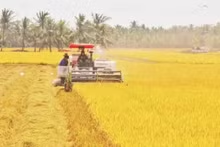
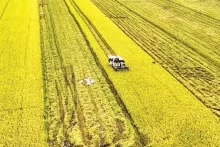
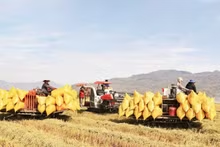
Following positive signals in the Mekong Delta, the agricultural sector is continuing to experiment with emission-reducing rice farming models in northern provinces and cities. Alongside expanding the cultivated area, authorities are urgently working to complete an internationally standardised monitoring and measurement system, gradually entering the carbon market.
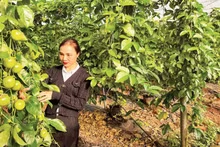
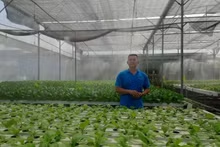
With advantages in its mild climate, fertile soil, diverse ecosystem, and early access to advanced science and technology, Lam Dong has long been regarded as the country’s “capital” of high-tech agriculture. On that foundation, the province continues to identify high-tech and smart agriculture as a breakthrough, gradually shaping a modern and efficient agricultural sector with strong competitiveness in international markets.
Facing the risk of slower growth as the price cycle turns, the agricultural sector needs to rethink how it participates in the market in a more proactive manner.
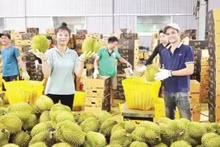
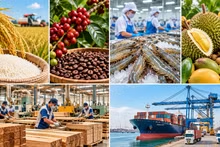
In 2025, the agricultural sector faced numerous disruptions, ranging from extreme weather events and consecutive floods to uncertainty in global markets and rising logistics costs. Amid these multiple headwinds, agriculture has continued to demonstrate strong internal resilience, with stable production, several commodities setting new export records, and the sector as a whole reaffirming its durability and adaptive capacity.
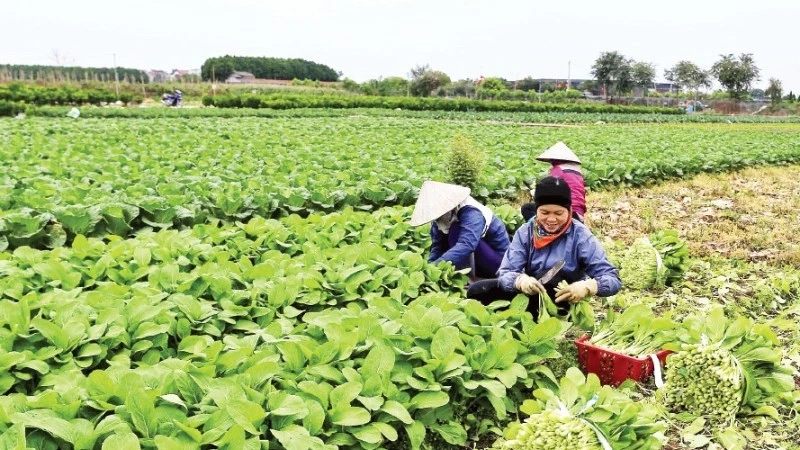
Producing vegetables and roots under GAP (Good Agricultural Practices) brings many practical benefits, most notably the creation of high-quality agricultural produce, the protection of human health and the environment, and higher incomes for farmers. At the same time, it contributes to building a green, low-emission and sustainable agriculture.
To promote start-ups, innovation, and intellectual property development, over the past time, the Department of Science and Technology of Dong Thap Province has actively supported individuals and organisations in completing projects and initiatives. As a result, they have successfully developed products that bring effectiveness in production and business activities.
Unlike traditional agricultural practices, Ho Chi Minh City farmers have applied scientific and technological advances to production, with a particular focus on advancing digital transformation in agriculture, gradually building high-tech agriculture and modern urban agriculture.