Expanding low-emission rice fields
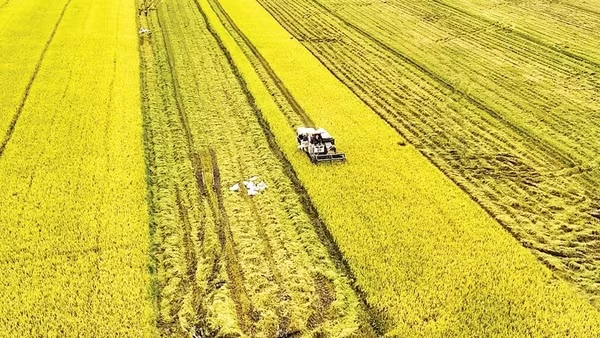
Huu Chung Cooperative (Hai Phong) has been selected as the location to implement a high-efficiency, low-emission rice cultivation model. With a scale of 2 hectares, the model uses the VNR20 variety with a sowing rate of only about 45 kg/ha. The production process applies a series of advanced technical solutions such as mechanised row sowing combined with machine-assisted fertilizer application, alternating wet-dry water management (AWD), fertilisation according to the “four correct principles,” and integrated pest management (IPM).
According to Tran Thanh Huong, Director of Huu Chung Cooperative, machine-assisted row sowing helps control density from the beginning of the season, creating conditions for uniform rice plant growth. In addition, fertilizer is directly incorporated into the soil at the same time as sowing, increasing nutrient absorption efficiency, reducing losses, and limiting greenhouse gas emissions. As a result, the amount of seeds and fertilizer applied has been significantly reduced, irrigation water and labor costs have been saved, contributing to a shift in rice production towards mechanisation, cost savings, and more efficient resource utilisation.
According to Luong Thi Kiem, Deputy Director of the Hai Phong Department of Agriculture and Environment, the model at Huu Chung Cooperative is an important test to assess the adaptability of emission reduction solutions in the locality. This serves as a basis for the city to promote sustainable farming associated with mechanisation on a large scale.
With three implementation sites in Hung Yen, Ninh Binh, and Hai Phong, high-efficiency, low-emission rice farming models have been tested in various ecological zones. Huynh Tan Dat, Director of Crop Production and Plant Protection under the Ministry of Agriculture and Environment, stated that this is an important practical basis for the agricultural sector to continue refining low-emission rice farming processes, ensuring suitability to the production conditions of each locality.
Through practical implementation, the technical solutions will be objectively verified and evaluated, forming the foundation for future scaling up. Simultaneously, it will contribute to perfecting technical processes and standardising data for measuring emissions in the agricultural sector.
Previously, the effectiveness of this approach was confirmed through the “1 million hectares of high-quality rice” project in the Mekong Delta. After two years of implementation (2024-2025), approximately 355,000 hectares of rice participated in the model, exceeding the plan by 197%.
The application of advanced farming methods helped reduce seed usage by 30-50%, nitrogen fertilizer by 30%, and irrigation water by 20%; farmers’ income increased by at least 13.4%. Notably, compared to traditional farming, greenhouse gas emissions decreased by 25-44% (2-7.8 tonnes of CO2 equivalent/ha). This provides a solid foundation for building a carbon credit payment mechanism.
Improving the MRV System
According to the Ministry of Agriculture and Environment’s plan for reducing greenhouse gas emissions in the 2025-2035 period, greenhouse gas emissions will be reduced by at least 15% by 2035 compared to 2020. To implement this effectively, emission-reduction farming models need to closely integrate three core elements: accurately applying emission reduction technical packages; organising production in a sustainable supply chain (farmers-cooperatives-enterprises); and integrating a monitoring, measurement, reporting, and verification (MRV) system.
Therefore, in parallel with operating the models, one of the key and urgent tasks of the plan is to establish a specialised and reliable MRV system for key crops such as rice, corn, cassava, sugarcane, coffee, etc.
According to Mai Van Trinh, Director of the Institute of Agricultural Environment, greenhouse gases produced from rice paddies (such as CO2, CH4, and N2O) are invisible and cannot be estimated visually or measured directly. Therefore, to accurately determine the emissions of a rice pad and how much can be reduced, it is necessary to apply precise scientific measurement methods.
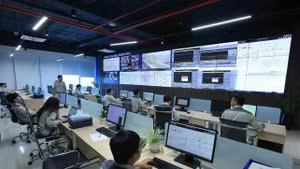
Over the past period, the Institute has collaborated with international experts to develop the MRV method and toolkit. This system is designed to closely reflect Vietnamese farming practices while strictly adhering to reputable international standards.
Since 2023, the Institute has applied the MRV toolkit to low-emission rice farming models in the Mekong Delta provinces. By 2025, 11 models will have implemented the MRV system. In 2026, this process will be implemented in the field on approximately 15,000 hectares of rice in the Mekong Delta. From this foundation, a national database on greenhouse gas emissions in crop production will be built, detailed by ecological zone, crop type, and cultivation process.
The MRV system is a crucial basis for implementing emission reduction payment mechanisms and carbon markets in agriculture. Despite its foundational role, the implementation of MRV still faces some difficulties.
According to the Department of Crop Production and Plant Protection, while the MRV process has been issued by the Ministry of Agriculture and Environment, there are currently no detailed guidelines on implementation and accompanying financial mechanisms.
The Department recommends that the agricultural sector urgently complete the MRV system, especially in rice production, in a way that is simple and easy to apply in practice. Simultaneously, more specific and detailed guidelines should be issued to create a basis for implementation and expansion of emission reduction payment mechanisms.
According to the Ministry of Agriculture and Environment, in the coming period, the ministry will closely coordinate with relevant units and localities to urgently complete the infrastructure of rice production areas and research the mechanism for paying carbon credits for rice production.
Along with that, it will encourage businesses and cooperatives to participate in production-consumption linkages, promote certification of production areas, and build a brand for high-quality, low-emission Vietnamese rice.
At the same time, it will mobilise resources from international programs and projects and carbon finance to expand the scale of implementation. It will continue to review and refine the planning of high-quality, low-emission rice production areas in the Mekong Delta provinces.
Priority will be given to areas with synchronised irrigation infrastructure, concentrated production, and the participation of cooperatives and businesses in consumption linkages...