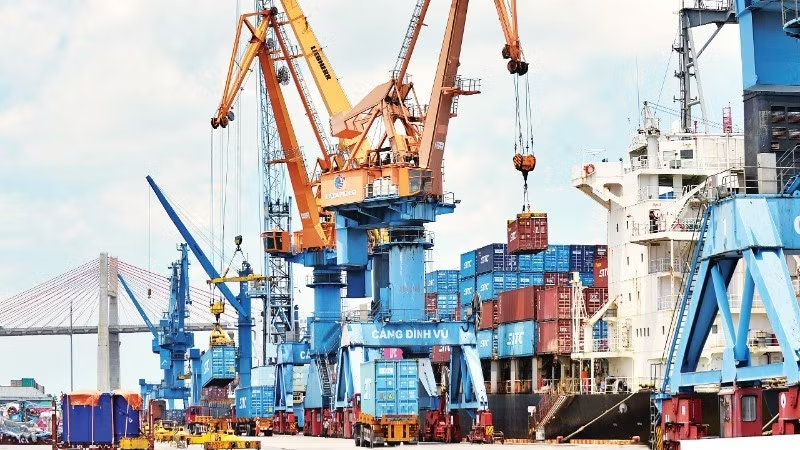
This reality calls for a comprehensive restructuring of the agricultural value chain, from production organisation to goods distribution, in order to control logistics costs and enhance risk resilience.
In Official Dispatch No. 23/CD-TTg on solutions to promote exports in 2026, issued on March 16, the Prime Minister underscored the need to build and upgrade transport infrastructure, warehouses, deep-water seaports, and logistics centres to meet import-export demands, while improving the capacity and market share of Vietnamese shipping enterprises in international cargo transport.
Widespread impacts
Nguyen Van Thich, Chairman of the Board of Directors of the Xa No Mekong Rice Cooperative Union in Can Tho City, said that rapidly rising logistics costs ahead of the winter-spring harvest have placed pressure across the entire production chain. Transport costs for paddy from fields to processing plants have increased by 30–50% and are expected to remain volatile, particularly in areas far from processing facilities. Notably, this pressure coincides with a 30–40% rise in fertiliser prices and harvesting machinery rental costs, significantly driving up input costs. As a result, production efficiency has declined, with average profit per hectare potentially falling by 15–20%, affecting farmers’ willingness to reinvest.
Beyond rice, the seafood sector has faced similar impacts. According to exporters, the most immediate effect of ongoing military tensions in the Middle East has not been a drop in demand but rather rising logistics costs, increased transport risks, and fuel price volatility. Several shipping lines have announced surcharges of between 2,000 USD and 4,000 USD per refrigerated container, excluding additional risk and fuel surcharges. Domestic logistics costs have also been affected by a sharp increase in diesel prices, with local transport operators raising fees by around 500,000 VND per 40-foot container.
Seafood exports to key markets such as the US, Japan, and Western Europe have not yet been significantly affected beyond higher freight costs. However, exporters to the Middle East and Southern Europe are facing serious challenges, with some companies forced to suspend shipments due to a lack of available routes and elevated risks.
Nguyen Hoai Nam,
Secretary General of the Viet Nam Association of Seafood Exporters and Producers (VASEP)
Nguyen Hoai Nam, Secretary General of the Viet Nam Association of Seafood Exporters and Producers (VASEP), noted that seafood exports to key markets such as the US, Japan, and Western Europe have not yet been significantly affected beyond higher freight costs. However, exporters to the Middle East and Southern Europe are facing serious challenges, with some companies forced to suspend shipments due to a lack of available routes and elevated risks.
Strengthening production linkages and proactive logistics planning
According to Dong Van Canh, Director of the New Green Farm Cooperative, the application of low-emission farming processes on a concentrated scale in the Mekong Delta’s upcoming winter-spring harvest has improved both yield and rice quality, thereby creating room to offset part of the rising logistics costs. More importantly, operating under a large-scale, integrated production model has helped optimise collection, make better use of storage systems and transport contracts, and reduce costs per unit of output.
In contrast, fragmented production with small volumes drives up logistics costs, undermining overall efficiency. This highlights that developing large-scale commodity production linked with value chain integration not only enhances the value of agricultural products but also reduces domestic logistics cost pressures, while strengthening the sector’s resilience to market fluctuations.
However, in international transport, businesses continue to face significant impacts from geopolitical tensions. Recent conflicts involving the US and Israel with Iran have increased risks along key maritime routes such as the Strait of Hormuz and the Suez Canal. Beyond rising costs and potential disruptions, these developments are also reshaping how importing markets select their suppliers.
Do Ngoc Hung, Trade Counsellor and Head of the Viet Nam Trade Office in the US, said that in an uncertain environment, US importers tend to be more cautious when placing orders, prioritising suppliers capable of ensuring stable delivery, transparency, and flexibility in commercial terms. Therefore, Vietnamese enterprises seeking to retain orders and expand market share must demonstrate not only competitive pricing but also reliability in delivery, contract performance and the ability to manage international logistics risks.
In an uncertain environment, US importers tend to be more cautious when placing orders, prioritising suppliers capable of ensuring stable delivery, transparency, and flexibility in commercial terms. Therefore, Vietnamese enterprises seeking to retain orders and expand market share must demonstrate not only competitive pricing but also reliability in delivery, contract performance, and the ability to manage international logistics risks.
Do Ngoc Hung,
Trade Counsellor and Head of the Viet Nam Trade Office in the US
The Viet Nam Association of Seafood Exporters and Producers has recommended that the Ministry of Industry and Trade and relevant authorities consider support policies for businesses amid surging logistics and fuel costs, while enhancing coordination with international shipping lines to maintain stable transport routes for exports. In the long term, Ngo Khac Le, Deputy Secretary General of the Viet Nam Logistics Business Association, advised companies to review transport contracts and bills of lading, particularly clauses related to war risks or deviation clauses that allow vessels to alter routes. When entering into sales contracts, businesses should consider adding provisions to address scenarios in which vessels change routes or discharge cargo outside the original plan.
At the same time, strengthening insurance coverage for the logistics chain is essential, including expanding protection against risks arising from geopolitical instability. Another key solution is to diversify transport routes and transshipment ports to avoid over-reliance on a single route or carrier.
In addition, developing contingency logistics plans is crucial. Businesses should identify alternative transshipment ports in advance, diversify transport modes — whether unimodal or multimodal — and establish partnerships with bonded warehouses or logistics providers in key transit regions to enhance adaptability under all circumstances.