This has created an urgent need to strengthen SPS implementation capacity to ensure that agricultural products remain competitive and are able to expand into new markets.
Ngo Xuan Nam, Deputy Director of the Viet Nam Sanitary and Phytosanitary Notification Authority and Enquiry Point, said that in just one month at the end of 2025, there were 130 SPS-related notifications, including 64 drafts and 66 enforceable regulations. Their impacts spanned most of Viet Nam’s key export markets, including China, the European Union (EU), the United States, Japan, Canada, Australia, New Zealand, the Republic of Korea, and the United Kingdom.
Specifically, China proposed the establishment of 807 maximum residue limits (MRLs) for 219 pesticide active substances in food. Taiwan (China) issued standards on MRLs for 16 pesticide active substances in food and 10 active substances in products of animal origin.
The EU has continued to supplement and update its regulations in an increasingly comprehensive manner, ranging from clarifying declaration requirements in phytosanitary certificates and expanding the list of quarantine pests to introducing measures to prevent the spread of fall armyworm (Spodoptera frugiperda) and setting new MRLs for numerous chemical substances. This reflects the EU’s growing focus on long-term biological risks.
In the US, residue regulations for many active substances continue to be updated. For example, an MRL of 1 ppm has been established for azoxystrobin in black pepper, a seemingly minor technical detail that can nevertheless determine whether an entire shipment is cleared.
Meanwhile, markets such as Canada, Australia, New Zealand, and the United Kingdom are strengthening measures related to animal diseases, biosecurity, border controls, and new import standards for specific product groups.
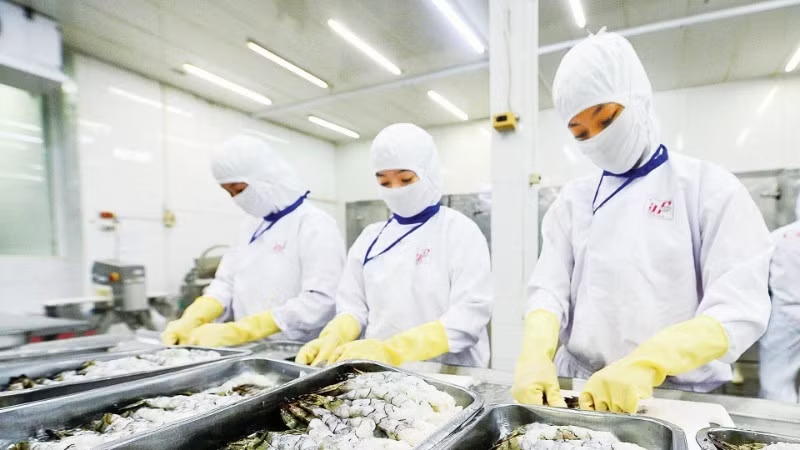
Overall, SPS regulations are trending towards tighter standards, broader control lists, and greater technical detail. According to the Viet Nam Association of Seafood Exporters and Producers (VASEP), the EU is one of Viet Nam’s largest seafood export markets and is currently rolling out a range of stringent rules on controlling the use of antibiotics in animals and imported products of animal origin.
Tran Hoang Yen, an expert at VASEP, noted that under Regulation (EU) 2023/905 on prohibiting the use of certain antimicrobial products in animals or products of animal origin exported from third countries to the EU, starting September 3, 2026, hygiene certificates must be accompanied by confirmation from Viet Nam’s competent authority that prohibited antibiotics have not been used throughout the entire farming, harvesting, and processing chain. Consequently, seafood exporters must promptly update their practices, strictly control antibiotic use across the supply chain, and retain monitoring records for at least two years.
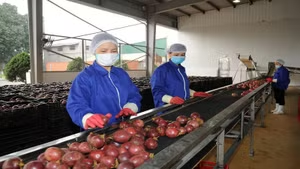
In addition, markets undergoing significant SPS changes are also major destinations for Viet Nam’s fruit and vegetable exports, notably China. In 2025, Viet Nam’s fruit and vegetable exports to China exceeded 5.5 billion USD, accounting for nearly two thirds of the national total. To sustain and further expand in this market, enterprises need to increase official exports under clear contracts and fully comply with the new standards.
As SPS requirements serve both as mandatory technical conditions and as sources of competitive advantage in many export markets, enhancing implementation capacity is no longer just a stopgap measure but a core task of quality management and market discipline.
Key solutions include long-term investment in raw material zones, improvements in domestic testing and analytical capacity, and the establishment of market-specific SPS early-warning mechanisms to proactively mitigate risks and stabilise exports.