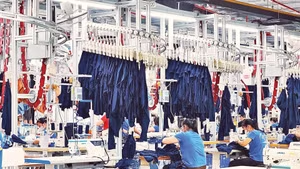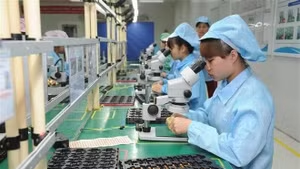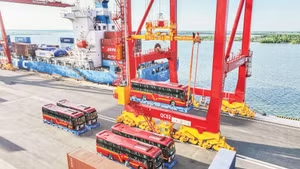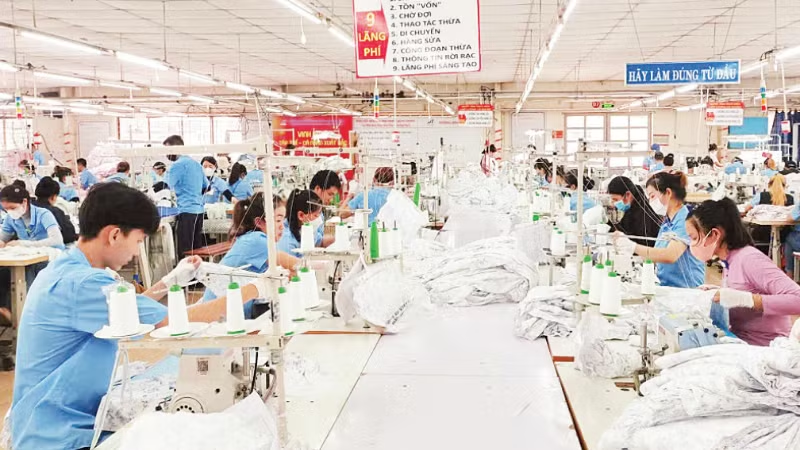
Authorities have proactively implemented a series of response measures, helping textile and garment enterprises maintain stable production and business activities, thereby sustaining growth momentum and promoting exports.
At present, enterprises have secured orders through the end of July and are negotiating and signing contracts for the remaining months of the year. In addition to diversifying markets and customers, businesses continue to invest in modern equipment and develop new products to enhance competitiveness.
Proactive in all situations
Chief of Office of the Board of Directors of the Viet Nam National Textile and Garment Group (Vinatex), Hoang Manh Cam, said that as soon as conflict broke out in the Middle East, enterprises within the system quickly developed response measures such as proactively securing sources of raw materials, diversifying supply and customers, and avoiding dependence on a single market or client.
In reality, export orders to partners have not been significantly affected, but risks may arise when shipping routes pass through this region to Europe and partly to the east coast of the US. To ensure safety, shipping lines have increased insurance levels, leading to higher costs.
From the textile industry’s perspective, especially in logistics, importing raw materials such as cotton from the US now takes longer due to detours, affecting production plans. Similarly, shipments to Europe and the US east coast also take more time. For instance, orders previously finalised with customers took about two months including transport, whereas now transport alone takes around one and a half months, immediately causing disruptions.
“While total production time remains unchanged, longer shipping times require enterprises to adjust production schedules accordingly. Although the Middle East market does not account for a large share and does not significantly affect the industry, prolonged conflict poses potential risks and instability, so businesses must proactively prepare response plans,” Cam emphasised.
Enterprises are also continuously investing in modern equipment, improving workforce skills, and developing new products to boost production and exports.
General Director of the Southern Textile and Garment Group — Vinatex, Nguyen Hung Quy, said that immediately after the Lunar New Year, the entire workforce returned to work at its three factories, all of which have now achieved high productivity. The company has secured orders through the end of July and is negotiating contracts for the remaining months of the year. With strong determination, it continues to accelerate its strategy, focusing on achieving high efficiency in production and business from the first quarter of 2026.
Similarly, Chairman of the Board of Directors of Nha Be Garment Corporation, Pham Phu Cuong, stated that in 2026 the company targets a profit of 570 billion VND (21.7 million USD). It has secured orders through the second quarter and is negotiating contracts for the third and fourth quarters of 2026. To achieve its targets, the company will restructure its product mix, focusing on high value-added and technically demanding orders, while investing in AI and robotics, aiming to reduce its workforce by 30% while maintaining production capacity and overall productivity across the system.
Leveraging strengths effectively
General Director of Garment 10 Corporation, Than Duc Viet, affirmed that global supply chains still contain many risks. Export orders tend to be smaller in volume, with shorter delivery times, and lower prices, requiring enterprises to accelerate responsiveness and streamline operations to maintain profitability.
Garment 10 targets revenue of 5.39 trillion VND (205.1 million USD) and profit of 222 billion VND (8.4 million USD) in 2026. Accordingly, the company will focus on diversifying customers and markets, researching and developing specialised new products and materials, handling complex orders, and investing in modern, highly automated equipment. It also aims to promote green, clean, and environmentally friendly production with social responsibility, enhance participation in high value-added stages, and gradually move up the global production chain.
According to Hoang Manh Cam, 2026 is a year in which textile and garment enterprises need to prioritise resilience amid uncertainty, including financial flexibility, risk management related to exchange rates and raw materials, supply chain restructuring, and upgrading value addition. As high tariffs become the “new normal”, advantages will belong to enterprises that can effectively control costs, ensure compliance with rules of origin, and deliver quickly. “Regarding the global geopolitical situation, the wave of instability at the beginning of this year, particularly the conflict in the Middle East, has driven oil prices up sharply in the short term. However, in the medium and long term, oversupply and US efforts to control prices may limit the upward trend,” Cam stated.
Chairman of the Board of Directors of Vinatex, Le Tien Truong, added that in the context of market volatility related to tariffs, geopolitics, and logistics costs, the entire system must be proactive, flexible, and develop specific action programmes with forecast scenarios. For the European Union (EU) market, enterprises must prepare suitable delivery plans under conditions where transport routes may change, logistics costs increase, and shipping times are extended.
At the same time, they need to recalculate material demand, pricing structures, and production schedules, and proactively accelerate production to offset transport time, minimising risks of delayed delivery and additional costs.
For the US market, businesses must anticipate continued pressure from customers to adjust prices, particularly as China maintains the yuan at a low level, increasing price competition.
Therefore, enterprises should accelerate orders to the US, taking advantage of the 10% additional tariff effective for 150 days to optimise delivery plans and minimise risks should policies change unfavourably.
“In conditions where high tariffs become the new normal and geopolitical instability persists, the ability to maintain balance in production, finance, and markets will determine enterprise resilience. Therefore, companies must maximise their strengths in production organisation, order management, and market intelligence to maintain market share, stabilise employment, and achieve growth targets for 2026,” Truong emphasised.