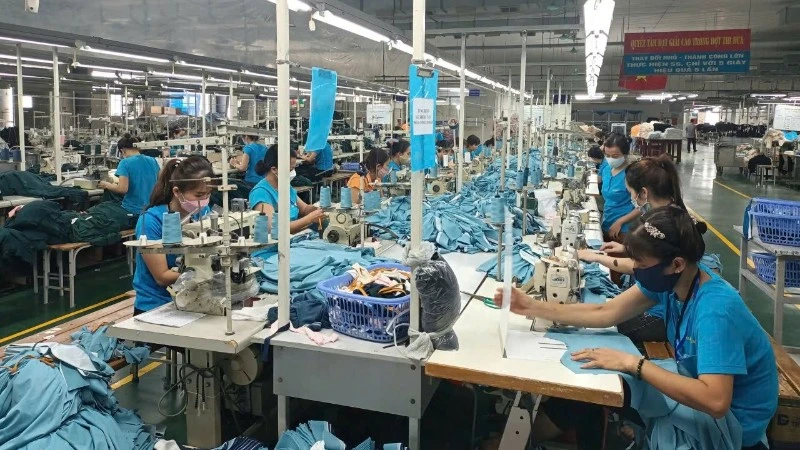
2025 marks an impressive recovery for Viet Nam’s textile and garment industry, with export turnover exceeding 46 billion USD, up around 6% compared to the same period in 2024 — an important milestone helping pave the way for the sector's future goals.
Maintaining growth momentum
According to Chairman of the Viet Nam Textile and Apparel Association (VITAS), the sector has faced numerous challenges, including market fluctuations, geopolitical uncertainties, and particularly US tariff policies that dampened consumption demand and caused high inventory levels - exerting major pressure on production and business activities. Thanks to the agility and flexibility of enterprises, the industry has maintained growth and preserved its position as one of the world’s top three textile and garment exporters.
In 2025, the industry’s recovery is marked by outstanding indicators: export turnover surpassed 46 billion USD, up 6% year-on-year; trade surplus reached 21 billion USD; and domestic value-added ratio climbed to about 52%. These reflect significant progress in securing raw material supply and reinforcing its role as a pillar of the national trade balance.
“With market, product, and customer diversification strategies, especially as Vietnamese textile and garment products are now present in 138 countries and territories worldwide, and 28 enterprises are investing abroad to capitalise on tariff incentives and reduce political risks, shipping, and labour costs — the industry is well positioned for continued growth,” Giang emphasised.
With market, product, and customer diversification strategies, especially as Vietnamese textile and garment products are now present in 138 countries and territories worldwide, and 28 enterprises are investing abroad to capitalise on tariff incentives and reduce political risks, shipping, and labor costs — the industry is well positioned for continued growth.
Since the COVID-19 pandemic, the textile and garment sector has continued to face difficulties, particularly due to the US new tariff policies, which have had direct and negative impacts on Viet Nam’s exports.
Cao Huu Hieu, General Director of Viet Nam National Textile and Garment Group (Vinatex), said that surveys conducted in key markets such as the US, EU, Japan, and China show that global textile and garment consumption has not returned to pre-pandemic levels. Inflation and rising living costs are causing consumers to tighten spending on non-essential goods.
After the US reciprocal tariff policy took effect, demand in this market dropped sharply, with orders falling 20–30%. In the coming months, enterprises will continue to face major challenges, as the US accounts for more than 40% of the sector’s total export turnover.
Hieu further noted that higher tariffs push up export prices while high inflation discourages spending. Recent surveys reveal that although retail prices of textile and garment products in the US have not increased, rising living costs have significantly dampened fashion purchasing demand. In addition, buyers now prefer short-term orders, smaller batches, faster delivery, and intense price competition — all of which drive processing prices and profit margins down.
“For Vinatex, flexible response measures have enabled the group to maintain growth, secure revenue, and move close to the profit threshold of 1,400 billion VND - the highest level in its 30-year history, previously achieved in 2021,” Hieu affirmed.
Tapping into opportunities
With a strategic focus on sustainable development and the circular economy, Viet Nam’s textile and garment industry has set goals of reaching 64.5 billion USD in export turnover by 2030, maintaining an average annual growth rate of 6.5–7%, and expanding the domestic market to 8–9 billion USD. Core to this strategy are “greening and digitalization,” increasing the localisation rate to over 60%, and building strong fashion brands. To achieve these goals, VITAS Chairman Vu Duc Giang noted that enterprises must accelerate market, product, and customer diversification while attracting investment into areas with supply shortages. They should also develop human resources in tandem with science and technology—and, importantly, foster the ambition to bring Vietnamese brands to the global market. “Viet Nam has researched and produced several differentiated, high-value products that meet the needs of industries such as healthcare and aviation. Some factories are completing final stages and will begin operations in 2026. This is a breakthrough that will enhance value and drive industry growth in the coming years,” he noted.
According to Giang, Viet Nam’s participation in 17 new-generation free trade agreements provides immense opportunities for enterprises to expand markets, partners, customers, and investment in supply chain gaps to boost exports. To fully capitalise on these opportunities, businesses must comply with rules of origin to qualify for preferential tariffs, and especially avoid the risk of US additional tariffs on transshipped goods.
Similarly, Vinatex General Director Cao Huu Hieu assessed that the textile and garment industry-one of Viet Nam’s key export sectors, ranking third nationwide-is facing significant challenges amid intensifying global competition and stricter requirements from major import markets. Therefore, enterprises must proactively meet small-volume orders, high technical standards, short lead times, and rapid deliveries, while securing domestic sources of raw materials. Currently, the industry relies heavily on imported materials, especially from China.
For example, the spinning segment imports 100% of cotton, 90–95% of synthetic fibers, as well as chemicals and dyes that are not produced domestically. This poses major risks if the US applies tariffs on products with high third-country content. Moreover, Viet Nam’s textile and garment industry is mainly involved in manufacturing and has not strongly developed high value-added stages such as design, branding, and distribution. At the same time, Viet Nam no longer enjoys a significant advantage in labour costs compared to other exporting countries, prompting a shift of basic, large-volume, low-margin orders to markets with cheaper labour.
To enhance competitiveness, businesses must invest in equipment, develop high-quality human resources aligned with modern technology, and reform organisational and management models to shift toward high-end, specialised, high-value-added products. At the same time, they must secure raw materials, strengthen brand building, and establish large-scale fashion industry development centres to boost production and maintain Viet Nam’s position in the global supply chain.
“To enhance competitiveness, businesses must invest in equipment, develop high-quality human resources aligned with modern technology, and reform organisational and management models to shift toward high-end, specialised, high-value-added products. At the same time, they must secure raw materials, strengthen brand building, and establish large-scale fashion industry development centres to boost production and maintain Viet Nam’s position in the global supply chain,” Cao Huu Hieu affirmed.