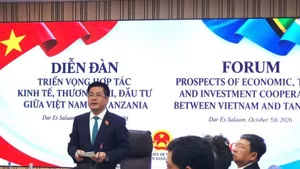
The forum was jointly organised by the Lao Ministry of Industry and Commerce’s Foreign Trade Department, the Vietnamese Ministry of Industry and Trade’s Agency of Foreign Trade, and the Viet Nam Trade Office in Laos. It brought together government officials, industry associations and hundreds of businesses operating in logistics, multimodal transport, warehousing, import-export and e-commerce.
Speaking at the event, Kingsadone Phetdaoheuang, Director General of the Foreign Trade Department under Laos’ Ministry of Industry and Commerce, said the forum was aimed at translating bilateral cooperation agreements into concrete action. She highlighted Laos’ efforts to transform itself from a landlocked country into a regional connectivity hub linking the Mekong sub-region and ASEAN, creating new opportunities for industry, agriculture and cross-border trade.
To realise this vision, Laos is implementing its Trade and Transport Facilitation Action Plan for 2025–2030, which targets to cut import-export licensing times by at least 40%, reduce customs clearance times at border gates by a minimum of 50%, raise the national Logistics Performance Index (LPI) by at least 40%, and eliminate at least half of unnecessary checkpoints along domestic transport routes. The country is also seeking Viet Nam’s support in sharing experience and enhancing logistics infrastructure transport routes.
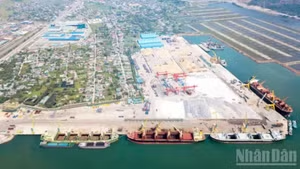
Laos is focusing on 12 strategic measures under the direction of the National Trade and Transport Facilitation Committee, she said, adding that the country hopes Viet Nam will share its experience and strengthen connectivity in warehousing infrastructure to help ease transport cost bottlenecks and expand access to the sea through the Vung Ang Port complex in Ha Tinh, central Viet Nam.
Tran Thanh Hai, Deputy Director General of Viet Nam’s Agency of Foreign Trade, said logistics cooperation between the two countries should become more modern, integrated and sustainable amid global trends toward digitalisation, green development and resilient supply chains. He called for closer collaboration in logistics infrastructure, multimodal transport, digital transformation, customs modernisation and business connectivity.
Hai underlined the significant potential for logistics cooperation between Viet Nam and Laos, noting that Viet Nam has advantages in seaport infrastructure, logistics network and international connectivity, while Laos holds a strategic position in the Greater Mekong Sub-region as a vital link between ASEAN and inland Asia.
He said that with more effective linkages, the two economies could complement each other in developing regional supply chains, not only meeting bilateral transport and trade but also attracting transit cargo from third countries, thereby generating higher added value for both countries’ logistics sectors.
During discussions, participants identified high cross-border logistics costs, infrastructure bottlenecks, procedural issues at some border gates and incompatibility in electronic customs documentation as key challenges. They agreed that greater digitalisation and investment in multimodal transport, including road, sea and the proposed Vung Ang – Vientiane railway route, would help address these obstacles.
The forum is expected to open a new chapter in Viet Nam – Laos economic cooperation, supporting the goal of raising bilateral trade turnover to more than 4 billion USD in 2026 and eventually 10 billion USD by 2030.