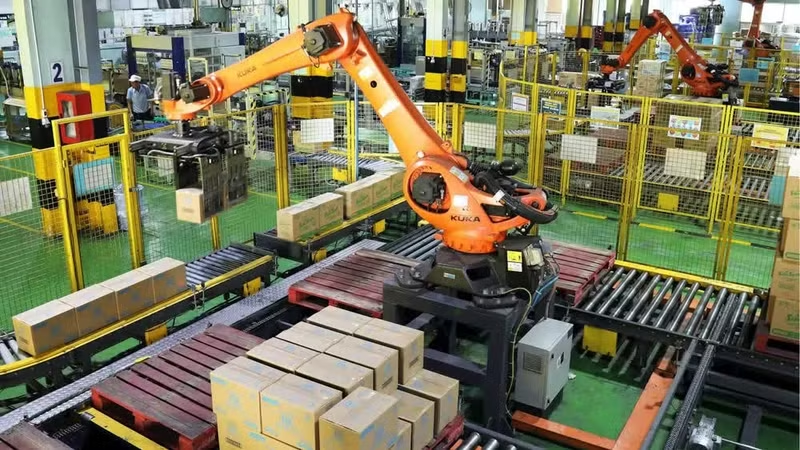
In this critical new phase of development, the requirement goes far beyond merely accelerating digitalisation; it demands transforming technology, data, and artificial intelligence (AI) into core drivers of productivity, added value, and long-term corporate competitiveness.
A shift in business models
Resolution No. 57-NQ/TW, issued by the Politburo on December 22, 2024, regarding breakthroughs in science, technology, innovation, and national digital transformation, sets a target for the digital economy to account for at least 30% of GDP by 2030.
To successfully achieve this ambitious goal, Viet Nam needs not only more enterprises participating in the digital economy but, more crucially, a cohort of businesses capable of mastering technology and leveraging data to ascend to higher-value stages within global production, supply, and distribution chains. Consequently, digital transformation must be viewed as a fundamental shift in business models rather than a mere supplementary investment in technology.
Professor Dr Hoang Van Cuong, Vice President of the Viet Nam Economic Association, argues that the contribution of the digital economy lies not merely in the scale of growth, but crucially in the genuine value created, retained within the economy, and captured by Vietnamese enterprises.
The stark reality of the wood industry illustrates this point: despite exporting to 167 countries and territories, most enterprises primarily engage in basic contract manufacturing (OEM), whereas higher value-added activities — such as design, product development, and branding (ODM) — remain virtually untapped. Consequently, digital transformation is a vital prerequisite for wood enterprises to transition from OEM to ODM and take a vastly more proactive role in design and product development.
The contribution of the digital economy lies not merely in the scale of growth, but crucially in the genuine value created, retained within the economy, and captured by Vietnamese enterprises.
Professor Dr Hoang Van Cuong, Vice President of the Viet Nam Economic Association
Thus, the core issue is no longer about which technology to purchase, but rather which specific growth challenges a technology can effectively solve for the enterprise.
According to National Assembly Deputy Ho Duc Thang, businesses need to shift their focus from selecting tools to identifying the core problems to be solved; from mere data storage to managing data as a high-value strategic asset; and from training staff on routine operational tasks to developing the capability to work alongside AI. Technology is only truly meaningful when it helps tangibly reduce costs, shorten timelines, improve quality, or expand market reach.
Bui Khanh Dung, General Director of Musa Pacta, cites highly compelling specific examples: the application of technology enabled a company to drastically cut laboratory setup costs from 2 billion VND to just 300 million VND, while the use of the Internet of Things (IoT) reduced the workforce from 10 people to just two, even as production scale increased. Therefore, true digital transformation must be measured by concrete gains in efficiency, productivity, and the genuine value generated.
However, for businesses to truly accelerate, it is essential to decisively remove bottlenecks regarding institutions, data, infrastructure, and technology absorption capacity. In reality, “superficial” digitisation remains frustratingly common; for instance, businesses may submit applications online yet still be required to provide additional physical documents, or they are forced to redundantly re-declare data that the State already possesses.
According to Phan Duc Hieu, a member of the National Assembly’s Economic Committee, the management approach must shift from focusing on specific technologies or models to focusing on objectives, outcomes, and risks.
Simultaneously, procedures should be comprehensively redesigned with a native digital mindset, and controlled testing mechanisms (sandboxes) should be implemented. Data must be viewed as the critical infrastructure of the digital economy; if data remains fragmented and lacks connectivity standards and sharing mechanisms, businesses will struggle to leverage AI and develop new business models.
Enhancing business proactivity
Moving forward, it is necessary to promote controlled data sharing, develop shared infrastructure, and gradually establish a robust data market so that data becomes a dynamic value-generating resource.
For small and medium-sized enterprises (SMEs), support for digital transformation should decisively shift from merely providing software and equipment to achieving tangible results — such as drastic cost reductions, increased productivity and revenue, and rapid market expansion.
The State can create an initial market for domestic technology through mechanisms like procurement based on outcomes and by publicly outlining real-world challenges for technology firms to solve.
Ultimately, no policy can substitute for a business's own relentless efforts to innovate. Enterprises must proactively invest in technology, human resources, and research and development, while also enhancing their governance capabilities and capacity to absorb new technologies.
Notably, it is essential to foster business linkages in the spirit of Resolution No. 19-NQ/TW (dated July 28, 2026, from the 3rd Plenum of the 14th Party Central Committee) regarding the reform of Viet Nam’s development model.
Large enterprises must play a leading role, drawing smaller firms deeper into global supply chains; small and medium-sized enterprises (SMEs) need to invest in human resources and R&D, build a culture of innovation, enhance their ability to meet stringent international standards, and truly master technology rather than merely utilising off-the-shelf solutions; meanwhile, innovative startups require dedicated spaces for rigorous testing and development.
Only when enterprises view digital transformation as a fundamental shift in their business models — and the State establishes the necessary institutional frameworks, data ecosystems, infrastructure, and markets to fully support innovation — can the digital economy become a genuine driver of sustained growth.
In this scenario, technology transcends the mere acceleration of existing processes; it becomes a powerful platform for enterprises to create new products, capture higher-value segments of the global value chain, and boost competitiveness. This approach enables Viet Nam to transform the scale of its digital economy into a tangible growth engine, unlocking unprecedented opportunities for a breakthrough in this new era of growth.