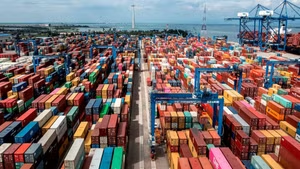
According to seaport businesses, although cargo throughput continues to rise, bottlenecks in planning, investment procedures and connecting infrastructure remain major obstacles.
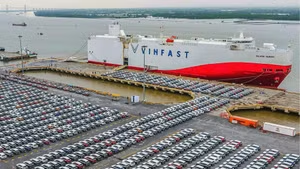
Behind the steady stream of cargo ships calling at ports lies a paradox: the potential of the marine economy is expanding, yet opportunities to realise it remain constrained by institutional and infrastructure bottlenecks.
Businesses have therefore urged the province to promptly resolve issues relating to planning, land, investment and transport infrastructure to expand storage facilities, increase port capacity and meet growing demand.
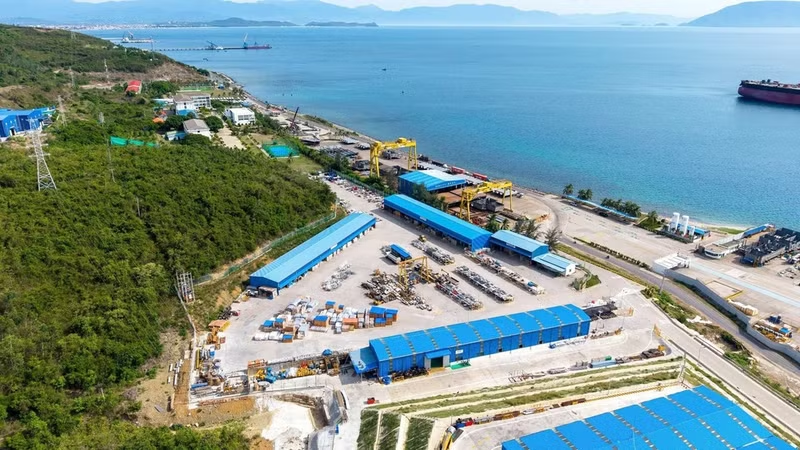
Le Van Toan, Deputy General Director of HD Hyundai Viet Nam Shipbuilding Co., Ltd. (HVS), said the company's biggest obstacle concerned an 18.9-hectare land reclamation area to the east of its shipyard.
Planning-related difficulties have prevented the company from completing investment procedures to expand its block storage area, even as the need to increase new shipbuilding capacity becomes increasingly urgent.
In addition, Road DT.652D, which borders the expanded Berth No. 4, has become a bottleneck. The road's current elevation is lower than the planned port surface, while its structure is inadequate for transporting oversized and overweight blocks.
The company has proposed funding temporary road construction within its own land to maintain production while the province is unable to upgrade the route.
At Van Phong Economic Zone, Nam Van Phong International Port JSC is also awaiting planning decisions before it can expand its operations.
Infrastructure development under Phase 1, covering seven hectares, has been completed. However, work on the 11.89-hectare Phase 2 remains stalled due to difficulties in updating the planning documents and determining which agency should receive the application.
Once these administrative obstacles are removed, the company will be able to prepare a feasibility study, expand its storage facilities and increase the port's capacity to accommodate vessels of up to 70,000 DWT. Meanwhile, at Ba Ngoi Port in Cam Ranh, the main challenge is no longer cargo demand but operational infrastructure.
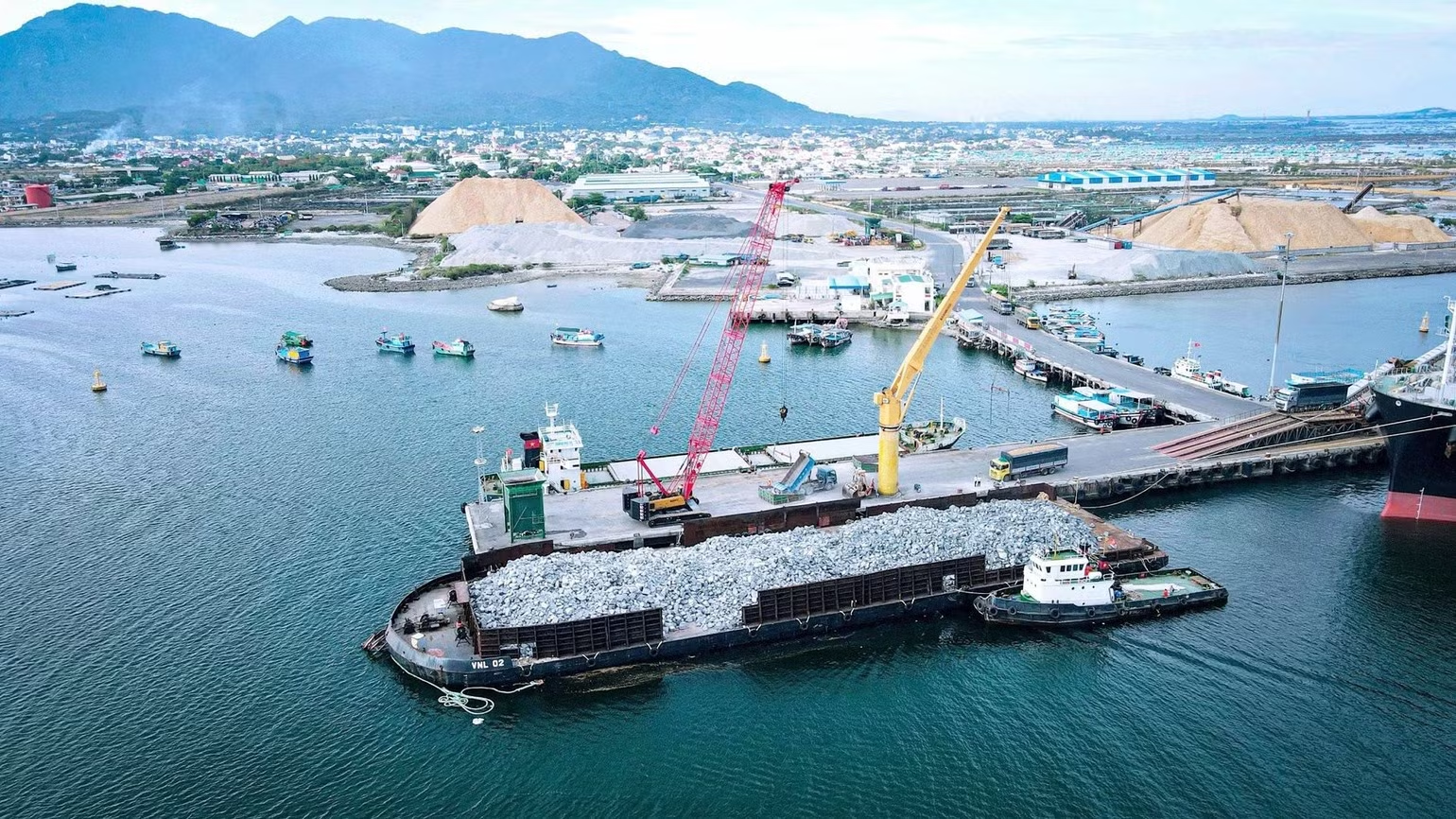
Nguyen Van Thang, General Director of Cam Ranh Port JSC, said cargo throughput had risen from two million tonnes in 2020 to 4.22 million tonnes in 2025, reaching 4.48 million tonnes in just the first eight months of 2026.
However, the two berths currently share a single narrow access bridge, causing frequent traffic congestion, reducing operational efficiency and posing the risk of a complete shutdown if the only access bridge requires repairs or suffers a technical failure.
The project to build a new access bridge for Berth No. 2 is stalled by procedures to change the investor. The company has called on the province to help complete the transfer of the investor's name on the Investment Registration Certificate and provide guidance on the necessary planning, land, construction, environmental, maritime and defence procedures so that the project can proceed promptly.
According to the Department of Construction, during the first eight months of 2026, the area managed by Nha Trang Maritime Administration, encompassing Van Phong, Nha Trang and Cam Ranh, recorded 4,918 vessel calls, equivalent to nearly 68% of the annual target and up 5.7% year on year.
Notably, cargo throughput at the ports exceeded 13 million tonnes, reaching nearly 87.4% of the annual target and rising by 37.4% year on year.
At Ca Na Port, cargo throughput also exceeded 1.2 million tonnes, up 46% from 2025. These figures reflect a clear reality: demand for maritime transport and logistics is growing faster than infrastructure development and the completion of investment procedures. If the bottlenecks are removed promptly, the sector still has considerable room for growth.
Chu Van An, Deputy Director of the Department of Construction, said that, in response to businesses' recommendations and to address their difficulties while ensuring that port services and logistics meet their 2026 growth targets, the department had proposed that the Provincial People's Committee direct relevant departments and agencies to tackle the issues in specific groups.
The Department of Finance would take the lead, in coordination with relevant departments and agencies, in urgently reviewing the application to amend the Investment Registration Certificate to change the investor's name from Viet Nam Maritime Corporation to Cam Ranh Port JSC. It would also guide the company through the relevant legal procedures in accordance with current regulations.
For HVS, the provincial Management Board of Economic Zones and Industrial Parks would lead efforts to review and resolve planning issues concerning the 18.9-hectare land reclamation area. The Department of Construction would study options for upgrading Provincial Road DT.652D and consider procedures to permit the company to build a temporary road, ensuring uninterrupted transport operations.
Le Huyen, Vice Chairwoman of the Provincial People's Committee, affirmed that the province had significant advantages in developing seaports and logistics, which it considers one of the key economic sectors contributing to local growth.
To improve management efficiency, the Provincial People's Committee has assigned the Department of Construction to develop an integrated database on seaport operations to support management and long-term policymaking.
Meanwhile, the provincial Management Board of Economic Zones and Industrial Parks will serve as the focal point for receiving and addressing recommendations from businesses operating in Van Phong Economic Zone, while the Department of Construction will handle those from businesses outside the economic zone. The arrangement is intended to shorten application processing times and help businesses complete investment procedures.
Resolving immediate difficulties is not merely about addressing individual investment applications; it also paves the way for a long-term strategy to develop a modern, green and sustainable seaport ecosystem.
According to Le Huyen, alongside improving administrative procedures, the province will continue investing in connecting transport infrastructure, developing logistics networks and establishing industrial parks linked to the seaport system to capitalise on the marine economy's advantages. Shipbuilding will remain one of its key pillars.
In 2025, HVS delivered 17 vessels and nine cabins, generating revenue of more than 674 million USD. In 2026, the company aims to build 17 new vessels and four cabins, targeting revenue of around 691 million USD. Revenue has so far been estimated at 71% of the annual target, with full-year revenue projected at approximately 694 million USD. These figures demonstrate the sector's substantial growth potential.
Businesses do not simply need more water space or longer quays. They need faster resolution of administrative procedures, better-integrated infrastructure and a sufficiently streamlined investment environment to enable the marine economy to become a genuine driver of provincial development in the new period.