Following the restructuring of administrative units, the development landscape of the South Central Coast and Central Highlands has undergone significant changes, with provinces increasingly taking on a distinctive coastal–highland structure.
This important transition has expanded economic space;strengthened connectivity between the highlands, coastal areas, and islands; and created new development corridors for transport, logistics, trade, and tourism.
Regional linkages such as Kon Tum–Quang Ngai, Gia Lai–Binh Dinh, Dak Lak–Phu Yen, and Lam Dong–Dak Nong–Binh Thuan have opened opportunities to develop new tourism product chains combining coastal attractions, highland landscapes, forests, and indigenous cultures. These connections are helping shape a regional tourism brand characterised by sustainability, environmental responsibility, and distinctive cultural identities.
Tourism infrastructure in the Central Highlands has also improved considerably. The Lien Khuong, Buon Ma Thuot,and Pleiku airports can currently handle a combined 4.5–5 million passengers annually, with their capacity projected to increase to 12–15 million by 2030.
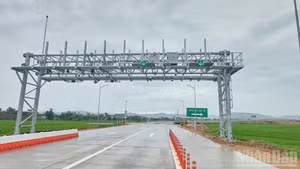
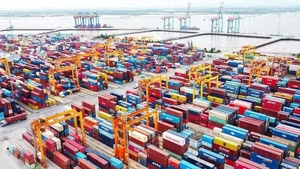
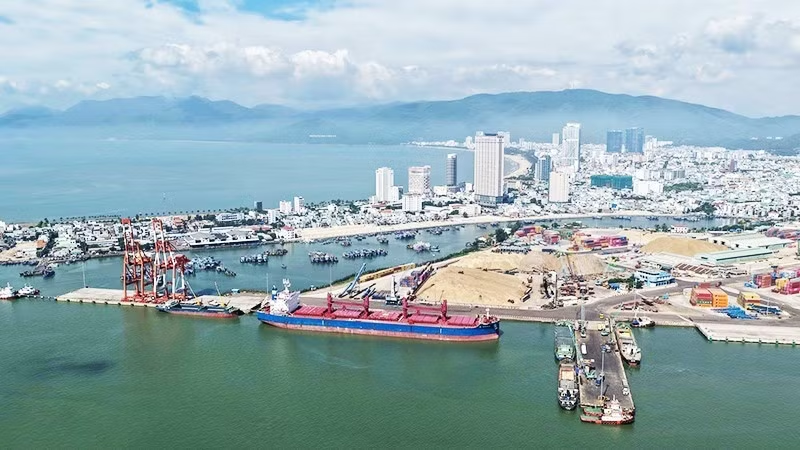
Meanwhile, seaports such as Quy Nhon are being upgraded to accommodate international cruise ships, while national highways and expressways, including the Quy Nhon–Pleiku Expressway, are strengthening connections between the Central Highlands, coastal provinces, the Southeast, and key economic regions.
Regional connectivity has consequently evolved from relatively limited cooperation among neighbouring provinces into a broader, more integrated development approach. Following administrative restructuring, several localities now encompass both coastal and highland areas, creating opportunities that did not previously exist.
Nevertheless, infrastructure bottlenecks remain. Destinations such as Mang Den, Ta Dung, and Lak Lake, along with community-based tourism villages, still depend heavily on narrow or deteriorating national and provincial roads that are particularly vulnerable during the rainy season.
Apart from Da Lat, which has a relatively comprehensive accommodation and service network, many emerging destinations continue to lack high-quality accommodation, visitor information centres, signage, parking facilities, and environmental treatment infrastructure.
The emergence of coastal–highland provinces has also placed more demanding requirements on infrastructure development.
Dr Tran Du Lich, member of the National Financial and Monetary Policy Advisory Council, said modern infrastructure development must be approached as a comprehensive ecosystem integrating five strategic components.
These comprise connectivity infrastructure, including roads, railways, airports, and seaports; large-scale accommodation and supporting services; visitor facilities at destinations; digital infrastructure for smart management; and ecological and institutional infrastructure, encompassing human resources, interregional governance mechanisms, and environmental protection standards.
Although the Central Highlands has recorded considerable improvements in infrastructure development, its transport network continues to face numerous challenges. With provinces now encompassing both coastal and highland areas, infrastructure priorities have shifted significantly from longitudinal connections within the region towards east–west development corridors.
Strategic transport routes linking Quy Nhon with Pleiku, Tuy Hoa with Buon Ma Thuot, Quang Ngai with Mang Den, and Phan Thiet with Gia Nghia and Da Lat are emerging as major development arteries. These corridors connect central Viet Nam and the Central Highlands with the Southeast while expanding access to southern Laos and northeastern Cambodia.
Gia Lai Province, for example, is concentrating resources on addressing major transport bottlenecks across road, maritime, and aviation infrastructure. The Quy Nhon–Pleiku Expressway is expected to reduce travel time between the two destinations to just over two hours.
In maritime transport, connecting the Central Highlands with Quy Nhon Port offers opportunities to attract international cruise passengers through distinctive four- to eight-hour excursion programmes.
In aviation, the Phu Cat and Pleiku airports continue to maintain frequent flight services. At the same time, efforts are being accelerated to complete a second runway at Phu Cat Airport, preparing the facility to accommodate wide-body aircraft and international flights.
Do Thi Dieu Hanh, Director of the Gia Lai Provincial Department of Culture, Sports and Tourism, said the province had proactively coordinated with ministries, relevant agencies, and airlines, including Bamboo Airways, to facilitate the early launch of international charter flights.
Charter services from the Republic of Korea were expected to begin in September, followed by flights from China, Japan, and other Northeast Asian markets.






![[Infographic] GRDP growth scenarios for 34 provinces and cities in fourth quarter of 2026](https://en-cdn.nhandan.vn/images/nyM650OGFWrOVWc-xajqN-rTZ68Rlmc1fiGJOhBRYHFSa4DhrHNDxEFdnz313Vk5dNJuxdkHglPA3rLeaPeiaUheNuCI723k2lNssd-YLJuKR58epWq7s21lV5WjM-HR2-Qpbi4MwAzqt9wRjL4WjGkfEz7RO9qhcwg8o8LQFK8/grdp-growth-scenarios-for-34-provinces-and-cities-in-q42026-anh-dai-dien.jpg.avif)