To realise this goal, the business community needs to proactively enhance corporate capabilities. Meanwhile, the State must continue to refine institutional frameworks and create a favourable environment for business growth, thereby contributing to rapid, sustainable economic development and affirming Viet Nam's position on the international stage.
The aspiration to master value
Many years ago, Viet Nam's advantage in the international market stemmed primarily from low-cost labour and incentives designed to attract manufacturing investment. While this model helped create jobs and boost exports for a time, it has since revealed significant limitations: the value retained domestically remains disproportionately low; many enterprises rely heavily on imported raw materials, equipment, and technology; and capabilities in product development and brand building remain limited.
In a competitive landscape increasingly driven by productivity, technology, and the ability to supply specialised products, Vietnamese enterprises must move up to higher-value segments of the value chain. Expanding production is necessary, but without technological innovation, better management, and human resource development, a larger scale alone cannot guarantee sustainable competitiveness.
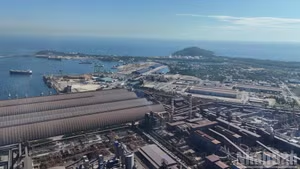
The shift towards adopting technology and manufacturing high-value products has become clearly evident in the steel industry in recent times. In addition to standard products, steel enterprises have focused on investing in high-quality steel lines that demand rigorous technical specifications and quality control. A prime example is Hoa Phat Group, which has strongly pivoted towards hot-rolled coil (HRC) production and is implementing a rail and special steel manufacturing plant project in Dung Quat (Quang Ngai).
The project has a designed capacity of 700,000 tons per year and utilises modern German technology lines, aiming to produce high-speed railway rails, urban railway rails, and special steels for the manufacturing sector. According to Hoa Phat Group, the plant is expected to roll out its first high-speed railway rail products in the first quarter of 2027. This move is intended to deepen the enterprise’s participation in the material supply chain for key infrastructure projects and gradually meet domestic demand, thereby reducing total reliance on imports.
According to Nguyen Viet Thang, General Director of Hoa Phat Group, investing in modern production lines is merely the starting point; operational capabilities, quality control, process improvements, and the development of a high-quality workforce are the true determinants of long-term competitiveness. This demonstrates that the challenge for enterprises extends beyond simply investing in advanced production lines; it is more important to train operational teams, master technological processes, and continuously improve products. Relying solely on transferred technology without building internal capabilities makes it difficult for an enterprise to establish a sustainable competitive advantage.
Hoa Phat’s strategic focus on developing a production chain spanning from steel smelting to deep processing also opens up opportunities to supply raw materials to sectors such as mechanical engineering, manufacturing, automotive, energy, and railways. With high-quality materials produced domestically, downstream enterprises can reduce their reliance on imports, take greater control of production, and enhance their competitiveness. This direction aligns with the requirements for private sector development outlined in the Politburo’s Resolution No. 68-NQ/TW, which aims to leverage corporate capabilities, foster linkages, and improve overall economic efficiency.
Creating value for the nation
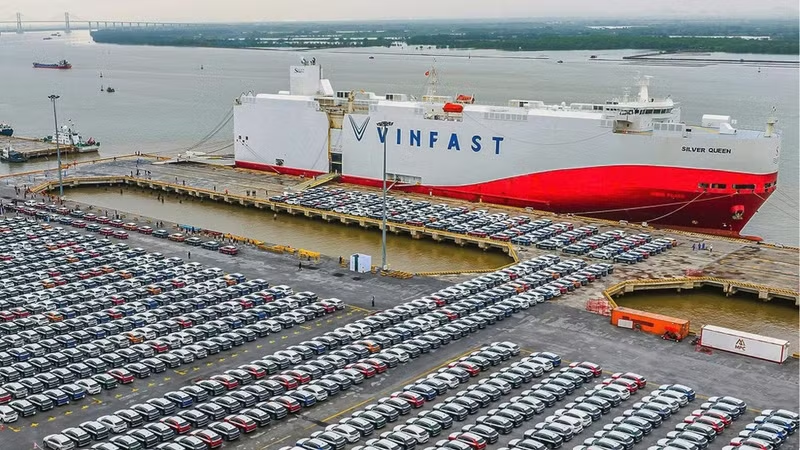
While Hoa Phat demonstrates efforts to upgrade industrial production capacity, the story of Vingroup — led by entrepreneur Pham Nhat Vuong — and its electric vehicle (EV) brand, VinFast, reflects a different path: bringing Vietnamese-made EVs to compete in the international market. In 2025, VinFast delivered nearly 200,000 EVs globally, with nearly 180,000 vehicles delivered in the first nine months of 2026 alone.
Vingroup’s experience illustrates that expanding the market for Vietnamese EVs not only creates opportunities for brand development but also imposes higher demands regarding product quality, technology, after-sales service, and the ability to adapt to the specific standards of each market. A Vietnamese brand establishing a firm foothold internationally holds even greater significance when that success is linked to the development of the domestic business ecosystem.
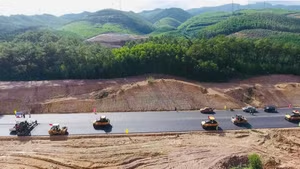
In the field of transport infrastructure and construction investment, Deo Ca Group demonstrates the importance of technical expertise and the ability to devise solutions for complex projects.
The construction of the Deo Ca Tunnel, undertaken by the Deo Ca Group, marks a milestone in efforts to enhance the capabilities of Vietnamese engineers and workers. The Deo Ca Group’s NATM tunnelling method — an innovation by the Group — has been granted intellectual property rights, reflecting a process of research, refinement, and the accumulation of construction expertise.
According to Ho Minh Hoang, Chairman of the Board of Directors of Deo Ca Group, the entrepreneurial spirit is defined by the courage to think boldly, act decisively, and accept responsibility. Throughout project implementation, the enterprise has steadfastly researched optimal construction solutions, adopted new technologies, reduced costs, and proposed policy refinements tailored to the practical realities of the projects.
It can be said that behind every corporate success lie immense determination and a spirit of constant innovation, alongside the sweat, tears, and tireless efforts driven by a deep aspiration for and belief in the nation's development.
However, alongside their confidence in and appreciation for the Party and State’s efforts in refining institutional frameworks, reforming administrative procedures, significantly improving the investment and business climate, implementing business support policies, fostering dialogue to address business community proposals, and substantively removing operational bottlenecks, many entrepreneurs have also frankly stated at various meetings and dialogues that corporate capacity can only be fully realised when accompanied by transparent investment mechanisms and stable, predictable State policies.
For large-scale infrastructure projects characterised by long implementation periods and complex technical requirements, changes in procedures and policies can drive up costs and introduce significant risks. Consequently, businesses have urged state management bodies to explore ways to enable capable enterprises to participate in key projects based on fair and transparent competition, thereby continuing to contribute to the nation's overall development.
Viet Nam has set ambitious development targets, requiring entrepreneurs to set greater goals for their businesses and build stronger Vietnamese companies and brands. They must go beyond conquering the domestic market to expand internationally; move beyond contract manufacturing towards designing, innovating, and mastering their own products; and aspire not merely to participate in value chains but to lead them.
For their part, businesses and entrepreneurs must strive to innovate management practices and invest substantially in science and technology to boost productivity, build brands, and master high-value-added stages of production. The corporate objective should not be limited to scaling up operations; it must also involve spreading this aspiration to other enterprises and enhancing the economy's competitiveness.
Experience shows that the "flame" of corporate aspiration for growth burns brightest when fanned by the "breeze" of a favourable business environment created by the State. When the State fosters the right conditions and entrepreneurs — possessing the necessary dedication, vision, and mettle — transform opportunities into competitive strength, each enterprise becomes a vital asset, helping to bolster the nation's power and standing on the global stage.