Vietnamese products shine at Paris Fair
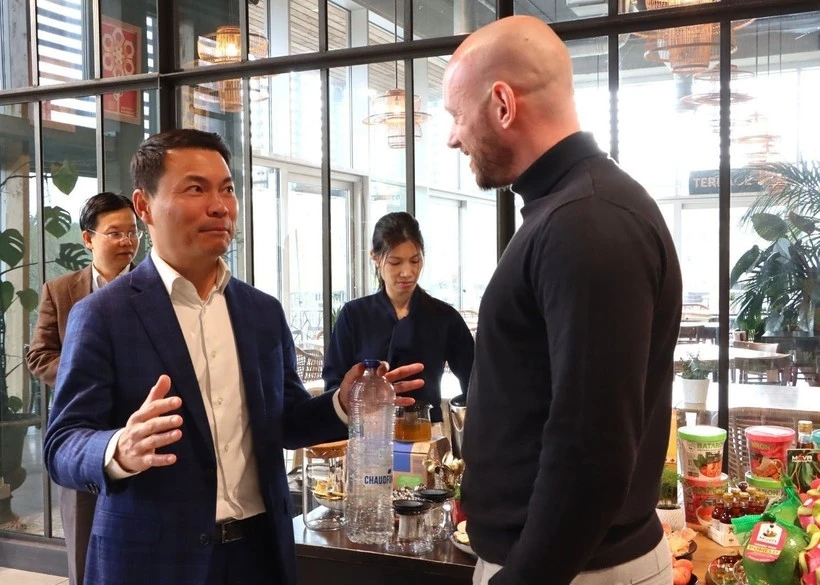
Vietnamese booths are drawing large numbers of visitors at the Paris Fair (Foire de Paris) – one of Europe’s largest trade fairs, which opened on April 30 in the French capital.
#vietnamese enterprises
Có 16 kết quả
Vietnamese booths are drawing large numbers of visitors at the Paris Fair (Foire de Paris) – one of Europe’s largest trade fairs, which opened on April 30 in the French capital.
In recent years, the position of the Viet Nam National Brand has been steadily strengthened, with the number of products recognised under the National Brand programme continuously increasing over selection periods. This shows that, with systematic investment in strategy, technology, and brand management, Vietnamese enterprises can fully create outstanding brand value and compete internationally.
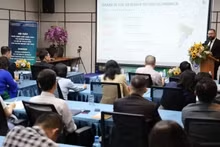
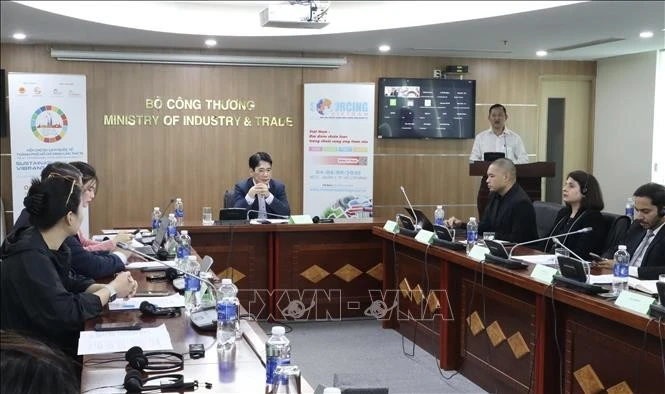
A seminar titled “Export prospects in the Brazilian market – opportunities and challenges for Vietnamese enterprises” was organised by the Ho Chi Minh City Investment and Trade Promotion Centre (ITPC) in coordination with the Viet Nam Trade Office in Brazil on April 21, providing businesses with insights to expand exports to this key Latin American market.
Japan and the Republic of Korea (RoK) are among Viet Nam’s most important economic partners, with considerable room for further cooperation, but Vietnamese enterprises must adopt clearer strategies and continuously upgrade technological capacity to attract more investment and expand trade, experts said.
From a practical perspective, many experts, representatives of business associations, and enterprises believe that for Viet Nam’s private sector to “reach the vast ocean,” it must be empowered by a comprehensive support ecosystem that closely connects policies, overseas trade offices, and the business community.
As the global economy undergoes significant fluctuations, particularly under the impact of the US reciprocal tax policies, businesses must reposition their strategies to expand markets and ensure sustainable development.
The implementation of environmental, social and corporate governance (ESG) standards is becoming an increasingly mandatory requirement for Vietnamese enterprises in the integration and sustainable development process.
In the context of fluctuating global trade, Europe remains a highly promising market for Vietnamese enterprises seeking to boost exports — provided they can take full advantage of preferential mechanisms and market opportunities.
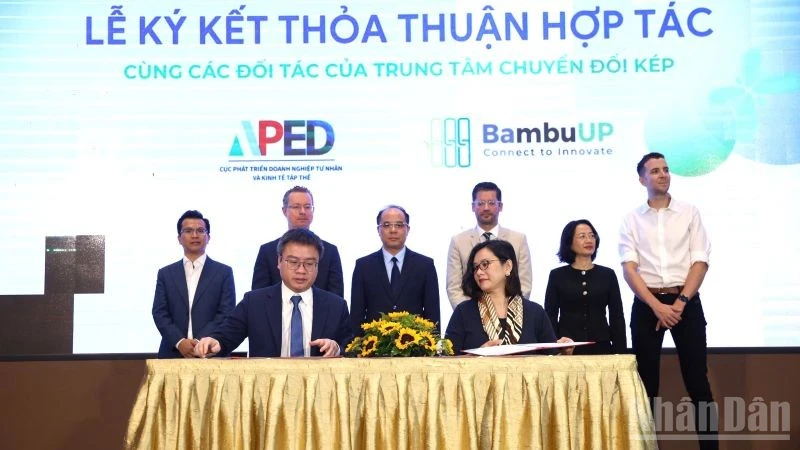
The Agency for the Development of Private Enterprises and Collective Economy (APED) under the Ministry of Finance, in collaboration with the German Agency for International Cooperation (GIZ), held the 2025 Partnership Conference on Promoting Green and Digital Transformation for Vietnamese Enterprises in Ha Noi on October 20.
Viet Nam has signed and implemented many important bilateral and multilateral free trade agreements (FTAs) such as CPTPP, EVFTA, UKVFTA, RCEP... These agreements open up many opportunities for enterprises to expand export markets, take advantage of tariff incentives... to improve the position of Vietnamese goods in the international market.
Amid a volatile global economy with risks from geopolitics, rapidly changing supply chains, and prolonged inflation, Vietnamese enterprises are under pressure to strongly renew business models and expand markets to sustain growth and enhance competitiveness.
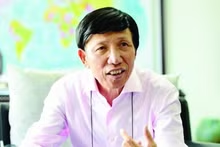
If the August Revolution in 1945 helped Viet Nam regain its national sovereignty, then foreign investment during the period of Doi Moi and integration affirmed the country’s economic sovereignty in the context of globalisation. A Nhan Dan Newspaper reporter interviewed Dr. Phan Huu Thang, former Director-General of Foreign Investment, on this issue.
Global trade volatility caused by trade wars, armed conflicts, and tariff policies are pushing Vietnamese exporters to diversify markets and customers, while also creating opportunities for them to deeper join emerging supply chains, experts said at a seminar in Ho Chi Minh City on August 1.
The Viet Nam Business Association in Belgium (VBAB) is stepping up efforts to connect Vietnamese enterprises with partners in Belgium and the EU, focusing on areas where the European country holds competitive edges in such as seaport, clean energy, and logistics.
In Viet Nam’s green transition roadmap, to move from potential to reality, domestic enterprises are forced to overcome a series of “obstacles” such as: shortage of human resources, dependence on technology, high investment costs and unsynchronized policy mechanisms.
As the world enters an era of sustainable development and full-scale digitalisation, dual transformation, combining digital and green transitions, has shifted from a mere trend to a survival strategy for Vietnamese enterprises.