Lessons drawn from revolutionary practice
In the early 1940s, under the direct and timely guidance of the Party Central Committee and the Northern Regional Party Committee, the revolutionary movement in Bac Ninh province advanced to a new stage of development in both scope and depth.
The provincial Party leadership committee advocated for actively consolidating and expanding revolutionary bases, building self-defence forces, and preparing personnel to swiftly seize power for the people when the opportune moment arrived.
Beginning with the first local uprising to seize power in Trung Mau, Tien Du, on March 10, 1945, a wave of vigorous mass struggles and self-defence actions subsequently swept across the province's districts and prefectures.
The uprising to seize power in Bac Ninh took place from August 17 to 22, 1945, achieving a swift and decisive victory. At that time, the Bac Ninh provincial Party organisation comprised approximately 50 members.
This August, Bac Ninh seems to shine even brighter with joy and pride. The lessons regarding proactive force preparation and seizing opportunities continue to be applied as Party committees and authorities strengthen internal capabilities, leverage potential, and capitalise on new opportunities to drive economic growth.
The socio-economic achievements of the first half of 2026 clearly reflect the dynamic momentum of a locality on the rise. The GRDP growth rate for the first six months of the year was estimated at 10.56% year-on-year, placing the province among the nine localities achieving double-digit growth.
Total import-export turnover for the period was estimated at 106.4 billion USD, maintaining the province’s position as one of the top two localities nationwide; specifically, exports reached 52.5 billion USD (up 31.49%, ranking first in the country), while imports stood at 53.87 billion USD (up 39.83%). Regarding FDI attraction, Bac Ninh currently ranks fourth nationwide.
Localities across Bac Ninh province have been striving to translate lessons learned from revolutionary history into effective task implementation through tailored approaches. Tien Du is a land that marks significant milestones in Bac Ninh's history of revolutionary struggle.
During the August Revolution of 1945, Tien Du was the first locality in the province to seize power, doing so on August 17, 1945. The current Tien Du Commune was formed through the merger of Lim Town and the communes of Phu Lam and Noi Due. Under the plan to establish urban wards within Bac Ninh Province, Tien Du is one of the 12 communes eligible for conversion into a ward.
According to Tran Van Vung, Secretary of the Party Committee and Chairman of the People’s Council of Tien Du Commune, the August Revolution of 1945 offered many lessons of profound theoretical and practical significance.
Drawing on the lessons regarding seizing opportunities and acting proactively and decisively—demonstrated by the Bac Ninh Provincial Party Committee during the uprising to seize power—the Party committee and authorities of Tien Du Commune have resolved to effectively leverage new potentials and advantages. They are focusing particularly on location, infrastructure, industry, services, and human resources to drive economic development.
Alongside economic growth, the Commune Party Committee has prioritised digital transformation, administrative reform, and improving service quality for residents and businesses; it also links economic development with ensuring social welfare, protecting the environment, and enhancing the quality of life.
To date, Tien Du’s public service, online payment, and shared operational management systems are functioning smoothly and synchronously. All agencies and units have published and updated their electronic identification codes on the National Public Service Portal.
In the first six months of the year, revenue from retail sales of goods and services in the area was estimated at over 1.58 trillion, an increase of approximately 11% year-on-year; meanwhile, activities related to education, culture, and social welfare have been effectively maintained.
Vung added that the spirit of initiative, solidarity, and boldness—hallmarks of the historic August 1945 days—continues to be rekindled among today’s cadres, Party members, and the public. This spirit serves as a driving force for Tien Du to seize new opportunities, achieve robust growth, and contribute to the overall development of Bac Ninh province as it moves toward becoming a centrally-run city.
Building a contingent of cadres and Party members that meets new demands
The Central Government’s consensus on the policy to establish a centrally-run Bac Ninh city—based on the province's existing administrative boundaries—has opened up a broader space for development, allowing the region to fully leverage its potential, advantages, and unique identity.
Bac Ninh possesses favourable conditions regarding urban planning, resources, infrastructure, industry, and geoeconomic location. However, these advantages can only truly transform into development momentum through synchronised, effective implementation, driven by innovative leadership and governance capabilities that match these new requirements.
At the conference held in Bac Ninh to study, grasp, and implement the Resolution of the 3rd Plenum of the 14th Party Central Committee, Nguyen Hong Thai—Member of the Party Central Committee and Secretary of the Bac Ninh Provincial Party Committee—emphasised that while this presents a major opportunity, it also imposes higher demands on the province regarding leadership mindset, governance capacity, the quality of its workforce, and the effectiveness of implementation.
Therefore, he urged Party committees, authorities, agencies, units, and localities to focus on the synchronised execution of tasks: building the Party and the political system; fostering socio-economic development; strengthening discipline and order; and cultivating a workforce of cadres characterised by steadfastness, competence, a sense of responsibility, and a spirit of service. Building a contingent of cadres and Party members capable of meeting new requirements is a crucial component of the development agenda, as they are the force directly responsible for implementing Party guidelines and translating Party policies into reality.
During the first half of 2026, the Provincial Party Committee issued numerous directives aimed at enhancing the quality of Party organisations and the workforce of cadres and Party members. Consequently, Party recruitment efforts ensured both quantity and quality, with 2,740 new members admitted—meeting the set targets.
The Provincial Party Committee organised training courses to improve political-theoretical knowledge, management skills, and practical problem-solving capabilities among grassroots cadres, ensuring they can meet the demands of the new situation.
According to Tran Van Vung, in the context of new development opportunities, the Party Committee of Tien Du Commune has determined that Party building must begin with establishing strong Party organisations and a workforce of cadres and Party members who possess the necessary integrity, competence, and sense of responsibility.
He remarked: Experience showed that historical lessons offered valuable insights for Party building and the development of the cadre workforce in this new phase of growth. Only when Party organisations are robust—and when cadres and Party members stay close to the people to truly understand issues, remain deeply engaged to select the right approaches, and act decisively in implementation—can Party policies be realized in practice and public consensus be fostered.
Bac Ninh played its part in forging the nation’s “Autumn of Independence”. Today, on this very land—renowned for its rich heritage and illustrious people—a new autumn is unfolding: an autumn defined by the aspiration for innovation, development, and advancement.
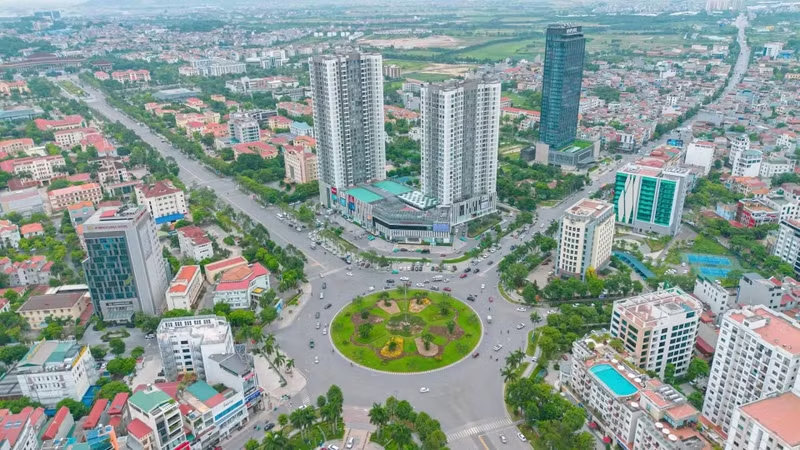
This aspiration has been embodied in new infrastructure projects, high-tech factories, emerging urban areas, and the vibrant pulse of a region undergoing a powerful transformation. It is in this way that Bac Ninh has turned its traditions and revolutionary lessons into a source of spiritual strength, transforms opportunities into driving forces for growth, and writed new chapters in the history of the Kinh Bac homeland.