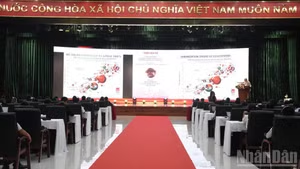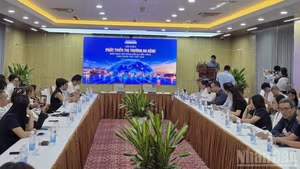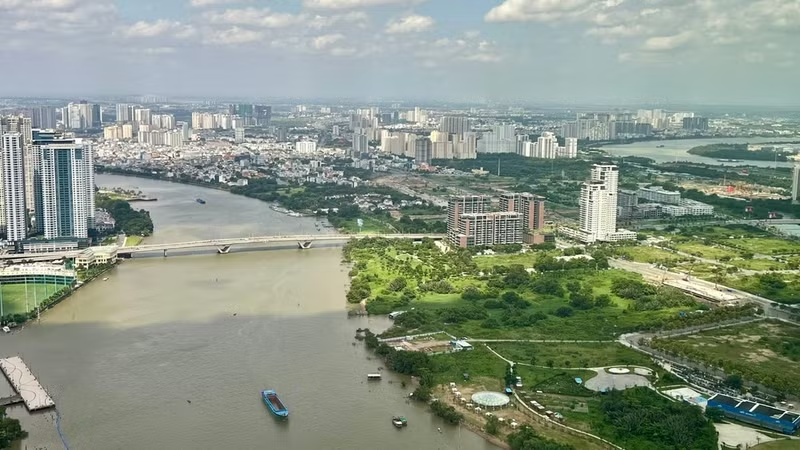
At the 2026 real estate forum themed “Megacity-mega opportunities”, recently organised by TheLEADER e-magazine, experts and businesses analysed the overall picture of the urban economy in the new period, offering deeper insights into the potential and opportunities, as well as the strategic challenges that need to be addressed.
The greater the opportunities, the greater the challenges
Prof., Dr. Nguyen Duc Thuan, Chairman of the Viet Nam Association of Corporate Administrators (VACD), said that the integration of Ho Chi Minh City’s development space has created a megacity region covering approximately 6,700km2 with a population of more than 14 million. This is not merely a mechanical increase in population or administrative area, but a transformation in scale.
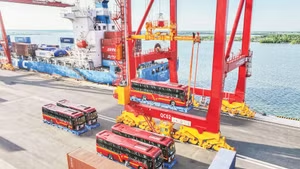
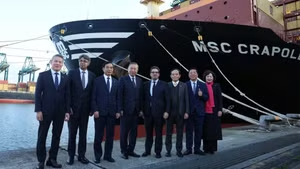
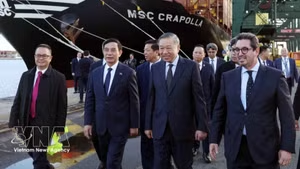
“Ho Chi Minh City possesses a development space that brings together all the strategic strengths needed to create numerous advantages: from a high-tech manufacturing centre and a chain of international deep-water seaports, and an inter-regional logistics system, to a financial and services centre and a high-quality human resources base,” Thuan said.

If the new spatial structure opens up new advantages, the next challenge is to turn those advantages into actual strength. Associate Professor, PhD Tran Dinh Thien, former Director of the Viet Nam Institute of Economics, said that the greater the opportunities, the greater the challenges, as Ho Chi Minh City’s potential has long remained underexploited.
With strong recent changes in governance thinking, infrastructure development will provide the foundation for addressing the new challenges facing the city. Therefore, in addition to its existing capabilities, the city needs to create new capabilities and even move beyond old capabilities that are no longer appropriate to meet the requirements of competition in the new context.
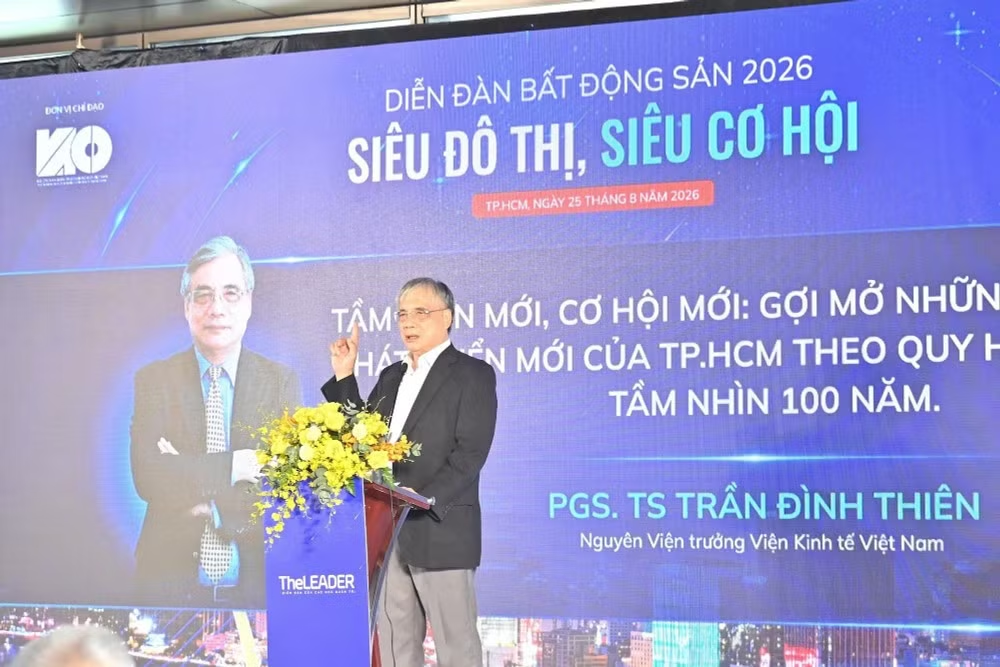
Assoc. Prof., Dr. Tran Dinh Thien said that one of the important conditions is the institutional framework, under which the National Assembly’s passage of the Urban Development Law provides a basis for unlocking the city’s capabilities, granting it greater autonomy and creating conditions for implementing models suited to a pioneering, open and integrated city. At the same time, adjustments to planning could open up new development space in terms of scope, structure and level of development.
Infrastructure driving urban development
Alongside the expansion of geographical space is an important institutional transformation. The direction set out in Politburo Resolution 31 clearly establishes the goal that by 2045, Ho Chi Minh City will become a leading economic, financial and innovation centre in Asia with a high quality of life, and by 2075, it will become a global, smart and modern city. Such a 100-year vision requires the authorities and the business community to move beyond thinking in terms of terms of office or short-term market cycles.
From a planning perspective, Nguyen Do Dung, General Director of international consultancy firm EnCity, said that it is necessary to select projects and infrastructure with the greatest positive impact on the economy, rather than investing in a scattered manner. Growth poles also need to be viewed in relation to one another. For example, Vung Tau, Ba Ria, Phu My, Cai Mep-Thi Vai and Can Gio should be considered as a whole associated with a shared marine space; at the same time, the north-south logistics infrastructure should be viewed in connection with the production areas in Binh Duong, Long Thanh Airport and the southern port areas.
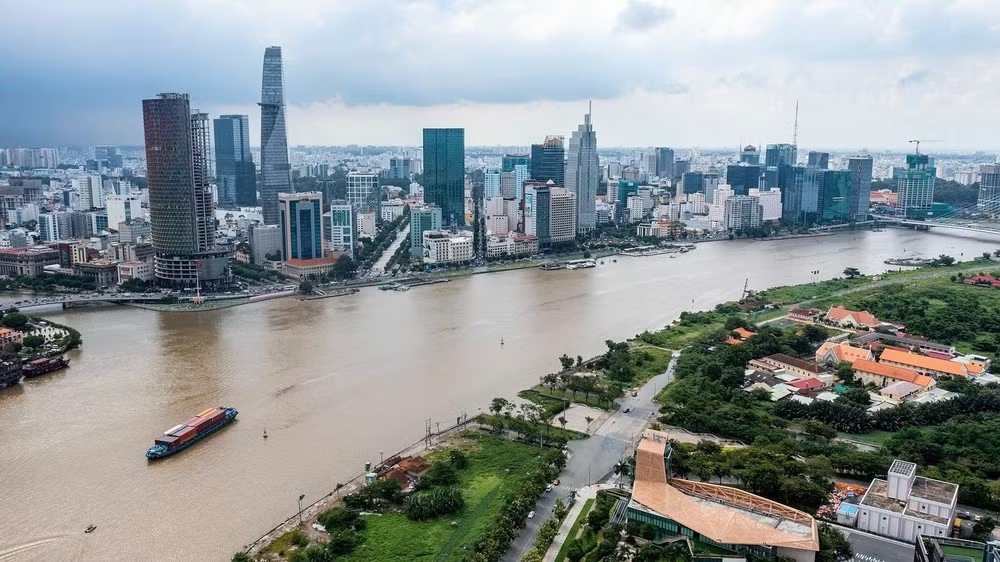
Nguyen Do Dung said that planning should not be overly detailed because no one can accurately predict the next century. What is needed is a strategic development framework, focusing on major choices while leaving room for subsequent stages of implementation. Once the planning framework is in place, the key questions are what should be done first, what should come next and how to turn the orientations into concrete results.
Also at the forum, many delegates said that planning is the foundation, but infrastructure is the factor that directly drives urban development, from organising spatial development and connecting employment to reallocating real estate value.
As Ho Chi Minh City expands, this role is becoming even more evident as the metro system, Long Thanh Airport, Ring Road 3, Ring Road 4 and inter-regional connectivity corridors are being developed. The metro system will not only shorten travel times but also expand the labour market and improve access to jobs and housing.
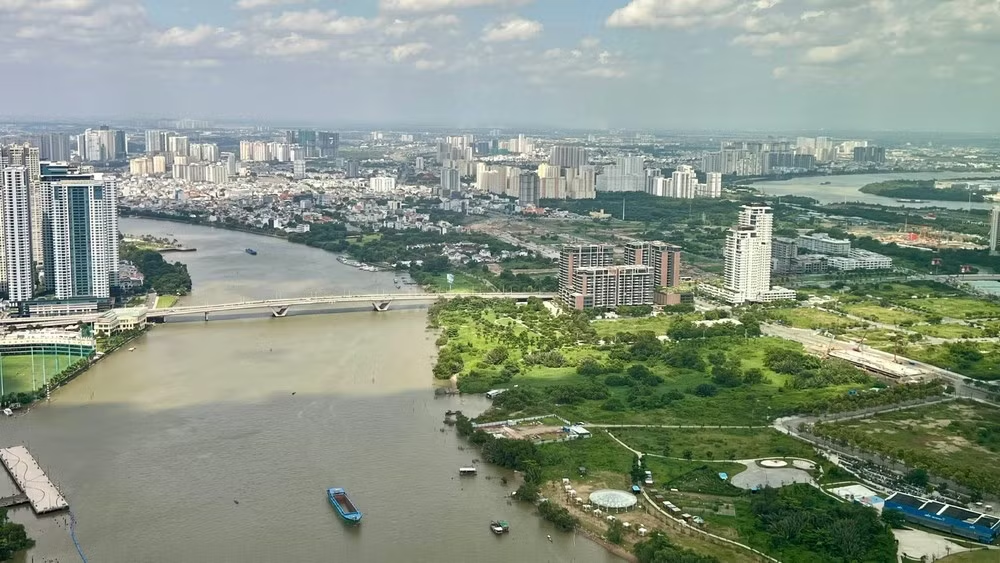
From a real estate perspective, infrastructure tends to redistribute value rather than cause prices to rise uniformly. Areas with good connectivity, suitable land funds and synchronised development will have greater advantages. Ring Road 3, particularly at nodes connecting with the metro system, could give rise to new development centres.
Synchronised connectivity infrastructure will create conditions for areas that were once on the urban fringe to become new development centres, contributing to the formation of a more polycentric and dynamic megacity.
The expansion of development space brings Ho Chi Minh City both enormous potential and mega opportunities, as well as challenges. The new space will only truly create value when accompanied by new governance capacity, an appropriate institutional framework, properly prioritised infrastructure and the ability to mobilise resources effectively.