According to 2025 statistics, two-way trade between Viet Nam and CPTPP members reached 124.5 billion USD, of which Viet Nam’s exports stood at 70.6 billion USD, up 11.5% compared with 2024. Notably, exports to markets with which Viet Nam had not had free trade agreements (FTA) before the CPTPP, such as Canada, Mexico and Peru, continued to grow positively.
From market redirection to supply chain restructuring
Speaking at a recent seminar “From global trade fluctuations to market opportunities: Leveraging CPTPP to redirect and expand exports”, Ngo Chung Khanh, Deputy Director of the Department of Foreign Market Development and Multilateral Trade under the Ministry of Industry and Trade, said that amid the restructuring of global supply chains, Viet Nam, as a production hub, is becoming a potential partner for markets seeking to diversify supply sources.
According to Ngo Chung Khanh, the total import turnover of CPTPP countries, excluding Viet Nam, stood at around 4.25 trillion USD in 2025, while Viet Nam’s exports to the remaining members of the bloc reached over 70 billion USD, equivalent to a market share of more than 1%. In Canada and Mexico alone, two markets that have only recently had FTAs with Viet Nam, Viet Nam’s export market share also remains at over 1%.
These figures show that there is still ample room for exploitation. However, the potential in each market does not mean that opportunities will automatically turn into orders. Businesses must identify which products are suitable, which segments have demand and where their own advantages lie.
Mexico is a clear example of the possibility of expanding export space through the CPTPP. In 2025, two-way trade between Viet Nam and Mexico reached 8.17 billion USD, up 27%; Viet Nam’s exports to Mexico exceeded 7 billion USD, up nearly 29%. By August 2026, bilateral trade had reached 7.2 billion USD, up nearly 40%, of which Viet Nam’s exports were nearly 6.3 billion USD, also up nearly 40%. Key growing product groups included computers, electronics and components, machinery and equipment, footwear, textiles and garments, vehicles and spare parts.
According to Nguyen Thi Trang, Trade Counsellor at the Viet Nam Trade Office in Mexico, Mexico should not be viewed only as a market of more than 130 million people. With its position connecting North America and the Latin American market space, Mexico has demand both for domestic consumption and for raw materials, components, machinery and equipment for production chains linked to North America.
However, “having a market and tariff preferences does not mean having orders,” Nguyen Thi Trang emphasised. The CPTPP creates tariff advantages when businesses properly meet rules of origin and import regulations, but the ability to turn opportunities into contracts still depends largely on business capacity.
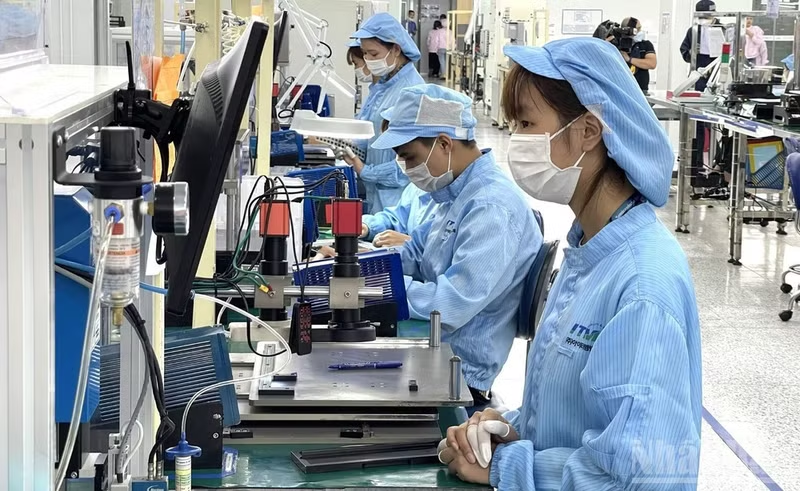
For the electronics sector, export redirection cannot happen immediately. Do Thi Thuy Huong, Vice Chairwoman and General Secretary of the Viet Nam Electronic Industries Association, said businesses should not wait until traditional markets face disruptions before starting to look for alternative markets. Each market has its own requirements regarding technical standards, supply conditions and customer demands.
Therefore, market redirection entails complex adjustments across the entire supply chain. Common bottlenecks facing businesses include a lack of market information, difficulties in verifying partners, technical requirements, rules of origin and the ability to build suitable supply chains.
Notably, for small- and medium-sized enterprises, the CPTPP does not necessarily open opportunities only for exporting finished products. Businesses can participate more deeply in supply chains as suppliers of components, materials, modules or certain stages of production. Thus, opportunities from the CPTPP lie not only in direct exports, but also in the ability to participate in regional production ecosystems.
“To do this, businesses must also change the way they manage themselves. In the electronics sector, requirements on traceability, sources of raw materials and components, suppliers, records and documents require businesses to invest in data management systems, supplier management and supply chain transparency. The CPTPP can therefore be viewed as a space that connects suppliers of raw materials and components, manufacturers, buyers, technology partners and logistics providers,” Do Thi Thuy Huong affirmed.
Turning preferences into competitiveness
To make effective use of the CPTPP, the first requirement remains compliance. According to Ngo Chung Khanh, rules of origin are a prerequisite for enjoying preferential tariffs. In addition, the CPTPP is a high-standard agreement that includes requirements on labour, the environment and other non-tariff issues, posing considerable challenges, especially for small- and medium-sized enterprises.
From the experience in Mexico, Nguyen Thi Trang said businesses need to approach market expansion across the entire lifecycle of a transaction. Before a transaction, they must correctly identify HS codes, rules of origin, technical standards, labelling requirements, quarantine or food safety requirements where applicable, while carefully studying their partners.
Once a transaction begins, issues relating to contracts, payment, documents, logistics and customs clearance must continue to be controlled. When trade turnover increases, businesses must also pay attention to policy changes and trade remedy measures in the host market.
One process recommended by the Viet Nam Trade Office in Mexico for businesses beginning to tap into the market is to study products and import requirements; assess their own competitiveness; bring products to the market to test demand; meet buyers directly and move deeper into transactions; and then continue monitoring and nurturing connections to turn them into long-term trade relationships.
Thus, leveraging the CPTPP is not about “exchanging” one market for another. It is a process in which businesses proactively build a more diversified business structure, from markets and supply sources to partners.
Accordingly, businesses should not wait for market volatility before looking for alternatives. Diversification needs to be prepared while markets are still favourable, while maintaining and developing traditional markets. According to Do Thi Thuy Huong, the greater value of an FTA lies not only in tariff rates, but also in creating broader market and supply chain space. Businesses need to diversify markets, sources of raw materials, components, technologies, suppliers and partner networks at the same time.
To support businesses, the Ministry of Industry and Trade is also moving towards building an FTA implementation governance system with three pillars: information; assessment of FTA implementation results at the local level; and development of an ecosystem for utilising FTAs, connecting resources from central and local authorities, associations, businesses, logistics providers and relevant organisations.
The CPTPP is therefore prompting a new approach for Vietnamese businesses: seeking not only places to sell goods, but also additional business options; diversifying both output and input markets; and making use of tariff preferences to turn FTA commitments into real competitiveness.
In a world of volatile trade, the value of the CPTPP lies in its ability to open more doors, spread risks, restructure supply chains and build capacity for long-term presence. When businesses correctly identify products, find the right partners, comply with rules of origin and proactively manage supply chains, the CPTPP will be more than an agreement with preferential tariff rates. It will become a concrete business tool, helping Vietnamese goods expand export space and strengthen resilience against fluctuations in global trade.


![[Infographic] Viet Nam's 16 Comprehensive Strategic Partners](https://en-cdn.nhandan.vn/images/nyM650OGFWrOVWc-xajqN-rTZ68Rlmc1fiGJOhBRYHHdkBILL2hAdMw_FHcqH-128bTaQBSOAMd0_NcTypwz7H-j_NBZzuSdgF8ETMmVl1xLtdcCjym8rCUyKZqQgOZtC4ouMEzxlJoQ-MllehtjehDxIkn58uqaoaCRy4fSY54/1792513260540-1528117236743671738-1528117236743671738-9e797c256fe32c7c7b9c1cc03b0ca64e.jpg.avif)