The CPTPP's role as a framework for promoting free trade is being further strengthened amid the global rise of protectionism.
For the first time, the CPTPP has introduced a preliminary consultation mechanism before opening formal accession negotiations. Candidate economies will undergo assessments of their domestic legal frameworks and trade regulations against the agreement's high standards.
To join the bloc, applicants must meet stringent requirements, including eliminating tariffs on the vast majority of goods, protecting intellectual property rights and complying with comprehensive trade rules covering other areas.
In addition, the launch of formal accession negotiations requires the unanimous consent of all existing CPTPP members. The introduction of the preliminary negotiation mechanism comes amid growing interest from countries seeking to join the bloc. Cambodia submitted its application for membership in November 2025, while Argentina formally applied earlier this month.
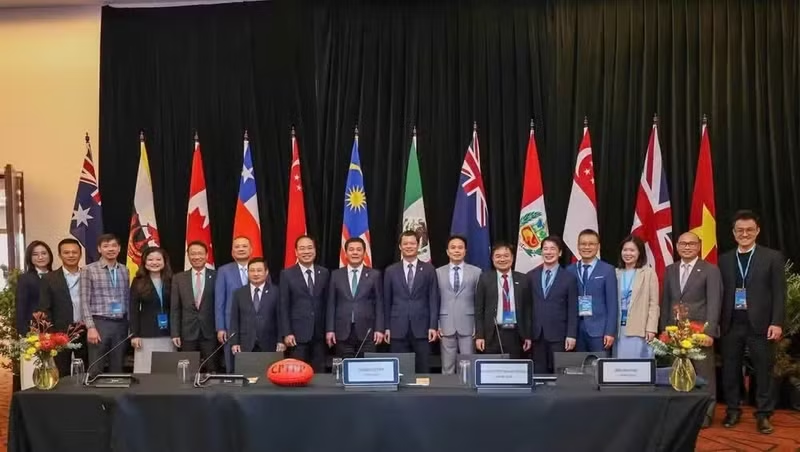
The CPTPP entered into force in 2018 after the US withdrew from its predecessor agreement during President Donald Trump's first term. The bloc now comprises 12 members: Australia, Brunei, Canada, Chile, Japan, Malaysia, Mexico, New Zealand, Peru, Singapore, the UK and Viet Nam.
The CPTPP entered into force in 2018 after the US withdrew from its predecessor agreement during President Donald Trump's first term. The bloc now comprises 12 members: Australia, Brunei, Canada, Chile, Japan, Malaysia, Mexico, New Zealand, Peru, Singapore, the UK and Viet Nam.
As the global economy faces a rising tide of protectionism, characterised by higher tariffs and the fragmentation of traditional supply chains, the CPTPP has emerged as a beacon for safeguarding and advancing trade liberalisation. Its role continues to strengthen, reflected in three key strategic dimensions.
First, its high-standard rules provide a counterweight to protectionism. Beyond eliminating 95–98% of tariff lines, the agreement establishes rigorous disciplines on intellectual property, e-commerce, state-owned enterprises, labour and environmental standards. When larger multilateral mechanisms such as the World Trade Organisation (WTO) face deadlock, the CPTPP serves as a model framework, ensuring that trade among its members remains open, transparent and predictable despite growing protectionist barriers elsewhere.
A second factor is its expanding appeal and wider influence. The clearest evidence of the CPTPP's growing relevance is its continued enlargement. The UK's accession in December 2024, together with applications and expressions of interest from a number of other major economies, demonstrates the agreement's strong international attractiveness. This expansion has transformed the CPTPP from a regional trade pact into an increasingly global trading bloc, strengthening its economic weight as a counterbalance to unilateral protectionist trends.
A third strategic advantage lies in supply chain diversification and resilience. For member economies, the CPTPP provides a safeguard by enabling businesses to diversify export and import markets. When major markets outside the bloc impose protectionist measures or punitive tariffs, companies within the CPTPP can shift trade more easily and benefit from preferential intra-bloc tariff arrangements. Its rules of origin also encourage members to develop more resilient regional supply chains.
The 12-member CPTPP represents a significant share of the global economy, with a combined gross domestic product (GDP) of around 15 trillion USD, accounting for approximately 15% of global GDP. Its consumer market encompasses nearly 600 million people, or about 7.3% of the world's population, while its combined trade accounts for roughly 15% of global merchandise trade. The agreement has played an important role in helping member economies maintain steady export growth despite increasingly complex geopolitical uncertainties.
The CPTPP's continued expansion sends a clear message to the world: while tariff barriers may rise in some regions, the flow of free trade will continue to find new pathways elsewhere. Beyond promoting economic growth, the agreement also serves as a mechanism for fostering stability and peace by strengthening shared interests and mutual prosperity among its members.