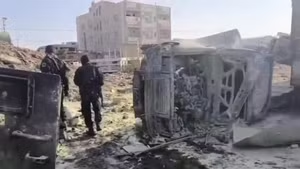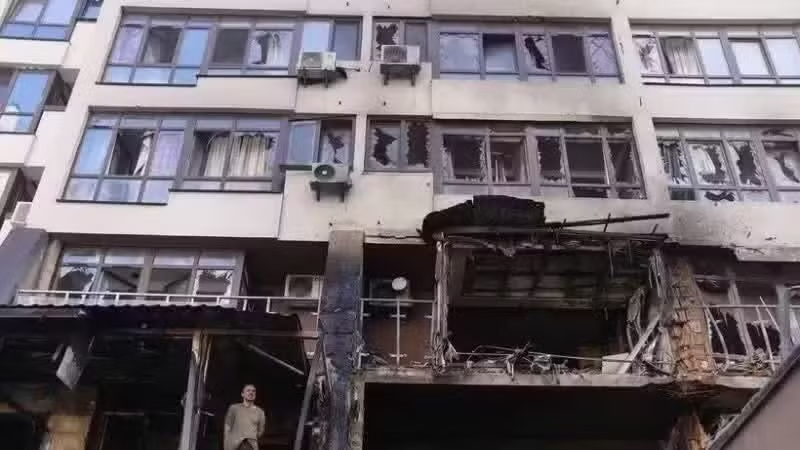
The cycle of retaliation through missile and unmanned aerial vehicle (UAV) attacks is pushing the confrontation between Russia and Ukraine into a new stage of escalation.
Moscow stated that Russia's intensified attacks are a response to changes in Ukraine's military strategy, while experts believe that the conflict has entered a new phase.
In the more than four years since it broke out, the conflict in Ukraine has evolved from a military campaign that was expected to achieve rapid results into a prolonged war of attrition, marked by complex strategic calculations and the extensive use of advanced technology.
The intense developments on the battlefield have made hopes for peace in the crisis, now entering its fifth year, increasingly fragile. Diplomacy, an essential tool for resolving the conflict, is being hindered by a range of factors.
On July 4, the US President Donald Trump held telephone talks with the leaders of Russia and Ukraine to discuss the conflict in Ukraine ahead of the North Atlantic Treaty Organisation (NATO) Summit. The talks marked a notable diplomatic effort by Washington after months of US-led negotiations being in a deadlock.
The conflict in the Middle East has shifted President Donald Trump's attention and reduced public focus on the crisis in Ukraine.
In any conflict, achieving a lasting peace agreement requires a certain degree of compromise from all parties involved.
Although Russia, Ukraine, the US, and the European Union (EU) have all expressed a desire to bring the conflict to an end, each side continues to pursue different strategies and priorities, creating an extremely complex and challenging negotiating environment. However, the territorial issue remains the biggest obstacle and a "red line" in the confrontation between Russia and Ukraine.
Moscow wants Kiev to completely withdraw its forces from the Donbass region and seeks to remove what it considers the root cause of the conflict, namely NATO's eastward expansion. Meanwhile, Ukraine regards the protection of its sovereignty and territorial integrity as a prerequisite for any peace agreement.
For the US and Europe, the issue of Ukraine is closely linked to their strategic priorities. The path to ending a war shaped by competing interests and deeply differing views is certain to remain paved with difficulties.
At the recent NATO Summit in Ankara, the capital of Türkiye, NATO pledged approximately 70 billion euros in military equipment and training assistance for Ukraine in 2026 and confirmed that it would maintain a similar level of support in 2027.
Moscow reacted immediately and strongly argued that such developments were not conducive to dialogue aimed at achieving peace. At the same time, doubts remain over whether NATO's aid package can be fully implemented in practice.
Some experts believe that the commitments made in Ankara are intended as long-term guidance, while their implementation will depend largely on the budget cycles of individual member states.
Several NATO members are currently facing difficulties in providing additional funding and weapons to support Ukraine's military efforts.
The Netherlands recently announced that it had "reached its limit" and could no longer provide direct military assistance to Ukraine, while the Czech Republic declared that it would not participate in the aid package recently pledged by NATO.
As the war continues and enters increasingly dangerous new phases, both Russia and Ukraine face growing pressure to sustain their financial and military resources in the long term.
Because of their deeply differing viewpoints, negotiations between the two sides have so far achieved progress only on technical issues, such as prisoner exchanges and temporary humanitarian corridors.
Meanwhile, reaching a peace agreement will require both sides to make concessions on strategic interests relating to sensitive issues such as territory and security guarantees.
As fighting continues to rage across the battlefield, efforts to bring the conflict to an end are facing increasing difficulty.