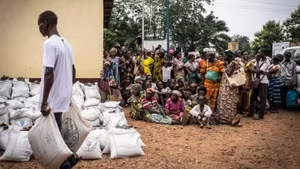
Global food security remains extremely fragile and faces multiple overlapping crises. The number of people enduring acute food insecurity worldwide has reached a record of around 266 million across 47 countries and territories, nearly double the 2016 level, and has remained above 20% of the total population since 2020. The situation is particularly severe in conflict hotspots such as Gaza and Sudan, as well as in several countries in South Asia and East Africa.
According to FAO, prolonged geopolitical conflict remains the leading cause, driving more than 80% of food crises. Conflict hotspots in the Middle East and Eastern Europe have disrupted supply chains, isolated markets, and impeded international trade flows through vital maritime routes such as the Strait of Hormuz and the Red Sea.
Another factor is the return of El Nino, unleashing extreme weather patterns such as severe drought, record heat, and erratic storms and floods, which directly diminish the output of key food crops including rice and maize. In addition, agricultural input costs have soared due to direct impacts from energy markets and export restrictions, forcing farmers in poor countries to reduce fertiliser use and indirectly lowering crop yields.
Finally, domestic food price inflation in many low-income countries has remained above 5%, increasingly impeding access to nutritious meals, even during periods when international agricultural commodity prices have eased.
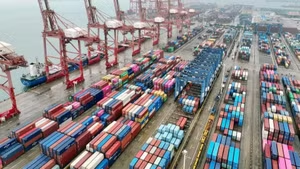
Global agricultural trade has surged over the past two decades, with its value increasing fivefold since 2000 to approximately 2 trillion USD. As climate change, geopolitical conflict, disease outbreaks, and economic shocks exert mounting pressure on supply chains, maintaining the stable operation of food trade networks has become a top priority for countries.
FAO emphasises that the primary solution is to strengthen trade connectivity. Countries that diversify their supplies across multiple partners or maintain close links with major trading hubs can more effectively mitigate the impacts of natural disasters, market volatility, and supply disruptions than economies dependent on only a small number of partners.
Experts have also cautioned against the consequences of trade protectionism. In the event of a severe El Nino, export restrictions could push an additional 21.4 million people worldwide into food insecurity.
FAO recommends more efficient and sustainable food reserve strategies. Rather than maintaining large and costly stockpiles to intervene in market prices, countries should focus on proportionate emergency reserves linked to social welfare systems to provide direct support to vulnerable groups during crises.
During the Covid-19 pandemic, international coordination and timely policy recommendations prompted countries to impose fewer export restrictions and keep them in place for shorter periods than during the 2007–2008 food crisis. As a result, only around 8% of globally traded calories were impacted, half the 16% recorded during the earlier crisis.
Although major shocks can still disrupt markets and trigger sharp price fluctuations, particularly for commodities with relatively low levels of international trade such as rice, the global food trade system generally retains the capacity to adjust in the short term.
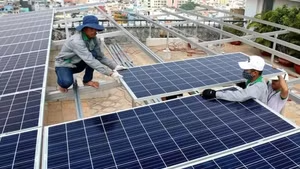
To address the root causes of food insecurity, experts recommend that the global community focus on three pillars: strengthening self-reliance through technology by shifting towards climate-smart agricultural models; keeping supply chains flowing by encouraging countries to reduce export barriers while investing heavily in logistics infrastructure to prevent agricultural products from being stalled; and reducing agriculture’s dependence on chemical fertilisers and fossil fuels by switching to organic fertilisers and renewable energy.