According to Chu Quoc Thinh, Head of the Food Safety Department under the Ministry of Health, to institutionalise the directives of the Politburo and General Secretary and President To Lam, the Ministry of Health has led coordination with ministries, sectors, and relevant agencies to mobilise resources to draft the revised Law on Food Safety and the Project to improve the State management apparatus for food safety through a unified authority from the central to the local level. At the same time, ongoing efforts aim to digitalise and establish an integrated national food safety database system.
These three policy pillars establish fundamental solutions for controlling the entire food value chain, from initial farming, livestock breeding, and cultivation through processing, distribution and final consumption.
Preventing risks at their source
According to Chu Quoc Thinh, the revised draft Law on Food Safety centres on shifts the management approach from merely "responding to problems after they occur" to proactively "preventing risks at their source".
Accordingly, the draft law focuses on establishing a risk-based management mechanism across the entire supply chain, to monitor and ensure food safety throughout all stages of the food supply chain, from initial production — including cultivation, livestock farming, aquaculture, harvesting, fishing, extraction, and slaughtering — to preliminary processing, manufacturing, trade, and market distribution. This approach is also widely adopted in many developed countries.
At the same time, gradually shifting towards food safety management based on digitised data and an integrated national information system will promote coordinated management and reduce processing times. The digitalisation of data enhances prevention, incident response, product traceability in the event of food safety incidents, and food inspection during market circulation.
In addition, a unified food safety information system spanning the central and local levels will provide a foundation for consistent and effective management across the entire food supply chain.
Eliminating fragmented management and overlapping responsibilities in food safety management
Discussing the draft project to improve the State management apparatus for food safety through a unified authority from the central to the local level, Chu Quoc Thinh noted it aims to eliminate the fragmented management structure and overlapping responsibilities currently shared among different ministries and sectors. A single management authority would facilitate smoother information flows, optimise comprehensive monitoring of the food supply chain, and empower competent authorities to swiftly identify and address food safety incidents as soon as they arise.
At present, Viet Nam's State management system for food safety divides responsibilities among three ministries: the Ministry of Health; the Ministry of Agriculture and Environment; and the Ministry of Industry and Trade. Each ministry oversees specific categories of food products.
Specifically, the Ministry of Health manages six food categories, the Ministry of Agriculture and Environment manages 19 categories, and the Ministry of Industry and Trade manages eight categories.
For each assigned food category, the relevant ministry is responsible for managing the entire food supply chain, including initial production, preliminary processing, manufacturing, storage, transportation, distribution, and commercial activities. Each ministry also maintains a specialised vertical management system for food safety from the central to the local level.
At the local level, People's Committees at all levels perform State management functions relating to food safety in accordance with responsibilities assigned by the Government and delegated by the specialised ministries.
Meanwhile, the Ministry of Science and Technology oversees State management of standards, technical regulations, measurement, product quality, and conformity assessment for food products, although it does not directly carry out specialised food safety management.
Under the current model, dividing food safety management by product categories limits coordination among State agencies. This causes overlapping responsibilities, inconsistent management, and, in some cases, uncertainty over which authority is responsible when a food supply chain spans the jurisdiction of many ministries and sectors.
Promoting public awareness to change behaviour across society
According to the Head of the Food Safety Department, n addition to long-term strategic institutional solutions, the Government and the Ministry of Health also regularly issue directives to strengthen inspections and supervision in sectors and locations considered to be at high risk of food poisoning.
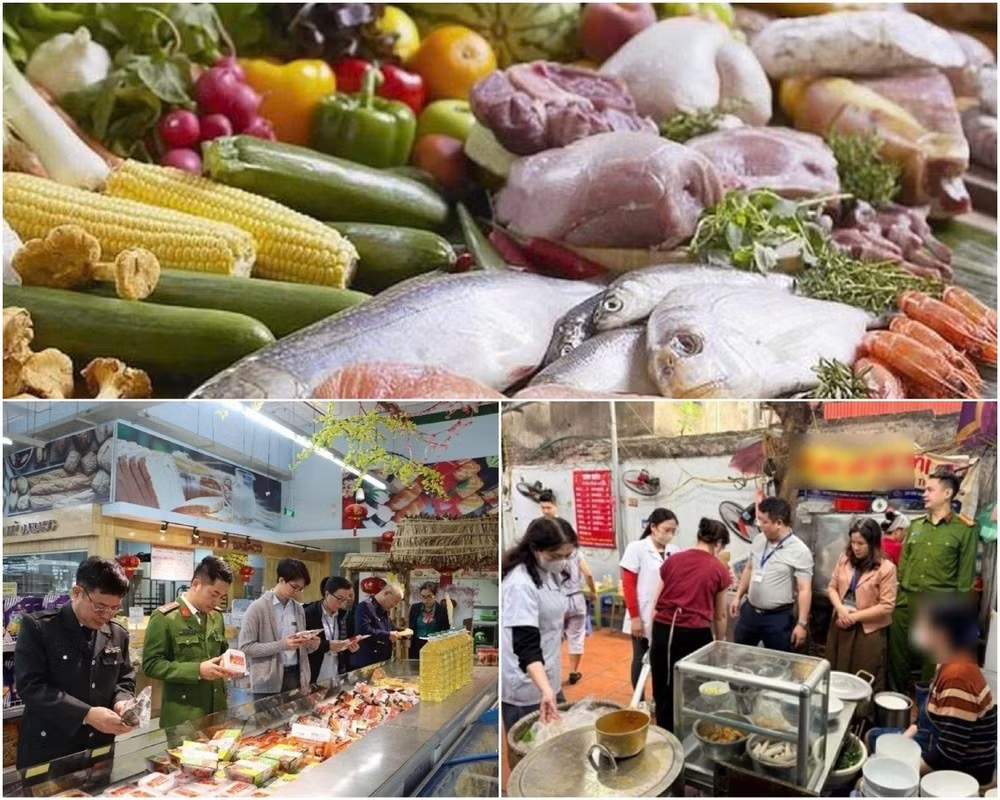
A major priority is the strictly monitoring collective kitchens in industrial parks and schools, where millions of meals are served daily. Management efforts will focus on controlling the quality of raw ingredients and strictly enforcing food sample retention requirements.
"In addition, street food businesses — which are difficult to manage because they are small-scale and frequently mobile — are subject to more frequent scheduled and unannounced inspections by local authorities. Vendors are also being guided to comply with the 10 golden principles of food hygiene and safety, while commune-level authorities, as the level of government closest to the public, are encouraged to strengthen community supervision," Thinh emphasised.
The Head of the Food Safety Department also noted that during the Action Month for Food Safety, held from April 15 to May 15, 2026, inter-sectoral inspection delegations from the central to the local level inspected more than 62,000 establishments and identified nearly 5,750 violating establishments. Of these, 3,687 establishments were sanctioned, with total fines exceeding 22.4 billion VND. Twenty-nine establishments were suspended from operating, while 17 cases showing signs of serious violations were referred to investigation authorities.
According to Chu Quoc Thinh, this round of inspections focused on food production and trading establishments; facilities operating collective kitchens, catering services, and street food businesses; production and import hubs; wholesale markets; trade centres; supermarkets; traditional markets; slaughterhouses; food transportation operations; while strictly controlling smuggling, counterfeit goods, substandard products, and expired food.
Alongside inspection and supervision, State management agencies view information dissemination, education, and public communication as the fundamental solution to change the behaviour of the entire society.
Communication activities have evolved beyond disseminating legal documents. Instead, they increasingly focus on providing practical guidance tailored to different target groups. For producers, livestock farmers, and food processors, communication campaigns encourage changes in long-standing practices such as the excessive use of pesticides and hazardous chemicals, promoting instead a mindset of safe production and accountability.
For consumers, communication programmes aim to cultivate the habit of refusing unsafe or untraceable food products, actively scanning QR codes to verify product origins, and instinctively reporting businesses engaging in dishonest or unsafe practices.
According to Chu Quoc Thinh, this sustainable behavioural change from both the supply and demand sides is the root solution to eliminate food safety risks and make food hygiene practices a conscious cultural norm in daily life.