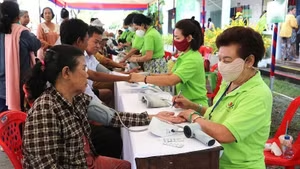
The conference emphasised the need to further improve the effectiveness of health insurance policy implementation, strengthen control of medical examination and treatment costs, and safeguard the rights and benefits of insured participants in the new context.
Speaking at the the conference, VSS Director General Le Hung Son noted that the social insurance system had implemented a range of coordinated measures during the first half of 2026, achieving significant results in implementing health insurance policies, contributing to protecting the interests of insured participants. However, he warned that rising healthcare costs would pose considerable challenges in the second half of the year, requiring continued innovation in management methods, improvement of assessment quality, and tightening of discipline and order in the performance of duties.
He urged localities to accurately assess existing shortcomings and proactively analyse healthcare expenditure data in order to detect abnormal spendings at medical facilities early, thereby preventing budget overruns that could affect the Health Insurance Fund and policyholders' benefits.
According to a report by the Department of Health Insurance Policy Implementation and the Centre for Social Insurance and Electronic Health Insurance Payment Control, by the end of June 2026, there were 3,672 medical facilities nationwide providing health insurance-covered services, including 2,354 public facilities and 1,318 private facilities, an increase of 26 facilities compared with 2025.
The healthcare network comprised 94 specialised hospitals, 1,498 primary-level facilities, and 2,080 initial-care facilities, helping meet the increasingly diverse healthcare needs of the people.
Approximately 94.4 million health insurance-covered medical visits were recorded during the first six months of the year, broadly unchanged from the same period in 2025. Inpatient treatment accounted for 10.3% of all cases, a slight increase year-on-year.
Total health insurance-covered healthcare expenditure reached 84.77 trillion VND, up 11.1% from the corresponding period last year and representing 54.42% of the annual spending estimate.
Following the introduction of several new health insurance regulations in 2026, VSS proactively issued guidance to localities to address implementation challenges.
Notably, the application of information technology, digital transformation, data analytics, and artificial intelligence (AI) continued to expand in management and assessment of health insurance.
In parallel, VSS remained actively involved in refining the legal framework governing health insurance to better reflect practical needs, remove policy bottlenecks, and improve public access to healthcare benefits.
Besides the achieved results, the conference also pointed out some shortcomings that need to be overcome. The estimated utilisation rate in some localities has exceeded 50% of the yearly target; the average cost per medical examination and treatment continued to increase by about 11.7% over the same period last year. Some localities have high spending growth rates such as Ha Noi, Ho Chi Minh City, Vinh Long, Ca Mau, and Son La.

At the conference, delegates focused on discussing and proposing many practical solutions to improve the effectiveness of implementing health insurance policies, focusing on strengthening assessment, inspection, and control of medical examination and treatment costs covered by health insurance; guiding medical facilities to develop and implement treatment processes and standards appropriate to actual conditions, ensuring reasonable use of drugs and medical supplies, and avoid waste.
According to Nguyen Duc Hoa, Deputy Director of Viet Nam Social Insurance, effectively controlling medical examination and treatment costs covered by health insurance is not only for the reasonable use of funds, but also an important basis for ensuring financial resources and improving benefits for participants, especially for people with serious illnesses, high treatment costs and people in difficult circumstances. "The top priority is to ensure the correct, complete and best benefits for health insurance participants according to the law," Dr. Nguyen Duc Hoa emphasised.
Along with that, promoting digital transformation and applying artificial intelligence in management, assessment, and payment of medical examination and treatment costs covered by health insurance are identified as key tasks, contributing to improving management efficiency, shortening payment time, and creating favourable conditions for people to access medical services.