A range of practical policies
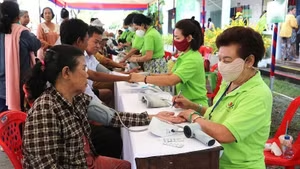
After nearly 20 years of implementing health insurance policies, Viet Nam has achieved significant progress, with health insurance coverage expanding steadily year on year.
Under Decision No.1468/QD-TTg dated July 31, the Prime Minister established targets for universal health insurance coverage for the 2026–2030 period.
Accordingly, the coverage rate is expected to reach 98.67% of the population by 2029 and progress towards 100% by 2030. These figures represent more than coverage targets; they also underscore Viet Nam’s determination to build a healthcare protection system for the entire population.
As living standards improve, demand is also rising for access to modern medical technologies, new medicines, and higher-quality healthcare services.
At the same time, healthcare costs are escalating due to population ageing, changing disease patterns, the increasing prevalence of non-communicable and chronic diseases, and the growing use of advanced treatment techniques.
A suite of new provisions under the Law amending and supplementing a number of articles of the Law on Health Insurance, Decree No.188/2025/ND-CP, and Decree No.161/2026/ND-CP have officially taken effect, significantly expanding benefits for health insurance participants.
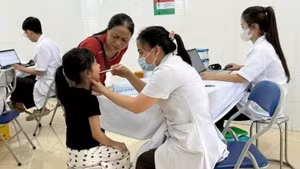
One of the new provisions garnering considerable public attention allows health insurance cardholders who seek outpatient care on their own initiative at certain basic-level and specialised healthcare facilities to still claim reimbursement from the health insurance fund at 50% of their entitled benefit level for a range of diseases. Previously, most outpatient visits to facilities other than the initially registered healthcare provider were not covered.
Vu Thien Huong, a resident of Gia Dinh Ward, Ho Chi Minh City, noted: “I find these changes to health insurance benefits very practical. As benefits are expanded, people will feel more confident about seeking medical examination earlier and will no longer be as worried about treatment costs as before.”
Tran Thi Trang, Director of the Health Insurance Department under the Ministry of Health, stated the new policies would facilitate greater ease in accessing healthcare services while reducing the financial burden of receiving treatment far from their initially registered healthcare facility.
Another important change is that health insurance benefits have been recalibrated in alignment with the new statutory base salary of 2.53 million VND per month.
Accordingly, health insurance participants are entitled to 100% reimbursement of medical examination and treatment costs if the total cost of a single consultation is less than 15% of the statutory base salary, equivalent to 379,500 VND.
Those who have participated in health insurance continuously for at least five years are entitled to 100% coverage of costs within their benefit package once their annual co-payments surpass six times the statutory base salary, equivalent to more than 15.8 million VND.
In addition, for medical procedures involving high-value medical equipment, the maximum payment from the health insurance fund has been elevated to the equivalent of 45 months of the statutory base salary, or more than 113.85 million VND per procedure.
These adjustments have expanded health insurance benefits and served to significantly reduce patients’ out-of-pocket treatment expenses.
Notably, at a time when many families confront annual medical bills running into hundreds of millions of VND for the treatment of cancer, cardiovascular disease, kidney failure, organ transplants, and long-term chronic conditions, expanding the scope of health insurance coverage is particularly significant in strengthening social security.
The challenge of strengthening financial protection mechanisms
Although health insurance benefits are being steadily expanded, healthcare experts contend the current level of financial protection still does not fully satisfy the increasingly diverse healthcare needs of the population.
According to Permanent Deputy Minister of Health Vu Manh Ha, out-of-pocket spending on medical examination and treatment currently accounts for around 40% of total health expenditure, higher than the level recommended by the World Health Organization. This implies that many households remain at risk of financial hardship due to illness.
In the context of rapid population ageing, unless healthcare financing policies continue to be reformed, the financial burden of medical examination and treatment will grow increasingly burdensome.
For this reason, alongside expanding benefits under compulsory health insurance, the Ministry of Health is formulating a supplementary health insurance policy tailored to people’s needs.
This major policy direction was delineated by the Politburo in Resolution No.72-NQ/TW on breakthrough solutions to strengthen the protection, care, and improvement of people’s health. It was also emphasised by the Party Central Committee’s Secretariat in Directive No.52-CT/TW, which calls for diversifying health insurance packages and gradually introducing supplementary health insurance to strengthen financial protection for the population.
Under the Ministry of Health’s direction, supplementary health insurance will not replace compulsory health insurance but will instead fulfil a complementary role.
A prerequisite is that people must first participate in compulsory health insurance, after which they may voluntarily procure supplementary health insurance packages offered by insurance companies. The coverage provided by supplementary health insurance will not overlap with benefits available under compulsory health insurance.
Packages currently under review include coverage of patients’ co-payments; payment for healthcare services outside the scope of the health insurance fund; financial support for the treatment of critical illnesses and diseases involving exceptionally high costs; and coverage of healthcare services based on individual needs.
This model has been implemented in many countries to provide an additional financial “buffer” for individuals while preserving the central role of universal health insurance.
The State encourages organisations and individuals to purchase or provide financial support for supplementary health insurance for employees. The new health insurance policies distinctly reflect a shift in the healthcare sector’s development approach.
Whereas the previous priority was to increase the number of people holding health insurance cards, the focus is now pivoting towards a higher goal: ensuring that participants receive meaningful benefits when they actually seek medical examination and treatment.
The goal of achieving 100% population coverage by 2030 will only be truly meaningful if health insurance effectively shields the public from health-related financial risks.
Expanding benefits, improving coverage levels, diversifying health insurance packages, and further improving healthcare financing policies will empower health insurance to become an increasingly reliable source of protection for every citizen, while providing an important foundation for achieving a more equitable, efficient, and sustainable healthcare system.