Gaps in the institutional framework
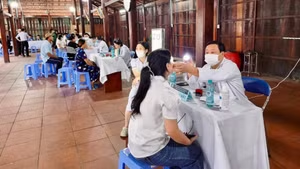
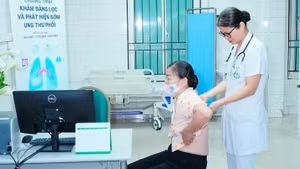
After many years of development, traditional medicine has become an important part of Viet Nam's healthcare system. From the central to grassroots levels, the network of traditional medicine examination and treatment facilities has continued to expand. Many traditional remedies and medicinal ingredients have also been preserved and utilised effectively in disease prevention and treatment, rehabilitation, and people's healthcare.
According to statistics from the Ministry of Health, in 2025, around 7 million visits for traditional medicine examination and treatment were recorded, equivalent to 3.3% of the total number of health insurance-covered medical visits. Spending on traditional medicines accounted for only around 5.42% of total expenditure on medicines from the health insurance fund. This shows that traditional medicine is present throughout the hospital and healthcare system, but it still does not have a commensurate position in resource allocation and reimbursement mechanisms.
In addition, many localities still lack traditional medicine doctors at the grassroots level, while the next generation of practitioners is insufficient to meet demand. The transmission of profession and the preservation of valuable remedies and treatment methods still rely largely on experience and have not been backed by sufficiently strong legal mechanisms to ensure their long-term preservation and development. More importantly, many specific mechanisms to enable traditional medicine to play a deeper role in primary healthcare, chronic disease management, rehabilitation, elderly care, and integration with modern medicine have not been fully institutionalised.
According to Dr Phung Tuan Giang, a traditional medicine practitioner and Chairman of the Viet Nam Institute for Traditional Medicine Development, in practice, there remains a considerable gap between policies and the achieved results. For many years, traditional medicine has developed mainly on the basis of provisions scattered across the Law on Medical Examination and Treatment, the Law on Pharmacy, as well as various specialised decrees and circulars.
Each legal document regulates part of the sector's activities, but they have not formed a unified legal framework for the entire field of traditional medicine. From training, professional practice, scientific research, medicinal plant development, the production of traditional medicines, and the preservation of traditional knowledge to digital transformation, these areas are governed by different legal documents, with insufficient coordination and consistency.
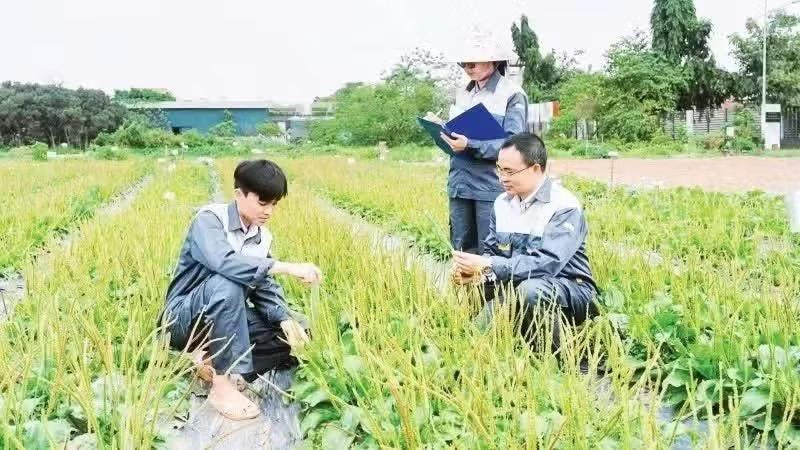
In addition, many medicinal-plant-growing areas have not been standardised; the quality standards system remains inconsistent; and traceability, quality control of medicinal plants, and the development of value chains have not met the requirements of both the domestic and export markets.
A driving force for development in the new period
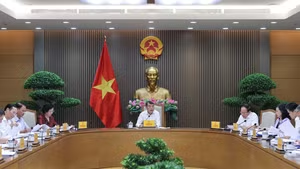
Resolution No. 72-NQ/TW sets out the requirement to strongly promote the role of traditional medicine in the new period of development, considering it one of the important solutions to improving the effectiveness of protecting, caring for, and enhancing people's health. If the resolution provides the strategic direction for the development of traditional medicine in the new period, the building of a law on traditional medicine would be the step needed to institutionalise the Party's policies into unified and feasible regulations.
According to Assoc Prof, Dr Pham Le Tuan, Chairman of the Viet Nam Association of Military and Civilian Medicine, practice shows that traditional medicine has great potential but still lacks a unified legal framework to connect resources.
Therefore, the construction of the law must clearly affirm the legal position of traditional medicine and pharmacy as a pillar of the healthcare system, rather than an auxiliary or secondary field. The development of traditional medicine and pharmacy must be based on the principle of harmony: preservation – inheritance – development – modernisation, while also embracing advanced science and technology.
Notably, all policies under the law must be geared towards putting patients at the centre and improving access to traditional medicine and pharmacy services, particularly at grassroots level and in communities.
Therefore, the law not only addresses current inadequacies but also resolves existing difficulties and obstacles within the system of sub-law documents, thereby laying the foundation for the development of the traditional medicine and pharmacy sector in a modern, scientific, and integrative manner.
According to Associate Professor Dr Le Van Truyen, Chairman of the Scientific and Training Council of the Health Economics Research and Assessment Centre, Viet Nam currently only has a national policy on traditional medicine through 2030 and does not have a separate law on traditional medicine.
If Viet Nam wants to raise the standing of traditional medicine in the region and internationally, while standardising and comprehensively developing the sector, it should consider submitting a Law on Traditional Medicine to the National Assembly in the future, as has been done by the Republic of Korea, India, and China.
The time has come to enact a law on traditional medicine and pharmacy. This would not only be a step towards completing the healthcare sector's institutional framework but also a solution for turning the heritage of Vietnamese traditional medicine into a resource for development, contributing to the building of a modern, humane healthcare system that is deeply rooted in national identity.