Over the years, research institutions and localities have implemented numerous projects and programmes on medicinal plants and indigenous knowledge, especially in ethnic minority and mountainous regions. A vast amount of data has been collected, ranging from lists of medicinal plants, remedies, and usage methods to information on distribution areas, healing practices, and the generational experience of traditional healers.
However, a current shortcoming is the fragmented and uninterconnected nature of the data, limiting its utilisation for long-term goals.
In reality, each project, programme, and locality develops its own set of survey questionnaires, recording methods, and classification systems. For example, the same plant species may have many different names, be described with varying levels of detail, or even be considered different objects in different databases. This makes data aggregation, comparison, and interoperability difficult.
Many studies remain focused on record-keeping rather than building a living data source that can be continuously analysed, updated, and utilised. Therefore, when a project ends, the data is almost “frozen” in reports, books, or other private storage media, with little chance of connecting with other studies later. A researcher in medicinal plants stated that data in books has already been summarised, analysed, and processed, while valuable data — the researcher's personal notes — is personal, not centrally managed, easily lost, and very wasteful.
The consequence of this situation is that it is difficult to identify major patterns in the use of medicinal plants and remedies for conservation and development purposes, such as which plant species are used by many ethnic groups, which disease groups are most commonly treated, which plant species harvested from nature are most frequently used, or where medicinal plant cultivation areas linked to indigenous knowledge can be developed? These significant questions are beyond the capacity of individual research projects to answer.
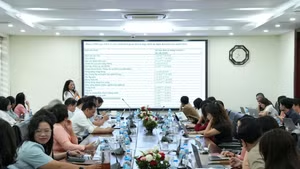
Recently, a research group from Ha Noi University of Pharmacy has collected and digitised medicinal plant and remedy recipes used by ethnic minorities in the northern mountainous region as part of a national target programme. The project’s task was not only to record a list of medicinal plants and remedies but also to digitise the knowledge, building a framework for future research and management.
Thanks to this, important discoveries have been made for the conservation and development of medicinal plants, such as: the main parts used are leaves, stems, roots, and bark; common treatment groups include musculoskeletal, digestive, dermatological, renal-urinary, and trauma; most traditional healers proactively cultivate wild medicinal plants in their home gardens.
Data also warns of the risk of the loss of traditional medicine knowledge, such as the average number of generations practicing medicine being only two to three, a low rate of apprenticeship; most remedies have not been registered or extensively researched, and have not been developed into products. According to experts, this is a risk of knowledge loss if timely solutions are not implemented.
A national coordinating agency is needed to promptly digitise knowledge of medicinal plants and traditional remedies nationwide to systematically preserve this valuable knowledge source, while simultaneously building a shared data system to effectively serve research, training, and management.
In Directive No. 25/CT-TTg (September 15, 2025) on promoting the development of Vietnamese traditional medicine in the new phase, the Prime Minister requested a focus on digitising valuable documents and materials on traditional medicine, building a national database on medicinal plant regions, medicinal herbs, medicinal plants, remedies, exemplary healers, and scientific works to facilitate preservation and retrieval.
Based on practical experience and the requirements of the aforementioned directive, the issue is to apply science and technology to transform research into lasting shared value. Accordingly, a national coordinating agency is needed to promptly digitise knowledge of medicinal plants and traditional remedies nationwide to systematically preserve this valuable knowledge source, while simultaneously building a shared data system to effectively serve research, training, and management.
Experts also believe that when the data is sufficiently large, the application of artificial intelligence will open up possibilities for in-depth analysis and automated data processing, allowing for the development of new research directions. This database is also an important tool for management agencies to monitor the current state of medicinal plant exploitation, assess the risk of genetic resource depletion, and supervise the effective use of traditional medicine knowledge. For local people, it will provide a more scientific basis for conserving and developing medicinal plants in conjunction with sustainable livelihoods.