Changes are not yet uniform, and points that still need improvement remain, but the apparatus has begun to leave the old trajectory and move toward a different mode of operation.
The whole country shifts to a new model
The year 2025 entered the history of state administrative reform as a particularly important milestone, when Viet Nam simultaneously implemented the largest-ever revolution in reorganizing and streamlining the organizational apparatus and, for the first time, operated a two-tier local government model nationwide. That decision was not merely about rearranging administrative units or reducing payrolls, but reflected a fundamental change in thinking and approach to national governance.
From July 1, 2025, the country formed 34 provincial-level administrative units and 3,321 commune-level administrative units; the operation of 696 district-level administrative units ended. At the same time, the system of specialized agencies under the People’s Committees at all levels was strongly reorganized and consolidated. From the beginning of the year to December 15, 2025, localities reduced 709 provincial-level specialized agencies and 8,289 district-level specialized agencies. At the same time, 467 provincial-level specialized agencies and 9,916 commune-level professional divisions were established under the new model and quickly put into operation.
This streamlining helps the apparatus operate smoothly, reduces intermediary stages, and increases connectivity, responsibility and efficiency in direction and administration. Notably, in administrative reform and digital transformation, by the end of 2025, the National Public Service Portal had integrated more than 3,300 administrative procedures from 34 provinces and cities, becoming a national digital “one-stop shop,” enabling people and businesses to search, submit applications and track results online conveniently and transparently, regardless of space and time.
Alongside the implementation of the two-tier local government model are significant changes from the Ministry of Finance – a pioneering unit with decisive and synchronous solutions that create a “foundation” for the process of streamlining and implementing public financial policies. According to Deputy Minister Nguyen Duc Tam, after three reorganizations of the apparatus since March 1, 2025, the number of organizational units under the Ministry has decreased by about 37%. The Ministry of Finance strives to ensure that 100% of people and businesses using online public services are seamlessly and consistently identified and authenticated through VNeID across the sector’s platforms and systems.
Working more, clearer results and people waiting less
Up to now, after nearly eight months of operating under the two-tier local government model, the correctness of a bold and appropriate policy decision has been affirmed, bringing practical results.
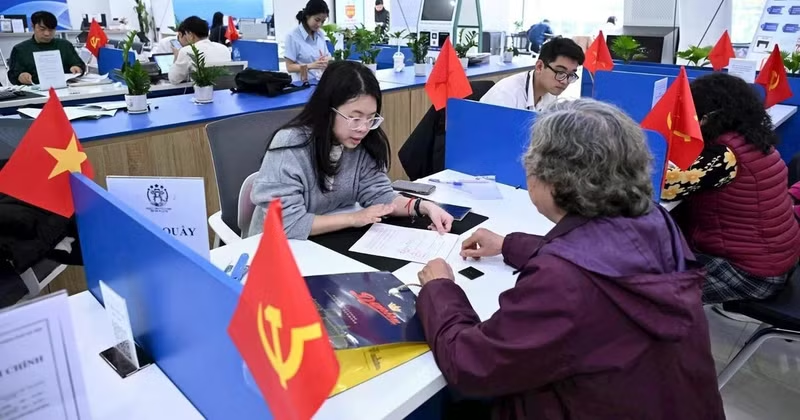
After merging five central wards including Dong Tam, Minh Tan, Yen Ninh, Nguyen Thac and Hong Ha, Yen Bai ward has become the largest urban center of Lao Cai province, with a population of more than 70,000 people. The new apparatus had to operate immediately on the basis of a workload many times greater. At the Public Administrative Center, 11 officials work regularly, receiving an average of 180–200 dossiers per day. The entire process operates according to the principle of “one door–one focal point,” separating reception from processing to avoid the situation of “asking–giving.” “Now the ward is larger and the population is greater, officials must go more places, sometimes even to people’s homes to guide them in completing procedures,” Nguyen Ngoc Ha, Vice Chairman of Yen Bai ward and Director of the Public Administrative Center, shared.
And of course, operating the two-tier model in the context of merged wards inevitably faces many difficulties and challenges, while technical infrastructure is not yet synchronized and some management software still encounters problems. “Officials must sign and process dossiers within the day. Sometimes the network system is congested and officials have to re-enter dossiers from the beginning, which creates great pressure.” But from that, officials understand that administrative reform does not lie only in software, but in changing their own thinking and working methods. “The most difficult thing is people. Not only citizens must learn, officials must also learn - learn technology and learn how to serve. Working more, clearer results and people wait less,” Ha said.
Different from Yen Bai ward, Yen Trung commune (Bac Ninh province) is a place where a large number of workers from many provinces and cities across the country come to work for Samsung Viet Nam in Yen Phong I and II industrial parks. Therefore, the difficult question for the new local government apparatus here is how to manage such a large population and maintain security and order for the area, industrial parks and enterprises.
“We are fewer than 40 people. Public administrative staff often work until 7 p.m. before going home. Every week we meet with the police, listen to reports on local situations to address new issues and adjust according to reality,” Yen Trung Commune Chairman Nguyen Van Hoi said.
Since the operation of the new commune government, according to Hoi, members of the Standing Committee and the Executive Committee of the Commune Party Committee have been assigned to attend Party cell meetings in 14 villages and are responsible for the security and social order situation in those areas. Because only by being close to the people can work truly be done for the people…
Eight months is not a long period, but the administrative reform apparatus has begun to “get into gear.” In Yen Bai ward and Yen Trung commune, the spirit of discipline and digital transformation has formed a professional and effective administrative working style. “Public administrative officials must now be both competent and dedicated. Each dossier signed earlier means one citizen has less hardship,” Nguyen Ngoc Ha said.
For officials in Yen Trung commune, “we not only manage the state but must learn how to manage by objectives, ensuring that every policy issued aims at people, businesses and local development,” Chairman Nguyen Van Hoi affirmed.
Reshaping national governance
According to the assessment of Deputy Prime Minister Pham Thi Thanh Tra, the shift to a two-tier local government is a comprehensive reform, from administrative management to constructive governance, from passive to proactive – a shift not only on paper but also in the thinking and working methods of civil servants. The human resources picture at the commune level is therefore not as pessimistic as many initial concerns suggested. The core issue lies in assigning the right people to the right jobs, creating conditions for retraining and building evaluation mechanisms linked to service effectiveness.
For example, in Ha Noi, the renewal of management and administration methods within the government apparatus has been implemented through the application of modern governance tools, evaluation and performance measurement methods according to OKR/KPI (Objectives and Key Results/Key Performance Indicators), and the application of information technology. The pilot implementation of OKR/KPI at the Ha Noi Department of Science and Technology, the Organization Commission of the Ha Noi Party Committee and Hoan Kiem ward is not intended to “score officials” but to transform the evaluation of officials into a “governance lever” that better serves the city’s leadership, direction and administration while better meeting the requirements of serving the people.
Entering 2026, the reform of the two-tier local government has reached a stage requiring clearer verification from practice, and the new model has begun to be evaluated based on its operational capacity in daily life. From here, the value of reform no longer lies in the determination to change, but in the degree to which that determination is transformed into stable, long-term and perceptible effectiveness.
That is perhaps also why during recent working visits to Cao Bang and Quang Ninh, General Secretary To Lam clarified a key requirement: the organization of the government apparatus after streamlining must truly be effective, public service discipline must be strict, and responsibility must be linked with concrete results. Because the two-tier local government model can only be effective when each task is clearly assigned to the right person, with clear responsibilities and deadlines; when avoidance and shifting of responsibility are ended; and when the satisfaction and trust of the people become the highest measure.
And according to the General Secretary, the value of the two-tier local government does not lie in how streamlined the apparatus has become, but in what people actually feel from that change. When administrative procedures are resolved faster, when the government appears closer in daily life, and when responsibilities are clearly defined, reform truly enters the heart of society.
That is also the deepest destination of the journey to reshape national governance that Viet Nam is pursuing in the new era.
According to the Ministry of Home Affairs, based on the guidance of the Government’s Steering Committee on the arrangement of administrative units at all levels and the building of the two-tier local government organizational model, and implementing Conclusions No. 163 and 174 of the Politburo and the Secretariat, the Standing Committees of provincial and municipal Party Committees have proactively decided and arranged staffing for agencies within the government bloc and Party and mass organizations in localities within the total staffing for 2025 assigned by the Central Organization Commission. The general principle is to ensure that the total staffing does not exceed the number allocated by competent authorities until the end of 2026.