Approaching history in a vivid and concrete way
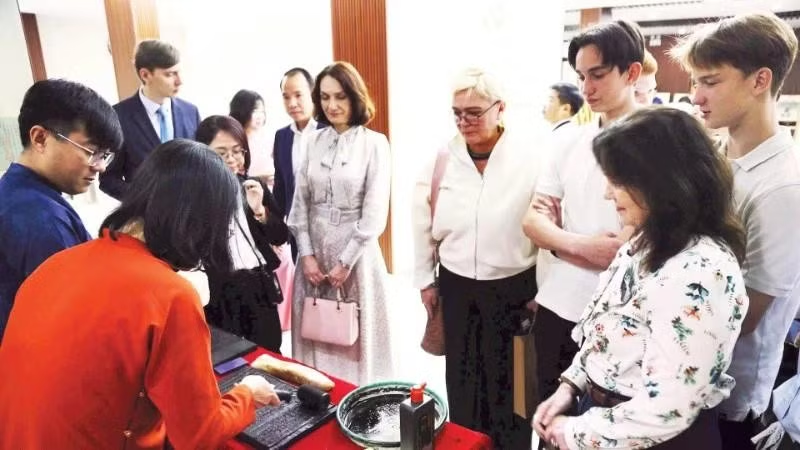
During the first days of spring, the Space for Introducing Viet Nam’s World Documentary Heritage and Outstanding National Archival Documents has been bustling with delegations of visitors from both inside and outside the country taking part in the activity related to woodblock imprints.
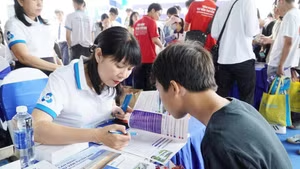
At the area, student Do Thu Bao Khanh (Faculty of Cultural Industries and Heritage, School of Interdisciplinary Sciences and Arts) enthusiastically participates in the experience of stamping imperial annotation seals onto spring greeting cards. These cards carry meaningful New Year wishes from emperors of the Nguyen dynasty, creating a unique connection between the past and the present. Arriving early, Bao Khanh spends time carefully observing, taking notes and directly experiencing the interactive activities.
“Previously I used to think heritage was something purely academic and could only be approached through narration. However, through the learning process and especially today’s real experiences, I realise that heritage can completely be touched. This is a valuable resource for developing cultural industries, thereby helping the younger generation approach history and participate in preserving traditional culture more easily,” Bao Khanh shared.
At the woodblock experience area, Le Tuan Hung (23 years old, Long Bien ward, Ha Noi) is carefully performing each step from rolling ink, placing do paper to pressing the print. Under his skilful hands, the characters in the “Imperial Edict on the Transfer of the Capital” gradually appear sharp and vivid on the traditional paper background. Experiencing this manual process directly for the first time, Hung cannot hide his excitement: “I did not think that to create a printed page, people in the past had to go through so many elaborate steps. This activity requires patience and meticulousness in every movement”.
Surprise, excitement and enthusiasm… are what hundreds of young people have experienced when coming to the Space for Introducing Viet Nam’s World Documentary Heritage and Outstanding National Archival Documents built and operated by the State Records and Archives Department. At present, the Department is preserving more than 30 kilometres (in length) of national archival shelves – a vast source of original historical materials reflecting the historical process, culture, society, national sovereignty, state governance activities and the life of the people across many periods.
Notably, two groups of World Documentary Heritage - the Nguyen Dynasty Imperial Records and the Nguyen Dynasty Woodblocks - together with the system of documents on the French colonial period, the resistance wars, and documents, images and heritage of President Ho Chi Minh selected from many domestic and international sources have created remarkable depth of content, faithfully recreating the nation’s history. Here, history is no longer static pages of books but is “infused with spirit”, becoming vivid and capable of “touching” the heart of each visitor.
Realising the spirit of Resolution No. 80-NQ/TW
Resolution No. 80-NQ/TW of the Politburo on the development of Vietnamese culture sets the goal in the cultural field that “100% of pupils, students and learners in the national education system are able to access and regularly and effectively participate in artistic activities and cultural heritage education”. This is a specific requirement for agencies managing and promoting heritage values, including the national archival system. The opening of the Space for Introducing Viet Nam’s World Documentary Heritage and Outstanding National Archival Documents free of charge has directly removed access barriers for pupils and students. When there are no longer costs and complicated procedures, educational institutions can proactively include archival visits in extracurricular programmes and experiential learning activities in a regular and systematic manner.
Assessing the significance of experiential activities at the State Records and Archives Department, Nguyen Ngoc Anh, Principal of Thu Le Primary School (Ha Noi), said that this is a practical activity helping pupils approach history and culture in the most visual way, like a useful cultural tour for both teachers and pupils. The school representative also expressed hope that in the coming time the Department will strengthen connections with educational institutions in the Capital in organising extracurricular activities, helping pupils nurture national pride and effectively supporting teachers in innovating methods of teaching History.
Dang Thanh Tung, Director of the State Records and Archives Department, affirmed that in the coming time the unit will continue to coordinate with educational institutions in the Capital and nationwide with the main objective of bringing appropriate historical content into the general education programme through digital platforms such as documentary films and official websites. According to Tung, providing accurate historical sources not only serves education but is also a key solution to protecting the ideological foundation. In the near future, the unit will propose that the Ministry of Home Affairs work with the Ministry of Education and Training to develop a systematic plan for providing historical learning materials based on the national documentary heritage treasure.
Resolution No. 80-NQ/TW also emphasises the requirement to “innovate methods of cultural management towards creation and service orientation; promote the application of science and technology, innovation and digital transformation to create breakthroughs for cultural development”. The introduction space has been built and operated as evidence of that spirit of innovation. It is not merely a static exhibition area but is oriented to become a “visual history classroom” and an open learning ecosystem applying digital technology, multimedia presentations and modern interactive forms.
The Space for Introducing Viet Nam’s World Documentary Heritage and Outstanding National Archival Documents is designed as an open platform allowing schools, training institutions, agencies and organisations to coordinate specialised activities, seminars, traditional talks, extracurricular classes and experiential educational activities based on original archival documents. Content can be flexibly designed according to the needs of each unit, associated with sectoral history, specific fields or requirements for political and professional learning.
The combination of original documents and a system of digitisation, electronic search tools, documentary films and multimedia products helps each theme not only serve as illustration but truly become a learning experience with depth. This way of organisation clearly demonstrates the shift in management thinking from passive preservation to creating an environment for access, from traditional archiving to archiving associated with digital transformation and public service. Accordingly, the Space for Introducing Viet Nam’s World Documentary Heritage and Outstanding National Archival Documents does not merely perform the function of introduction but is operating as a flexible educational and communication institution, concretising the requirement for innovation in cultural management in the spirit of the resolution.
The archival shelves are no longer “sleeping” in storage warehouses but are transformed into vivid learning materials. From this creative model, the spirit of Resolution No. 80-NQ/TW is being realised in a convincing way. Bringing heritage out of archival spaces and allowing it to “touch” the emotions of the public not only helps preserve traditional values but also creates a sustainable foundation for the development of cultural industries in the future.