However, how to turn language proficiency into a practical competitive advantage, meeting the demanding professional standards of employers, remains a question that requires thorough answers from students, educational institutions and management agencies alike.
Young people’s own roadmaps
After weighing options between economic and social sciences, Nguyen Hoang Anh decided to study English language in class QH2022.E19, majoring in International Studies at the Faculty of English Language and Culture, University of Languages and International Studies under Viet Nam National University, Ha Noi.
According to Hoang Anh, English is an essential tool for accessing knowledge and global issues. He sees great career opportunities in communications, tourism and technology, but is also aware of the pressure as more and more people become proficient in foreign languages. To expand his job opportunities after graduation, the final-year student has proactively learned Chinese while practising content writing and social media management through internships at BATIK International Viet Nam and his role as a communications ambassador at the university.
“Each student needs to equip themselves with additional supporting skills and practical experience to create their own advantage,” Hoang Anh shared, referring to his preparation for the goal of working in journalism and communications after graduation.
Unlike Hoang Anh, third-year student Le Thi Thao Van from the Faculty of Arabic Language and Culture has found her direction in a promising niche market. Choosing to study a language pursued by few people once surprised her family, but Van believes difference itself is an opportunity.
After a one-year exchange programme in Egypt, Van’s language proficiency and cultural understanding improved significantly. She is currently pursuing a double degree in English while developing organisational skills in her role as class monitor. Van affirmed: “Choosing a specialised field of study still opens up many development opportunities in areas such as diplomacy and trade.”
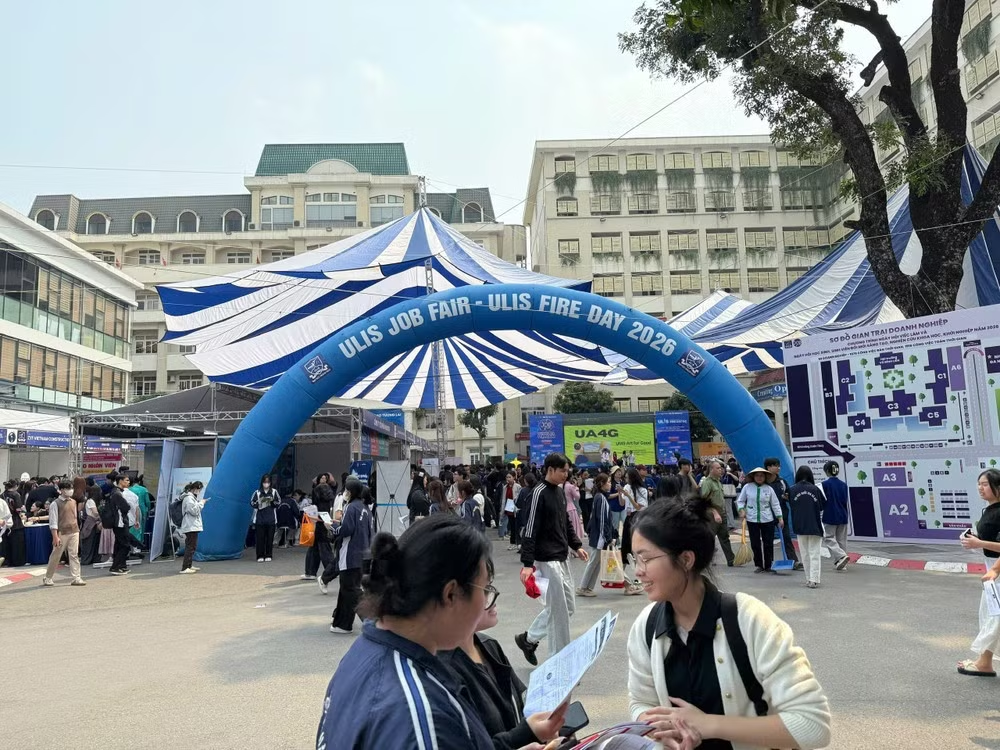
Sharing the same passion for Middle Eastern culture, Nguyen Phuong Thao, a third-year student at the Faculty of Arabic Language and Culture, highly values the potential of the wealthy Gulf economies. Thao believes that proficiency in Arabic will offer a major advantage as Viet Nam expands cooperation with this region.
Through internships translating websites and producing communication videos in Arabic, she realised the importance of intercultural communication. Thao has drawn a lesson for herself: “Without a clear understanding of partners’ religions and customs, communication can easily lead to misunderstandings and affect work efficiency.”
Currently, Thao is actively practising listening and speaking with native speakers and working as a tour guide for visitors from Middle Eastern countries such as the United Arab Emirates, Qatar, Kuwait, Oman and Bahrain, in order to be ready for a professional working environment.
Innovating and improving training quality
Dr Nguyen Xuan Long, Rector of the University of Languages and International Studies under Viet Nam National University, Ha Noi, affirmed that foreign languages are a particularly important foundational competency today. However, to truly gain a competitive advantage, students need to develop three additional groups of skills: soft skills, including communication and adaptability; digital competencies; and vocational skills linked to specialised fields. In recent years, the university has renewed its curriculum towards an interdisciplinary approach, integrating foreign languages with economics, tourism and education to help students work effectively in specific environments. Experiential modules and practical projects have been strengthened to narrow the gap with real-world demand.
Foreign languages are a particularly important foundational competency today. However, to truly gain a competitive advantage, students need to develop three additional groups of skills: soft skills, including communication and adaptability; digital competencies; and vocational skills linked to specialised fields. In recent years, the university has renewed its curriculum towards an interdisciplinary approach, integrating foreign languages with economics, tourism and education to help students work effectively in specific environments. Experiential modules and practical projects have been strengthened to narrow the gap with real-world demand.
Dr Nguyen Xuan Long, Rector of the University of Languages and International Studies under Viet Nam National University, Ha Noi.
Regarding the policy of making English a second language in education in line with Resolution No. 71-NQ/TW dated August 22, 2025, of the Politburo on breakthroughs in education and training development, Long affirmed that this would help improve the quality of national human resources and expand opportunities in the global environment. As foreign languages become increasingly universal, demand for human resources with specialised and professional qualifications will grow even further.

From the perspective of employers, Bui Van Manh, Director of the Department of Tourism of Ninh Binh Province, said that local demand for workers with foreign language skills is rising rapidly and has become urgent. With the appeal of international destinations such as Trang An, Tam Coc-Bich Dong, Hoa Lu Ancient Capital, Thung Nham, Cuc Phuong and Tam Chuc, the number of international visitors is increasing, leading to higher demand for tour guides fluent in English, French, Korean and Chinese, as well as receptionists, service staff and tour operators with strong communication skills.
However, supply still falls short, especially when it comes to personnel who combine foreign language proficiency with professional vocational skills.
According to Manh, foreign language students have the advantage of open-minded and dynamic thinking, but often lack practical skills and deep understanding of local culture and history needed to convey heritage values to international visitors. To address this issue, Manh proposed close coordination among three parties: training institutions, enterprises and management agencies.
He said universities need to strengthen second foreign language training and invite enterprises to take part in teaching. Enterprises should proactively place training orders and increase the reception of students for internships to provide on-site training. For State management agencies, it is essential to build mechanisms to support the training of high-quality human resources and connect labour supply and demand.
“Improving the quality of foreign language human resources is a key requirement for tourism to develop sustainably and integrate internationally,” Manh affirmed.
Meanwhile, Master Ngo Xuan Lieu, Director of the National Centre for Employment Services, said that an open economy and the wave of foreign direct investment (FDI) are creating huge demand for workers with foreign language skills. Projects requiring English and Chinese have increased sharply in industrial parks in Ha Noi, Ho Chi Minh City, Dong Nai, Bac Ninh and Quang Ninh. Notably, not only manual workers but also technical workers need foreign languages to communicate directly with foreign experts. However, recruiting workers who have both technical expertise and foreign language skills remains difficult because supply is both limited and weak.
Ngo Xuan Lieu pointed out the reality: “The foreign language capacity of young people in specific technical and professional fields is generally still limited.”

In addition, workers’ communication skills, adaptability to change and ability to cooperate at work are not yet strong. In particular, the requirement for digital citizenship skills is becoming universal. Proficiency in using computers, smartphones and application software to access online public services is a minimum requirement that each person needs to learn and research on their own in order to adapt to the modern environment.
The journey of foreign language students into the labour market requires careful preparation in both quality and quantity. Proactiveness in diversifying skills, accumulating practical experience and maintaining a receptive attitude are decisive factors that help each individual stand firm amid the fluctuations and challenges of the times.