The Ministry of Education and Training has issued Circular No. 33/2026/TT-BGDDT dated April 15, 2026, promulgating the Foreign Language Proficiency Framework for Viet Nam. The circular will take effect on May 31, 2026.
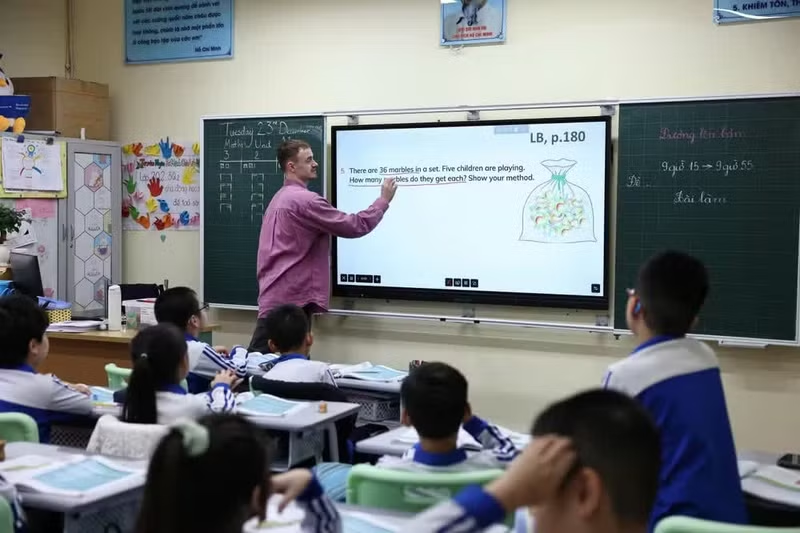
The circular was issued to establish a common benchmark for foreign language proficiency across the national education system, providing a basis for curriculum development, teaching, testing, assessment, and recognition of learning outcomes. It is also intended to give learners a clearer roadmap for language development, while helping educational institutions improve training quality and strengthen articulation across education levels and qualifications.
A key feature of the circular is the update of Viet Nam’s foreign language proficiency framework in line with the latest version of the Common European Framework of Reference for Languages (CEFR) 2020–2021, ensuring compatibility with international assessment standards and making it easier for Viet Nam and other countries to recognise each other’s diplomas and certificates.
The circular also introduces the Pre-A1 level, helping complete the assessment system from the very first stage of language learning and reflecting the growing trend of foreign language education from an early age in Viet Nam.
According to the ministry, this addition broadens the proficiency spectrum and ensures the continuity and comprehensiveness of the framework.
It also places emphasis on clarifying and detailing descriptors for each skill, including listening, speaking, reading, and writing, making the framework easier for teachers, learners, and training institutions to apply in practice. The content has been designed to be specific, accessible, and closely linked to real-life language-use situations, thereby improving the effectiveness of foreign language teaching and learning.
For certain languages with distinctive characteristics, such as Chinese, Japanese, and Korean, the circular stipulates the use of proficiency frameworks issued by the respective countries, in order to ensure compatibility with linguistic features and international practice.
The Ministry of Education and Training said the issuance of Circular No. 33 marks an important step in completing a unified foreign language proficiency assessment system, meeting the requirements of fundamental and comprehensive education reform while supporting Viet Nam’s increasingly deep international integration.