To attract, retain, and effectively utilise talented individuals, it is necessary to build a comprehensive policy system along with a favourable environment to maximise intellectual resources for national development.
Professor Nguyen Tien Thao, Director of Higher Education (Ministry of Education and Training), stated that many major policies and guidelines on science, technology, and education and training have been issued in recent years, such as Resolution No. 57-NQ/TW of the Politburo on breakthroughs in the development of science, technology, innovation, and national digital transformation; Resolution No. 71-NQ/TW of the Politburo on breakthroughs in the development of education and training; and the Law on Higher Education No. 125/2025/QH15.
These policies have expanded the scope of autonomy, creating an important legal framework for higher education institutions to play a central role in the knowledge ecosystem, gradually becoming centres of innovation and places for the convergence, nurturing, and dissemination of talent.
From this practical requirement, identifying and nurturing talent from the secondary school level is considered a crucial foundation.
According to teacher Tran Thuy Duong, Principal of Ha Noi Amsterdam High School for the Gifted, the concept of talent in schools is undergoing a clear shift. While previously, gifted students were often “confined” to a few traditional subjects like mathematics and literature, now students’ abilities are assessed more diversely, from science and technology to engineering and creativity.
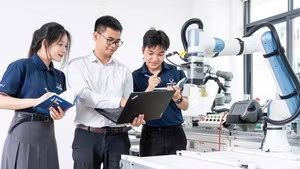
A student specialising in mathematics not only aims for international competitions but can also exploit strengths in other fields such as robotics, engineering, and STEM.
The concept of talent in schools is undergoing a clear shift. Previously, academically gifted students were often “confined” to a few traditional subjects like mathematics and literature. Now, however, students’ abilities are assessed more broadly, encompassing science, technology, engineering, and creativity. A student specialising in mathematics can not only aim for international competitions but also explore strengths in other fields such as robotics, engineering, and STEM.
Thuy Duong, Principal of Hanoi Amsterdam High School for Gifted Students
The important thing is that the way students are perceived has changed, no longer limited to a single standard but focusing on recognising the diversity of abilities and potential of each student.
This gives students more opportunities to develop according to their individual strengths. However, to nurture these talented “seeds”, continued investment in high-quality teachers and improved facilities and learning infrastructure are necessary to create conditions for students' holistic development.
Continuing the process of identifying and nurturing talent from an early age, many higher education institutions are accelerating the innovation of their training models to meet the requirements of developing high-quality human resources.
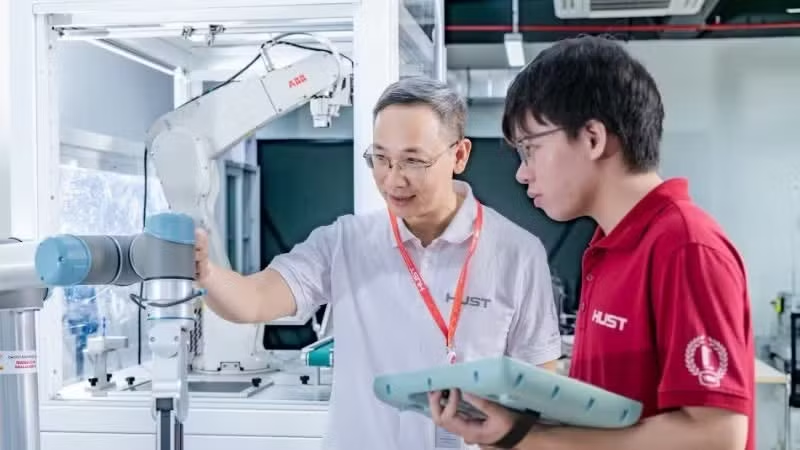
At Ha Noi University of Science and Technology, the talent training model is undergoing significant innovation. According to Assoc Prof, Dr Nguyen Phong Dien, the vice rector of the university, the school focuses on two main pillars: admissions and training programs.
Methods such as talent selection and aptitude tests are still maintained. For fields like computer science, which have very high entry requirements, the aim is to ensure students have a solid academic foundation and the ability to quickly access advanced content.
Meanwhile, Assoc Prof, Dr Dang Thi Thu Huong, Vice Rector of the University of Social Sciences and Humanities (Viet Nam National University, Ha Noi), stated that the school’s talent training strategy is implemented in a personalised and early nurturing manner.
From high school with its specialised social sciences and humanities model to university with its basic science funding and annual scholarships, the school is gradually building an ecosystem for developing “social talent”.
Notably, strengthening digital capabilities and international cooperation, exemplified by the partnership programme with Meta, is opening new avenues for students to access modern knowledge.
From the perspective of attracting high-quality human resources, Tan Anh, Head of the Human Resource Development Department, National Innovation Centre (Ministry of Finance), stated that a more flexible approach is needed, especially for Vietnamese people abroad.
It’s not necessary for talented individuals to return completely to contribute; Viet Nam can still utilise the intellectual resources of Vietnamese people globally through various flexible forms such as part-time work, project collaboration, or professional consultation.
Currently, the National Innovation Centre is actively connecting with a network of Vietnamese experts worldwide, while also sharing domestic problems and challenges to invite the intellectual community to participate in solving them.
To effectively train and utilise talent, it is necessary to build a system for early talent identification and nurturing, linking from secondary school to university and postgraduate levels; and to form “elite training streams” with special selection mechanisms. Along with that, there needs to be a fundamental reform of the talent training model towards individualised learning, linking training with research and strong research groups; strongly developing the “three-party” cooperation model: State-university-enterprise; and building a competitive mechanism for income, working conditions, opportunities to access research resources, and an open and transparent creative environment.
Professor Nguyen Tien Thao, Director of Higher Education Department, the Ministry of Education and Training
Professor Nguyen Tien Thao believes that to effectively train and utilise talent, it is necessary to build a system for early talent identification and nurturing, linking training with research and strong research groups; forming “elite training streams” with special selection mechanisms.
Along with that, there needs to be a fundamental reform of the talent training model towards individualised learning, linking training with research and strong research groups; strongly developing the “three-party” cooperation model: State-university-enterprise; and establish a competitive mechanism regarding income, working conditions, access to research resources, and an open and transparent creative environment.
Notably, each higher education institution needs to become a true “incubator,” a place to sow and nurture great aspirations; and at the same time, a centre for innovation and a “talent magnet,” capable of competing regionally and internationally.