However, unlike previous cycles, the market is now showing positive movements driven by major policy changes and businesses’ efforts.
Reviving projects, moving supply
One of the notable signals in the market today is that many businesses that previously faced difficulties are gradually returning to the race. Recently, Novaland held a signing ceremony for cooperation with nearly 50 distribution agencies nationwide, while also announcing a roadmap for launching new products. This is considered a sign that the company’s business activities are entering a new phase after more than three years of focusing on restructuring.
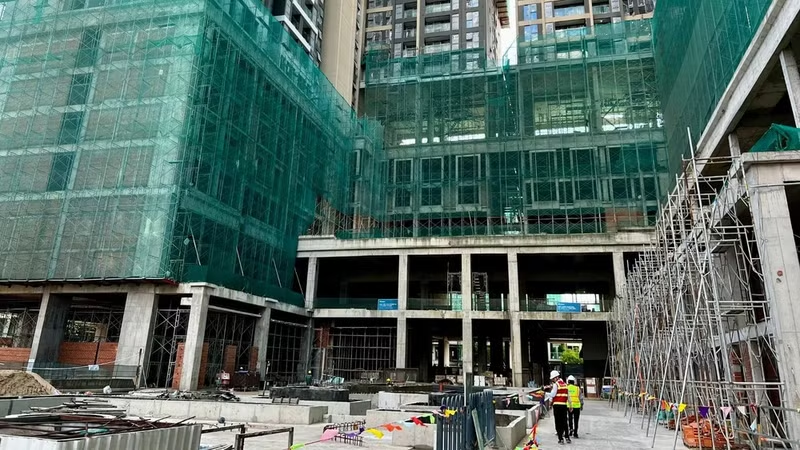
For example, the strong restart of several projects, such as The Grand Manhattan at 100 Co Giang-Co Bac and The Park Avenue on Ba Thang Hai Street, is significant not only for the businesses themselves but also reflects a broader movement in the market: if projects that were once stalled resolve their legal, capital, and implementation bottlenecks, they will soon return to the market when conditions are appropriate.
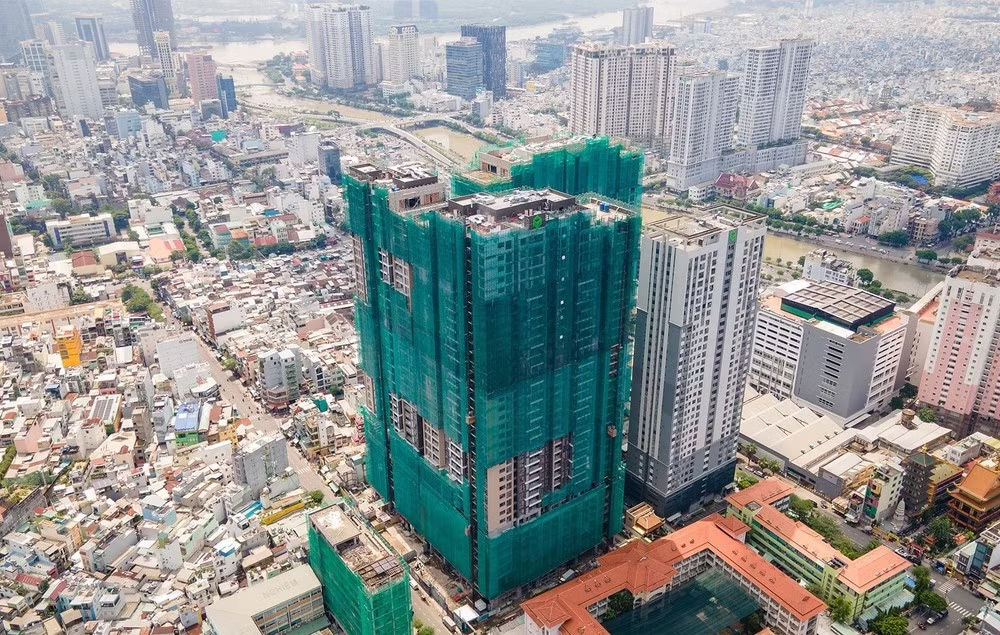
In addition, new supply is also emerging in the market. In the eastern area, the A&K Tower project in the An Phu area is adding apartment supply amid continued improvements in transport infrastructure in the east, particularly the transport network.
At Van Phuc City urban area, Hiep Binh Ward, the developer plans to launch two additional apartment blocks with nearly 300 units on the market, alongside townhouse and shophouse products being offered with flexible payment policies.
These developments show that supply is tending to improve, but, more importantly, the structure of supply is becoming increasingly closely linked to the actual implementation capacity of projects.
After a period of strong market consolidation, buyers are paying attention to legal status, construction progress, location, construction quality, amenities, and the ability to establish a residential community. These are factors carrying greater weight in customers’ purchasing decisions. This is also why distribution networks are once again receiving greater attention from developers in order to create new values for customers with genuine housing needs.
According to experts, completing the legal framework therefore is not merely a matter of removing obstacles for individual projects but also has significance in unlocking the entire market chain.
Resolution No. 21-NQ/TW of the 3rd Plenum of the 14th Party Central Committee sets out the requirement to comprehensively amend the Land Law and related laws, with a view to unlocking land resources and building a transparent, stable, and sustainable market for land-use rights and real estate; while also emphasising the disclosure of information on planning, project legal status, land prices, and transactions.
Real estate returns to real value
If policies are creating conditions for supply to return, changes in buyers’ behaviour are creating a new filter for the market.
According to CBRE Vietnam, the market is entering a recovery phase but is also becoming clearly differentiated. Buyers are no longer following herd mentality but are prioritising projects with transparent legal status, assured construction progress, and the ability to meet genuine housing needs. This is forcing developers to focus more on product quality and implementation capacity rather than competing solely on expectations of price increases.
The market is shifting from a phase of “differentiation” to “selection”. Accordingly, capital will concentrate on projects that combine three factors: completed legal procedures, convenient infrastructure connectivity, and the ability to meet genuine housing needs. This will also be the product segment playing a leading role in driving liquidity during the new recovery cycle.
Experts said that Ho Chi Minh City is benefiting from the process of resolving projects that have been stalled for many years. Although this process cannot create supply immediately, the positive developments in recent times are highly encouraging for the market.
According to CBRE forecasts, new apartment supply across Ho Chi Minh City in 2026 could reach around 45,000 units, rising to around 48,000 units in 2027 and continuing to increase sharply in 2028. This is considered the result of an ongoing process of removing legal bottlenecks rather than a short-term boom.
However, another reality that needs to be recognised is that most apartments brought to the market are still in the high-end segment. This means that a gap may still exist between products brought to the market and their affordability for people with genuine housing needs.
It can be said that, after a period of strong consolidation, real estate is returning to a game of real value. Policies are paving the way for projects to revive, infrastructure is expanding the space for development, and buyers are becoming the most important “filter” of the market. This also provides a basis for expectations that the new recovery cycle will unfold in a more substantive, selective, and sustainable direction.