From raw production to deep processing
With a natural area of nearly 1.5 million hectares and diverse topography and climate, Quang Ngai enjoys favourable conditions for the robust development of distinctive forest- and marine-based products.
Director of the Department of Science and Technology Nguyen Tan Liem said that science, technology, and innovation are gradually becoming driving forces behind the comprehensive restructuring of the province’s agricultural sector, with a focus on higher added value and green, sustainable agricultural development.
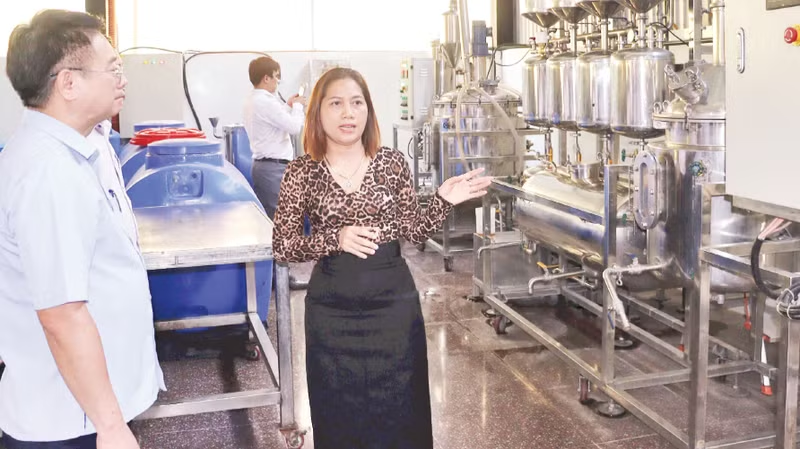
Several businesses have boldly invested in drying and packaging lines, cold storage facilities, and modern traceability systems, while pursuing advanced processing methods linked to the development of sustainable raw material production areas. These efforts have helped shift production from raw commodities to deeply processed products, increase the added value of agricultural goods, and improve local people’s incomes.
Pham Van Thi, Chairman of the Members’ Council of TBT Agroforestry Company Limited, which specialises in producing rice seeds and high-quality organic rice products, noted the company has invested in four refrigerated storage facilities over the past few years, with a combined capacity of 400 tonnes, to store paddy rice at temperatures of 16 degrees Celsius or above.
Replacing traditional sun-drying with drying and cleaning technologies, followed by cold storage, has helped the company reduce post-harvest losses and labour costs, while increasing profits, improving product quality, and enhancing its brand value in the market.
The company has also established a production and harvesting network with agricultural service cooperatives and farmers, with partial financial support from the State budget.
On Ly Son Island, known as the “Kingdom of Garlic,” Phu Sinh Trading and Services Company Limited has not only partnered with farmers to expand organic garlic cultivation but also invested in equipment and machinery to shift from trading raw products to deep processing.
Director Nguyen Van Nhat said that, building on the five-star OCOP certification and the established reputation of Ly Son white garlic, the company has continued to research and develop a range of value-added products, including single-clove black garlic, black garlic with few or multiple cloves, black garlic extract, and black garlic wine. These products command prices three to four times higher than those of raw garlic.
These achievements have opened up new opportunities for the company to develop higher-value-added products and expand into domestic and international markets.
Taking Quang Ngai’s agricultural products to the world
Despite the progress made, the application of science and technology and the promotion of innovation in agricultural processing and preservation in Quang Ngai still face considerable limitations.
Most agricultural products are still sold raw or undergo only basic processing, leaving producers vulnerable to traders. This results in low added value, while deep-processing capacity remains underdeveloped. According to Nguyen Tan Liem, a major bottleneck is the prohibitive upfront costs for agricultural processing and preservation technologies, which poses significant barriers for small and medium-sized enterprises, particularly cooperatives and farming households.
The “four-party linkage” model, involving the State, scientists, businesses, and farmers, remains fragmented and lacks sustainability when it comes to translating innovative ideas into practical results. In some concentrated raw material production areas, supplies are insufficient to meet the capacity requirements of large processing plants, partly because contracts lack sufficiently robust commitments.
Amid agricultural restructuring towards modern, green, and sustainable development and higher added value through innovation, in line with Politburo Resolution No. 57-NQ/TW dated December 22, 2024, economic experts say Quang Ngai faces both an urgent and a long-term task: removing bottlenecks while expanding raw material production alongside enhanced processing, preservation, and product commercialisation capabilities.
This is a vital step for increasing product value and developing agricultural value chains.
Specifically, production needs to be reorganised to establish stable raw material zones of an appropriate scale capable of meeting processing and market demand. Stronger links must also be forged among businesses, cooperatives, and local people throughout the value chain, from production to consumption.
At the same time, priority must be placed on drawing investment in deep processing, post-harvest preservation, cold storage, and agricultural logistics, alongside the application of modern technologies and digital transformation. The development of high-value-added products tied with local brands should also be encouraged.
With the goal of modernising its preservation systems, Quang Ngai aims to ensure that more than 70% of establishments processing and preserving the province’s key agricultural products achieve advanced technological standards by 2030. The province also plans to develop agricultural logistics services to support exports, targeting annual growth of more than 10% in the added value generated by the agricultural processing industry.
According to Nguyen Quang Trung, Deputy Director of the Department of Agriculture and Environment, the provincial agricultural sector is prioritising land consolidation and plot reorganisation to establish large-scale specialised production areas, creating favourable conditions for businesses to secure long-term land leases and invest in processing infrastructure.
Quang Ngai is also prioritising State budget funding to support the transfer of post-harvest preservation and advanced medicinal herb extraction technologies. It will fully fund the registration of growing area codes, packing facility codes, and collective trademarks for the province’s key products, while vigorously promoting digital agricultural extension services.
Breakthrough policies and mechanisms in science, technology, and innovation, combined with close coordination among the “four parties,” will enable Quang Ngai to accelerate innovation in agricultural processing and preservation, paving the way for a major leap forward in its agricultural economy.