Tran Quang Trung, Business Development Director of OneHousing, noted that the average absorption rate of primary market projects in the first half of 2026 stood at approximately 50–60%, a significant decline from the over 80% recorded in 2025.
Buyers are becoming more cautious
However, lower liquidity does not mean capital is leaving the market. “Demand for real estate ownership has not disappeared. Buyers are simply becoming more cautious and selective in their purchasing decisions,” Trung said.
Indeed, projects featuring favourable locations, comprehensive planning, and reputable developers continue to achieve absorption rates of 70–80%, even amid a more segmented market.
While investors previously committed capital based on anticipated price appreciation driven by future planning initiatives or infrastructure projects, buyers are now paying greater attention to actual usability and practical value. Increasing transparency regarding planning information, housing supply, and infrastructure progress provides customers with a stronger basis for decision-making. As a result, the market is gradually shifting from a “buy and wait for appreciation” mindset to a “buy for value creation” approach.
Research by the Market Research and Customer Insight Centre of One Mount Group indicates that changing asset-selection preferences are driving a clear filtering process within the market. Projects with prime locations, convenient transport connections, integrated planning, strong prospects for community formation, and backing from reputable developers continue to attract buyers and maintain positive absorption rates. In contrast, products that rely heavily on expectations of future price increases or require long periods before generating actual demand are facing greater liquidity pressure.
Urban redevelopment drives new demand
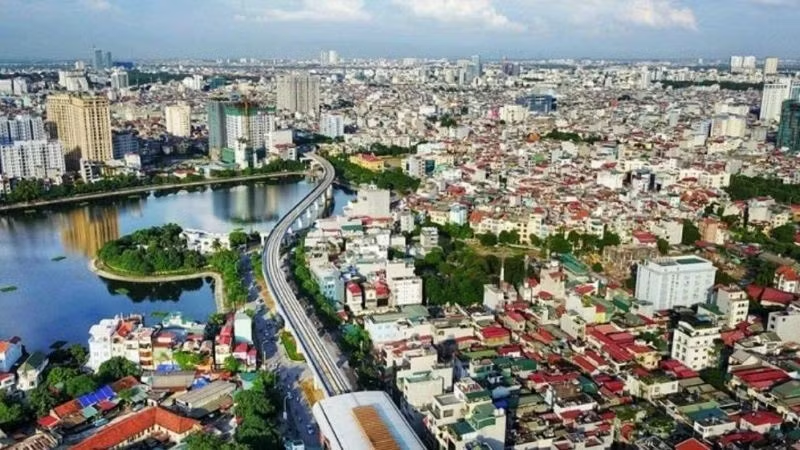
The development of urban areas based on the Transit-Oriented Development (TOD) model and the creation of new economic and commercial hubs has emerged as an inevitable trend in major cities, including Ha Noi. As the Government allocates substantial resources to urban restructuring, transport infrastructure investment, and the development of new growth poles, areas benefiting from public transport systems and regional connectivity corridors are expected to emerge as major residential centres in the future.
However, the success of new urban areas depends not only on transport infrastructure but also on the degree of integration between housing, employment opportunities, education, healthcare services, and social amenities.
When these conditions are effectively coordinated, satellite cities will help ease pressure on urban cores while generating new growth momentum for the real estate market.

Moving forward, the market is expected to remain clearly segmented during the second half of 2026. Segments that meet genuine housing demand, offer strategic locations, provide convenient connectivity, possess established residential communities, and feature suitable financial policies are likely to maintain their appeal and continue leading the market.
Meanwhile, interest rates are forecast to remain relatively stable in the second half of the year, helping preserve market stability while encouraging investors to become more selective with their capital allocation.
Notably, demand for long-term asset accumulation remains strong but has evolved in nature. Rather than seeking short-term price gains, buyers are increasingly favouring assets capable of preserving value, maintaining liquidity, and generating future returns.
According to Tran Quang Trung, major infrastructure projects and the development of new urban spaces — particularly in eastern Ha Noi and along the Red River corridor — could trigger significant population shifts over the medium to long term. These factors are expected to become key drivers of housing demand and real estate transactions during the latter part of 2026 and throughout 2027.
![[Infographic] Viet Nam's 16 Comprehensive Strategic Partners](https://en-cdn.nhandan.vn/images/nyM650OGFWrOVWc-xajqN-rTZ68Rlmc1fiGJOhBRYHHdkBILL2hAdMw_FHcqH-128bTaQBSOAMd0_NcTypwz7H-j_NBZzuSdgF8ETMmVl1xLtdcCjym8rCUyKZqQgOZtC4ouMEzxlJoQ-MllehtjehDxIkn58uqaoaCRy4fSY54/1792513260540-1528117236743671738-1528117236743671738-9e797c256fe32c7c7b9c1cc03b0ca64e.jpg.avif)