In practice, many higher education institutions have proactively reformed their training methods, strengthening the link between learning, research and real-world practice, thereby gradually narrowing the gap between research and application.
Enhancing students’ practical capabilities, creative thinking and adaptability is one of the key solutions to help form a high-quality workforce to serve national development in the new phase.
From research ideas to practical products
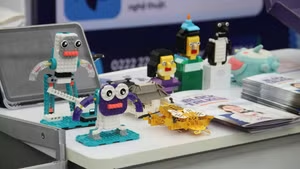
In reality, many training models have encouraged students to participate directly in application-oriented research projects. One notable example is the “Starter Kit” project—a set of starter cultures for fermented foods—developed through research and practical observation in the food sector. The project was carried out by a group of students at Phenikaa University in the university’s laboratory, under the direct supervision of lecturers specialising in biotechnology.
The research team comprises students from various disciplines. Biotechnology students are responsible for researching and developing microbial strains, while Business Administration students focus on building the product model and market orientation. This interdisciplinary approach clearly demonstrates how scientific research and practical application can be implemented in parallel.
Sharing the idea behind the project, Nguyen Thi Tuong Van, a K16 Biotechnology student at Phenikaa University, said that while dieting trends are becoming increasingly popular, many consumers still fail to ensure adequate nutrition. Based on this reality, the group developed a solution enabling users to produce fermented foods at home safely and with consistent quality, even without specialised knowledge.
The product is a starter culture kit containing isolated and cultivated microbial strains, which helps standardise the fermentation process, control microbial quality and minimise contamination compared with traditional methods. It also contributes to improving nutritional value and supplementing beneficial probiotics for the digestive system.
During the implementation, the group encountered numerous challenges, particularly in ensuring consistent quality. Members continuously tested and adjusted the product to meet both scientific standards and user convenience.
Regarding its application potential, Vu Hoang Anh, a Business Administration student and team member, noted that the product could meet the growing demand for healthy foods and be used by households or small-scale businesses. Being developed in a laboratory environment under expert supervision helps ensure safety and reliability before market introduction.
Assessing the project, Dr Nguyen Hong Minh, Director of the Centre for Genetic Resources Research and Deputy Head of the Faculty of Biotechnology, Chemistry and Environmental Engineering at Phenikaa University, as well as the project’s academic advisor, stated that the student group demonstrated a strong sense of initiative in developing ideas and implementing the project.
In particular, they effectively applied specialised knowledge while combining teamwork, project management skills and entrepreneurial thinking. The Starter Kit project stands as evidence of the successful transformation of research ideas into highly practical products with real-life applicability.
Enhancing learners’ competencies
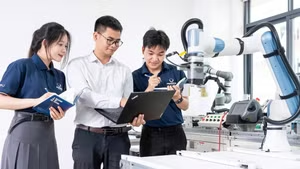
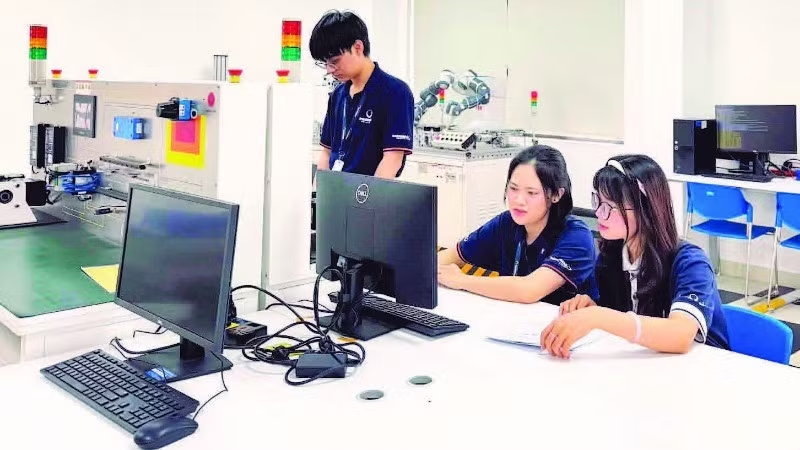
Alongside research projects, the need to study and practise in modern technological environments has become increasingly essential for students. At the Robotics and Artificial Intelligence Laboratory of Phenikaa University, the facility spans approximately 72 square metres and is equipped with advanced technological systems simulating a scaled-down smart factory model, serving learning, scientific research and project implementation.
According to engineer Dao Minh Thanh, a technician and practical instructor at Phenikaa University, the laboratory is designed with fundamental stages of a production line such as assembly, product sorting, transportation and warehousing, enabling students to gain an overall understanding of operational processes in an industrial environment. Here, students have the opportunity to access and directly practise with various modern technologies, including computer vision, artificial intelligence (AI), radar and 3D cameras, thereby gaining deeper insight into how these technologies are integrated and applied in smart manufacturing systems.
Sharing her experience, Nguyen Thi Khanh Dieu, a K15 student from the Faculty of Electrical and Electronics Engineering at Phenikaa University, said that before entering the lab, she had assumed it mainly consisted of separate pieces of equipment or basic simulation systems. However, hands-on experience revealed a synchronised and highly practical system, helping students better visualise how a real-world factory operates. For engineering students, learning theory alone often makes it difficult to understand real-life applications. Practical training and research have helped students gain a clearer understanding of sensors, actuators, programming and system monitoring, while also improving their ability to handle real-world situations.
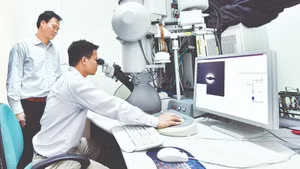
Beyond Phenikaa University, the integration of training, research and practice has also been implemented at Ha Noi University of Science and Technology. During their studies, Chemical Engineering students are exposed to modules closely linked to production practice, helping them better understand the role of engineers in operating and improving industrial processes.
Sharing his learning experience, student Do Dinh Chien said that before taking specialised courses, his understanding of chemistry was mainly associated with laboratory experiments in test tubes. However, through subjects such as chemical engineering, he began to better understand the role of chemical engineers in large-scale production. Laboratory sessions help students develop observation, analytical and problem-solving skills. Unexpected factors arising during experiments require learners to make adjustments, thereby deepening their knowledge and accumulating practical experience.
The process of learning and research also helps cultivate meticulousness, carefulness and analytical thinking. These experiences show that a practice-oriented training environment not only helps students master knowledge but also gradually builds professional competencies.
It is evident that linking training with research and practice is becoming an effective approach to improving the quality of higher education. From specific models at Phenikaa University and Ha Noi University of Science and Technology, the transformation of scientific ideas into practical products is being progressively promoted, contributing to enhancing students’ practical capabilities and adaptability.
In the near future, continuing to refine mechanisms, strengthening links between universities and enterprises, and promoting the application of research outcomes in real life will be crucial factors in effectively implementing Conclusion No.18-KL/TW and meeting the socio-economic development requirements for 2026–2030.