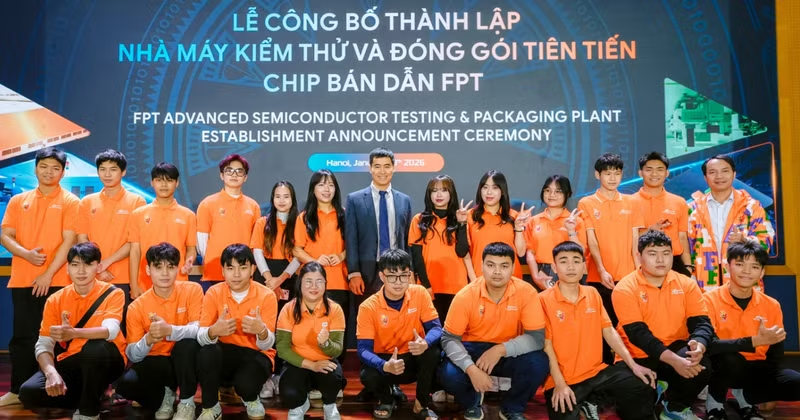
In practice, a number of domestic educational institutions have proactively adapted to this model, orienting training programmes towards practical application and close enterprise engagement. This approach creates opportunities for students to access real working environments at an early stage.
According to Principal of FPT Polytechnic College Vu Chi Thanh, developing training programmes closely aligned with practical requirements, in conjunction with enterprises and real workplace settings, is regarded as an effective way to help learners quickly meet job demands, particularly in core technology fields such as chip design and semiconductors.
In Viet Nam, training programmes in microelectronics, chip design, and artificial intelligence are being expanded, alongside policies aimed at attracting foreign direct investment (FDI) and fostering the development of domestic technology enterprises.
Notably, the orientation of strengthening linkages among research, application, and the market in the 2026 plan indicates that many domestic educational institutions are approaching the true nature of the semiconductor sector — not merely as a technology field, but as a comprehensive techno-economic ecosystem.
Vice Principal of FPT Polytechnic College Tran Van Nam noted that observations of the semiconductor training model in Saxony —Germany’s major semiconductor industrial hub — highlight the substantial role of enterprises throughout the process.
Enterprises engage from an early stage, even recruiting personnel in advance and then coordinating with relevant stakeholders to organise training. Practical training typically accounts for up to 70% of the total programme duration and is conducted directly at enterprises or enterprise-linked training centres.
For companies lacking sufficient in-house training capacity, inter-enterprise training centres have been established within industrial parks, where multiple firms pool resources to train a shared workforce.
Tran Van Nam added that this system not only focuses on training but also ensures stringent quality control. Regardless of where they study, trainees must pass an independent assessment conducted by the German Chamber of Industry and Commerce before officially entering the labour market.
“This has established a unified standard across the system. Enterprises participate in training but do not unilaterally determine outcomes,” he said.
From this perspective, semiconductor workforce training cannot be developed in isolation from market demand. Learning, working, and recruitment should be viewed as a continuous chain rather than three separate stages.
For the semiconductor industry to develop sustainably, human resource training must be closely aligned with actual production practices. Students need early exposure to real-world environments and the acquisition of essential job-related skills. Conversely, enterprises must engage deeply in the training process so that educational institutions can design appropriate curricula, thereby developing a workforce that meets market demand.