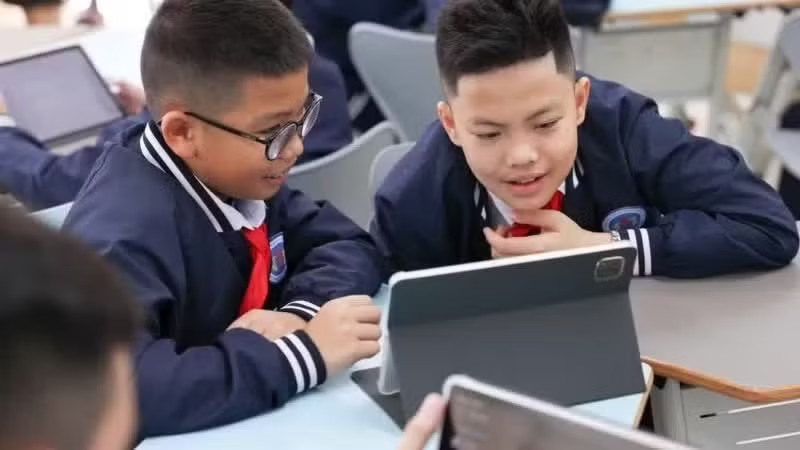
The teaching and learning of foreign languages with AI support is becoming increasingly common, gradually replacing many traditional training methods. Technology tools allow learners to experience new skills and improve both the quality and effectiveness of teaching. AI is genuinely transforming the way students learn and the role of teachers.
Some recent studies show that enrolment in foreign language majors at many universities around the world is tending to decline. Rather than pursuing in-depth study, many young people are considering learning a language independently with AI support, thanks to its ability to provide solutions for communication, essay writing and translation quickly and at low cost.
In response, many foreign language training institutions have invested in AI technologies for teaching. As a result, teachers are no longer simply in the traditional role of lecturing, but instead act as guides who check, review and refine the results students generate with AI in the course of their learning and research.
The most basic forms of support that AI applications can offer learners include simulating conversations, editing texts, detecting errors in speech and pronunciation, building vocabulary, designing exercises and creating study plans. The choice of tool will vary depending on each learner’s needs.
At present, the applications most widely used by foreign language learners include Duolingo, Memrise, Babbel, Talkpal, LingoDeer, Rosetta Stone and ELSA. Among them, ELSA and Talkpal are particularly favoured for their ability to analyse learners’ speech in detail and provide specific suggestions to help them achieve more native-like pronunciation.
When AI is capable of identifying a learner’s level and designing a suitable programme for each individual, language learning becomes easier, and listening, speaking, reading and writing skills can improve more quickly and effectively. Importantly, thanks to AI tools, learners can study anywhere and at any time, without being constrained by time or place.
For teachers, AI acts as a dynamic assistant, capable of creating lessons in a distinctive style, generating in-depth materials, designing tests, and tracking and assessing learners’ results. This saves time and allows teachers to spend more of it interacting, exchanging ideas and discussing with students during class. However, the use of AI in language teaching and learning needs to be approached cautiously, with strengths maximised but over-reliance avoided.
To remain competitive, training institutions are compelled to keep pace with teaching trends that reflect real-world needs. Innovation and curriculum restructuring have become matters of survival.
To remain competitive, training institutions are compelled to keep pace with teaching trends that reflect real-world needs. Innovation and curriculum restructuring have become matters of survival. In reality, not a few foreign language lecturers still see AI as a professional threat. They worry that using AI for vocabulary practice, writing practice or text translation may erode the cultural depth that has always been highly valued in learning and researching a language.
In many fields, especially education, AI cannot fully replace the role of humans. However, it is essential to change perceptions of AI through a better understanding of it and through mastering AI-related skills. Used appropriately, AI can help improve the effectiveness of foreign language teaching and learning.
According to experts, the biggest challenge now for foreign language training institutions is to integrate AI knowledge into teaching. There is a need to organise regular and ongoing AI training courses for teachers and learners, while also strengthening links with technology companies and working together to develop specialised AI applications for foreign language education that are suited to the psychology and learning habits of Vietnamese users.