Knowledge acquisition and expansion
At the primary school level, AI education focuses on helping students become familiar with AI technology, forming basic awareness and initial competencies that prepare them for further learning at secondary school.
Accordingly, primary schools guide students to understand that AI is a technology created by humans to serve daily life. This helps cultivate a human-centred mindset when observing and using AI tools in everyday situations. At the same time, students are encouraged to develop awareness of safe and responsible use, including protecting personal data, respecting copyright, and behaving appropriately when using smart devices and the Internet.
At the secondary level, the objective is to help students continue developing the AI competencies formed at primary school and consolidate them at a basic level. At this stage, students learn to recognise the benefits and risks of technology, understand issues related to privacy and personal responsibility when using digital tools, and develop appropriate behaviour that respects the law and digital culture.
Meanwhile, at the high school level, the AI education framework focuses on strengthening and advancing students’ competencies while also providing career orientation in AI-related fields or industries that apply AI. Students are expected to demonstrate a receptive and responsible attitude and adhere to ethical principles; develop the ability to design, test and improve tools; apply AI in learning, research and the creation of digital products for community benefit; and cultivate self-learning and independent research skills while forming career orientations in the digital society.
Observations from several localities show that educational institutions have been actively implementing AI education and achieving encouraging results. According to Do Duy Hung, Deputy Director of the Hai Phong Department of Education and Training, the education sector views AI education as an inevitable requirement for developing students’ digital and AI competencies while equipping them with the foundational knowledge to use technology responsibly and safely.
Introducing AI into schools also contributes to innovation in teaching methods, the development of e-learning materials and improved assessment practices. In the 2025–2026 academic year, the city’s education sector conducted surveys to assess the current use of AI in teaching as well as students’ understanding of and demand for AI education.
At the same time, many specialised training sessions have been organised for administrators and teachers at different levels to enhance students’ digital competencies and apply AI in lesson.
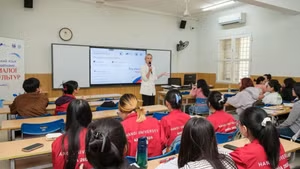
Schools have also integrated digital competency development into various subjects, with Informatics serving as the core discipline, while professional clusters and schools are encouraged to organise thematic activities and seminars on AI use. On March 6, the city’s Department of Education and Training held a city-level seminar on the use of AI in teaching Grade 8 Civic Education, under the theme Planning Personal Expenditure.
According to Pham Ngoc Thuong, Standing Deputy Minister of Education and Training, to effectively implement AI education, schools may adopt one or combine three organisational approaches: integrating AI into subjects and educational activities within the general education curriculum; offering elective learning modules or independent thematic topics; or organising additional teaching activities such as clubs and extracurricular programmes. Among these approaches, integrating AI content into existing subjects and educational activities is considered the priority as it ensures broad accessibility without overloading the curriculum.
For the Informatics subject, in addition to the content already included in the curriculum, several AI-related topics and themes are integrated and strengthened to ensure relevance and effectiveness. For other subjects and educational activities, the Ministry of Education and Training guides the use of AI as a supporting tool to innovate teaching methods and learning formats, thereby improving the effectiveness and quality of education.
Towards new educational approaches
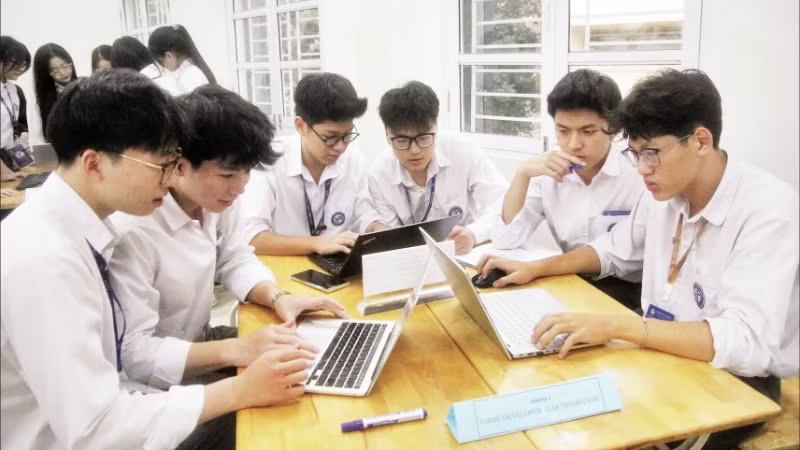
At Luong Van Tuy Gifted High School in Ninh Binh Province, specialised training sessions on the application of AI in teaching have been organised since the beginning of the academic year. Teachers have effectively applied AI in developing lesson plans and supporting the design of assessment questions on practice and revision systems. Many student innovation projects related to AI won prizes at provincial science and technology competitions in 2025.
According to Hoang Hai Nam, Principal of Luong Van Tuy Gifted High School, students are regularly encouraged to use AI tools to design posters and banners for extracurricular events. Despite these achievements, Nam noted that AI education activities at the school still face several challenges that need to be addressed, including limited equipment and slow internet connections, the requirement for high-performance computer systems, and the difficulty faced by many students from disadvantaged backgrounds in accessing advanced technologies.
“AI evolves very rapidly, which means teaching materials must be updated continuously. Managing students’ use of AI to ensure it serves appropriate purposes and prevents cheating in examinations is another issue that needs attention. Balancing technological support with the preservation of independent critical thinking is an ongoing challenge for teachers,” Nam said.
In Hai Phong, AI education in general education schools has also been strongly promoted. Mac Dinh Chi High School was among the early adopters. According to Principal Nguyen Minh Quy, during the 2023–2024 academic year, the school focused mainly on training teachers (through two sessions) and students (one session) while piloting several AI applications.
From the 2024–2025 academic year, AI has been widely integrated into teaching activities. Nearly 100% of teachers actively use AI to support lesson preparation and grading, particularly by integrating AI with active learning methods. Many students now follow personalised learning pathways supported by AI, gradually forming a new learning ecosystem.
In the coming period, the school plans to develop and issue a code of conduct and ethical guidelines for AI use while continuing to train teachers in digital pedagogy. The aim is not only to ensure teachers know how to use AI tools but also to help students use them intelligently, effectively and in compliance with the law.
The effective use and application of AI to enhance students’ learning capacity, thinking skills and experiential learning has become an inevitable and necessary trend. This requires continuous knowledge updates, proper management and guidance, thereby shaping new and more effective educational approaches and raising students’ awareness — an important responsibility of schools and the education sector as a whole.